Welcome to e-con Systems' Vision Vitals, your go-to weekly podcast on embedded vision.
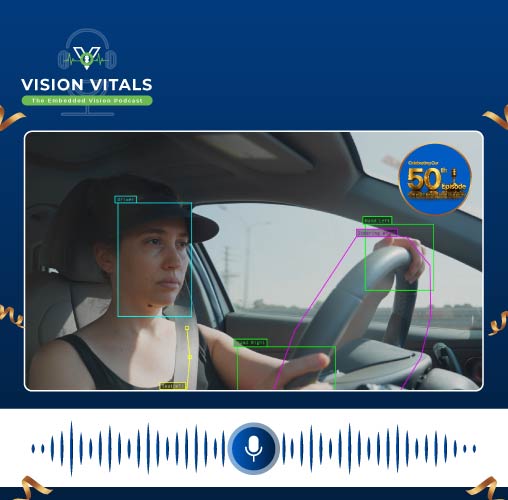
Most people think of automotive cameras as things that look outward, watching the road, detecting pedestrians, reading signs. But some of the most critical imaging work in a modern vehicle happens on the inside, watching the driver and the occupants.
Today, we are looking at in-cabin monitoring and what it takes for a camera to do this job properly.
Our embedded vision expert is here with me. Good to have you on, as always.
Happy to be here. In-cabin vision is something I think deserves a lot more attention than it typically gets.
Host:
So what is the in-cabin camera trying to understand? What is it looking for?
Expert:
Quite a range of things, actually. The primary use case is drowsiness detection. The camera tracks eye behavior, head tilt, blink rate, eyelid closure, and how long the driver is visually engaged with the road. If those patterns shift toward drowsiness, the system can trigger alerts or even influence the vehicle's response.
Then there is distraction monitoring, which looks at head orientation and gaze direction. If the driver is consistently looking away from the windshield, the system escalates its alerts.
Beyond that, you have object detection to distinguish between occupants and inanimate objects, and body posture monitoring, which feeds into things like airbag deployment decisions and seatbelt tensioning.
Host:
That is a lot of information to extract from a camera inside a cabin. What makes the imaging environment difficult?
Expert:
Well, the lighting situation is the first big challenge. A cabin goes from full daylight to a dim evening commute to complete darkness on a night drive, sometimes within the same journey.
Standard visible-light cameras struggle badly in those low-light conditions precisely when you most need to detect whether a driver is falling asleep.
So in-cabin cameras rely on IR illumination. IR LEDs emit light that is invisible to the human eye but is picked up by sensors with near-infrared sensitivity. That allows the camera to keep observing the driver continuously regardless of how dark the cabin gets.
Umm the sensor also needs strong NIR sensitivity specifically to accurately capture subtle features like pupil movement, eyebrows, and skin tone under that IR light.
Host:
And motion must be an issue too. Drivers are constantly moving, even small movements, right?
Expert:
Yes. And that is where global shutter becomes critical. A rolling shutter sensor captures a frame line by line, so any quick movement during capture can produce a skewed or distorted image.
For something like eye tracking or gesture classification, that distortion can mislead the detection algorithm entirely.
A global shutter captures the entire frame in a single instant, so there is no geometric drift regardless of how fast the driver moves their head or hands. It is non-negotiable for reliable driver attention monitoring.
Host:
What about field of view? The cabin is a contained space but presumably the camera needs to cover more than just the face.
Expert:
Hmm right, and this is an important one. A narrow lens mounted in a fixed position would miss significant parts of the scene, particularly in larger vehicles or when the seating layout is flexible.
The camera needs to capture facial expressions, head movements, hand gestures, and upper body changes, all from one mount point.
A wide field of view solves this. In some configurations, a single well-placed wide-angle camera can cover both the driver and front passenger areas, which reduces the need for multiple units.
The interface also, matters a lot in vehicle environments. GMSL2 handles the long cable runs and EMI challenges inside a car, while MIPI suits compact setups where the sensor sits close to the processor and low latency is the priority.
Host:
Isn't it striking how many constraints come together in such a small physical space?
Expert:
That is really the crux of it. The camera has to be compact enough to fit behind a mirror or on a steering column without obstructing the driver, yet capable enough to run continuous, accurate monitoring across all lighting conditions and all occupant behaviors.
Form factor and imaging performance have to coexist, and neither one can give much ground.
Host:
Fascinating stuff. Thanks for walking us through all of that.
Expert:
My pleasure!
Host:
And thanks to everyone who tuned in for this episode of Vision Vitals.
You can explore e-con Systems' in-cabin monitoring cameras and the full mobility portfolio at e-consystems.com.
To find and deploy the right camera for your application, please write to camerasolutions@e-consystems.com.
We'll see you in the next episode of Vision Vitals!
Close Full Transcript


 Mr. Thomas Yoon
 +82-10-5380-0313




 Employee Login