✨ Introductory Launch Offer !!
Sample price
USD 349
USD 299Offer valid until 30th Oct 2026

Accurate depth on reflective and dark surfaces, via IR-assisted active stereo.

High-accuracy depth data with excellent frame-to-frame consistency.

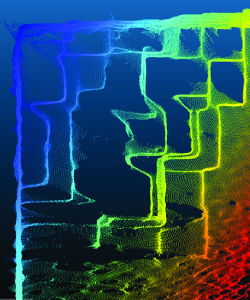
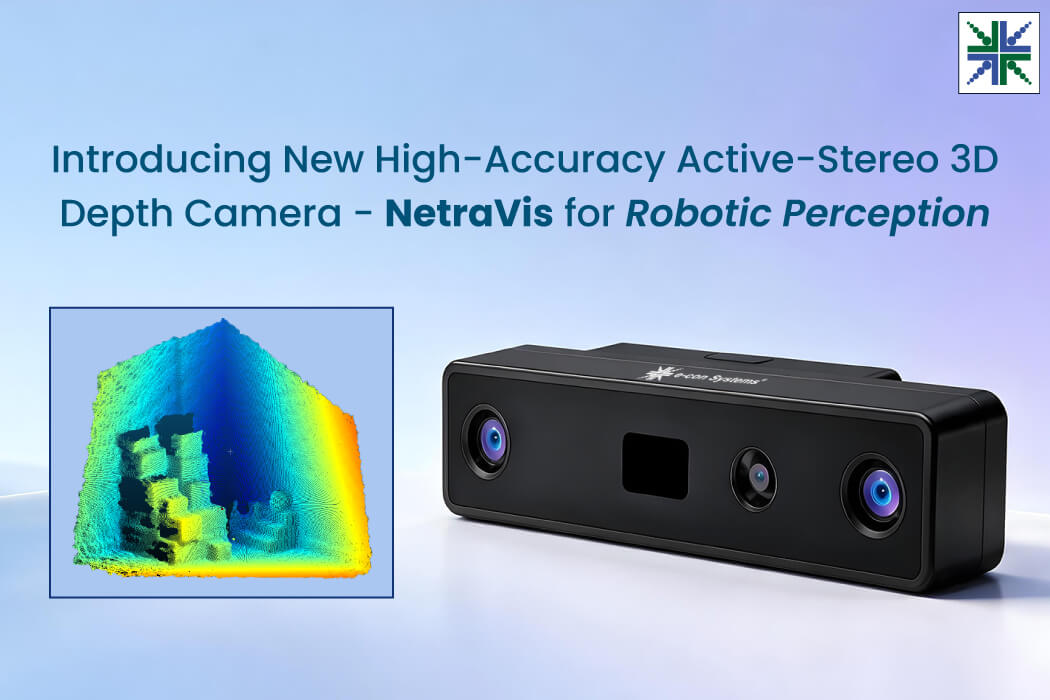
Delivers detailed point clouds for enhanced 3D reconstruction.

On-camera NPU enables AI inference at the edge, offloading vision processing from the host CPU.

Global-shutter RGB sensors and 6-axis IMU add color and motion context to every depth frame.

Python/C++, OpenCV, and ROS 2 packages for rapid development.
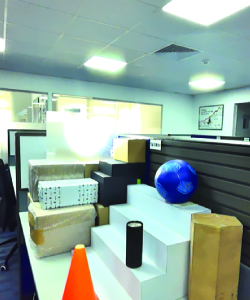
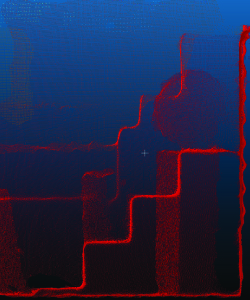
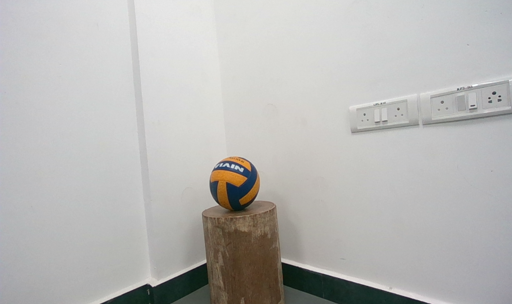
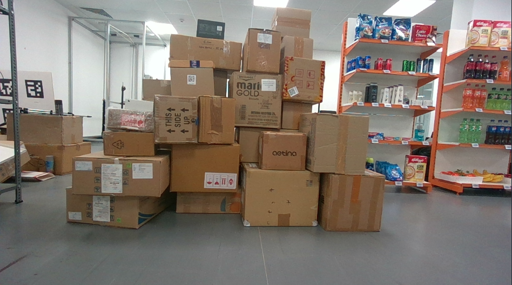
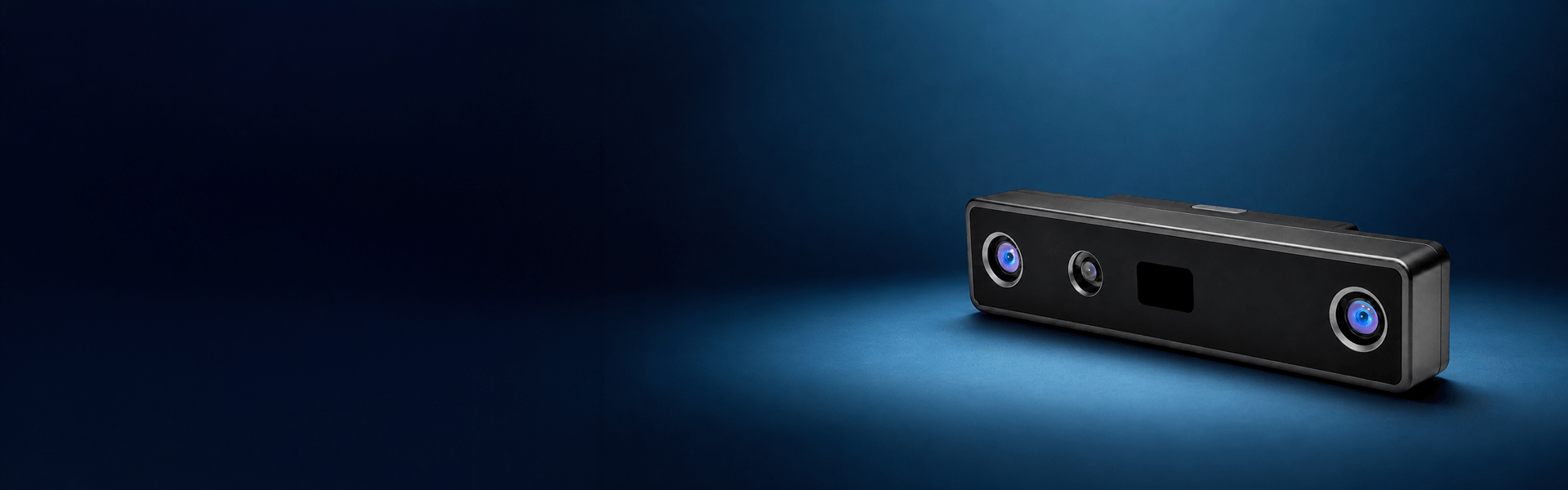
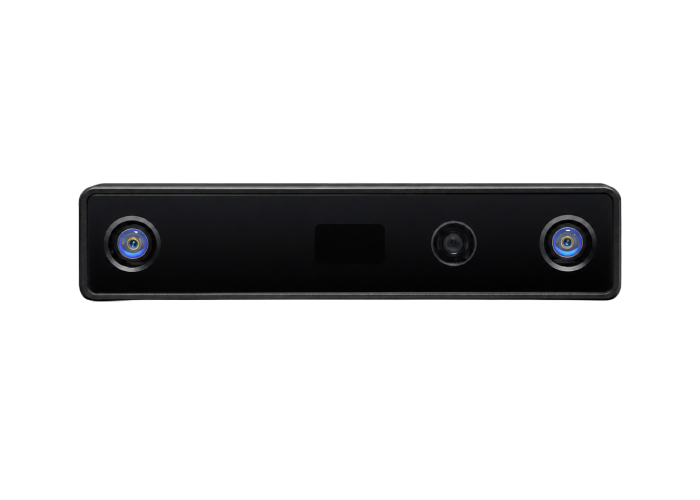
NetraVis_USB is a 1MP Global Shutter Active Stereo Depth Camera designed for indoor 3D vision applications in robotics and industrial automation. It features dual 1MP global-shutter sensors spaced on a 100 mm baseline, working with IR-assisted active stereo to deliver 0.5% depth accuracy at 1 m, including on reflective and low-texture surfaces. An integrated 6-axis IMU provides inertial data, while the camera delivers accurate depth data up to 6 meters.
An onboard NPU enables real-time AI inference for applications such as object detection and segmentation at the edge. This reduces the processing load on the host system and supports faster vision workflows.
NetraVis_USB connects over USB 3.0 Type-C, works out of the box on Linux, and needs no lens calibration during integration. Its compact, low-power design makes it perfect for AMRs, ASRS, collaborative robotic arms, pick-and-place systems, and any application needing precise Depth-to-Color (D2C) registration.
| Parameter | Value |
|---|---|
| 3D Technology | Active stereo |
| Depth sensors | Two monochrome, global shutter |
| Baseline | 100 mm |
| Depth accuracy | 0.5% @ 1 m |
| Depth range |
0.19 m (binning) – 6 m; 0.38m - 6m |
| Depth FOV (H × V) | 88° × 68° |
| Depth full resolution | 1080 × 720 |
| Depth binning resolution | 544 × 360 |
| Depth frame rate | 1080×720 @ 30 fps ; 544×360 @ 60 fps |
| Depth output format | 16-bit Z-depth map (mm, unsigned short); disparity / point cloud / colorized depth via SDK |
| Depth compute | On-board ASIC |
| Wavelength | 850 nm IR filter |
| Parameter | Value |
|---|---|
| RGB sensor | Single, global shutter, 1 MP |
| RGB resolution | 1280 × 720 @ 30 fps 640 x 480 @ 60 fps |
| RGB FOV (H × V) | 95° × 65° |
| RGB output format | BGRa |
| Module output | Depth, IR and RGB |
| IMU | 6-axis |
| Interface | USB 3.0, Type-C |
| Focus | Fixed focus |
| Parameter | Value |
|---|---|
| Dimensions | 124 × 27 × 25.5 mm (±0.5 mm) |
| Weight | 109 g |
| Launch date |  |
| Parameter | Value |
|---|---|
| Operating voltage | 5 V, 1.5 A |
| Typical power consumption | ≤4.5 W |
| Operating temperature | -10°C to 50°C |
* - Under Development
Depth, IMU, RGB and point-cloud sample code using the our SDK, plus OpenCV demos.
Applications covering depth, IMU, RGB, OpenCV, point cloud and on-camera AI model inference.
Full ROS 2 packages
README files and setup/API documentation for fast bring-up.

0.5% accuracy at 1 meter.
0.38m - 6m in full resolution mode.
USB 3.0 over a Type-C connector.
A Python wrapper, C++ sample applications, ROS 2 packages, and OpenCV demos, with accompanying documentation.
| Product Name | Platform | Wavelength | Suitable for | Interface | Baseline | Action |
|---|---|---|---|---|---|---|
| NetraVis_USB | x86/ARM | 850 nm | Indoor | USB 3.0, Type-C | 100mm |

|
| NetraVis_GMSL2 * | NVIDIA Jetson Platforms | 940 nm | Indoor / Outdoor | GMSL2 | 60mm / 100mm |
|
* - Under Development


 Mr. Thomas Yoon
 +82-10-5380-0313


 Employee Login