Mr. Thomas Yoon
 +82-10-5380-0313


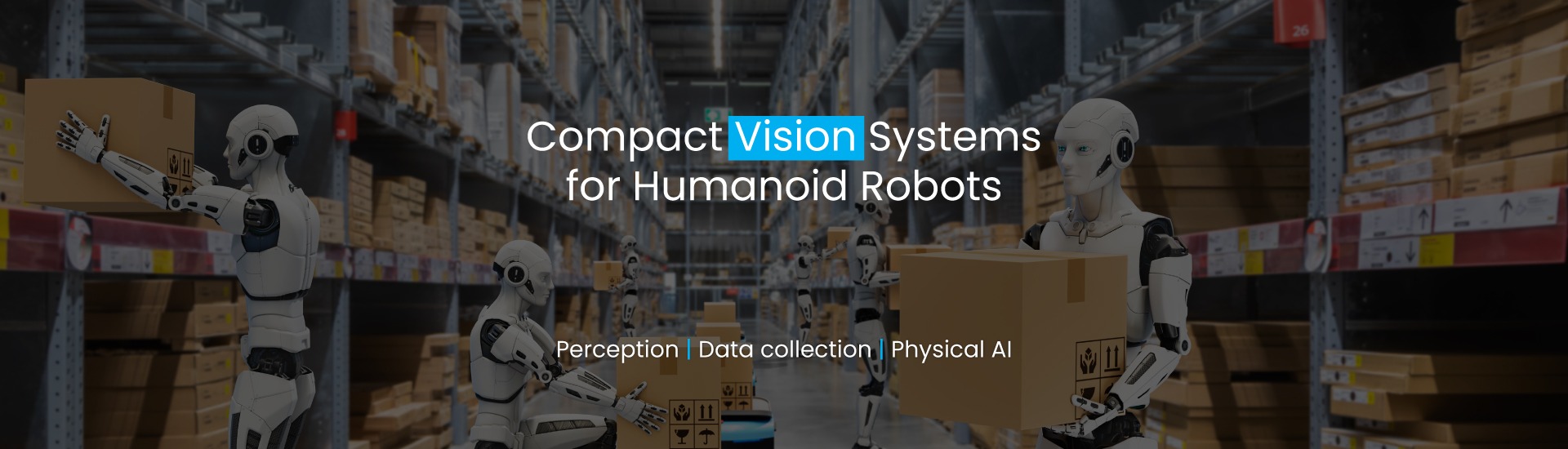
Humanoid robot development is moving from controlled prototypes toward real-world deployment, increasing the demands placed on their vision systems. These robots need visual data to interpret their surroundings, move through dynamic environments, and interact safely with people and objects. e-con Systems' camera solutions power the intelligent vision backbone for navigation, depth perception, human-aware interaction, and precision motion control for physical AI systems.
Humanoid development also requires visual data for training and validating navigation, manipulation, and human-interaction models. Our camera solutions can support data collection during development as well as real-time perception after deployment.

How Our Cameras Address Humanoid Vision Challenges
Complex Navigation
Our 3D vision systems (ToF and stereo cameras) generate accurate depth maps for SLAM, obstacle avoidance, and spatial understanding.
Motion Blur Handling
Global shutter and high-frame-rate sensors ensure sharp image capture during fast robotic motion and dynamic scenarios.
Varying Lighting Conditions
HDR and low-light optimized sensors maintain consistent perception in indoor, outdoor, and mixed lighting environments.
Low Latency Integration & Control
High-speed interfaces such as GMSL2 and MIPI enable real-time data transmission for closed-loop control and robotic actuation.
Our Vision Solutions for Humanoid Robots
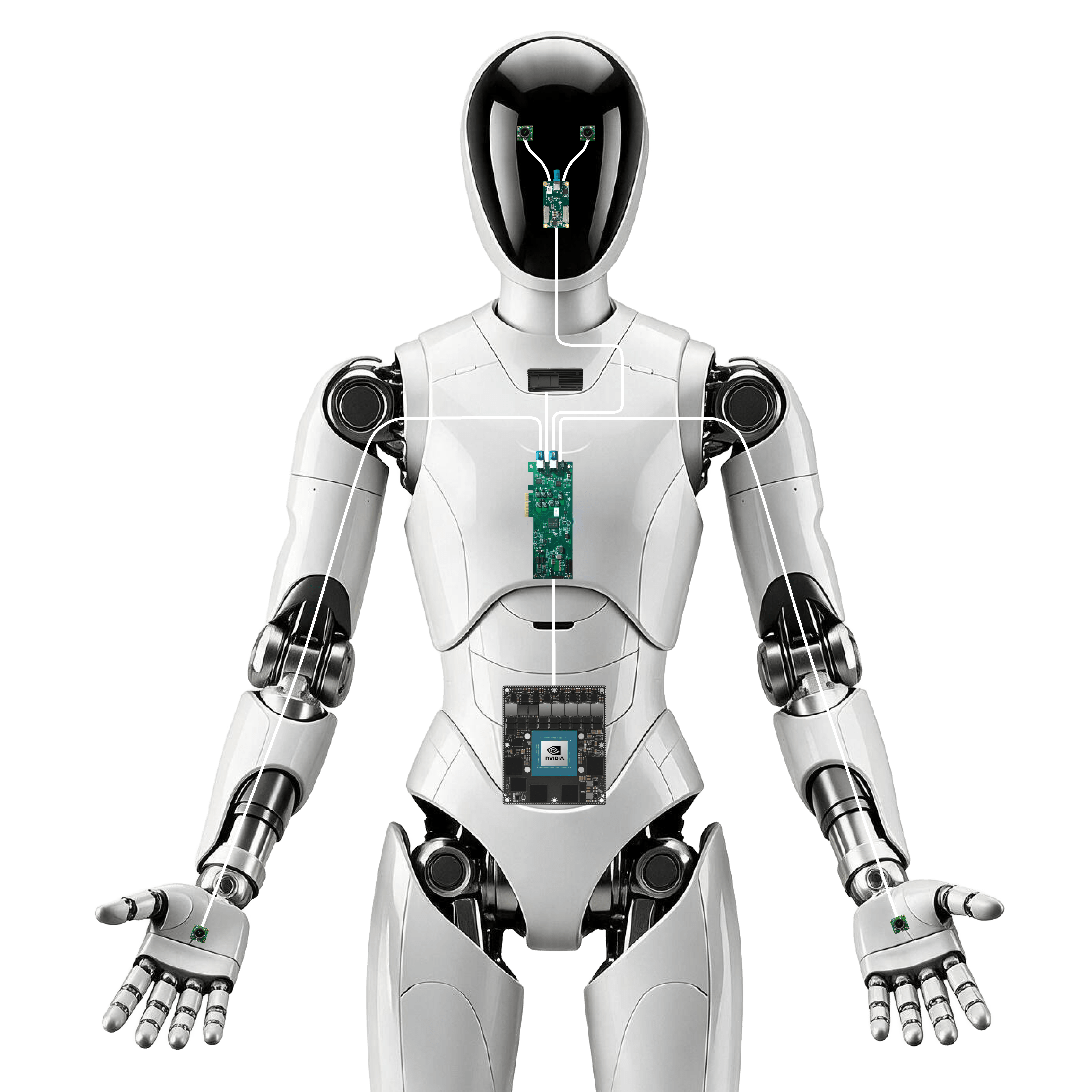
We offer camera systems for humanoid robots that depend on real-time perception, depth sensing, and synchronized inputs from multiple viewpoints. Our cameras can be integrated into the head, torso, arms, palms, and other robot modules, with lens, enclosure, and interface options covering USB, MIPI, and GMSL2.
3D Vision for Navigation & Localization
Most stereo systems break down over the distance between a humanoid's head and its compute unit. Robot movement can introduce motion blur, while timing differences between the left and right sensors can reduce stereo-depth quality.
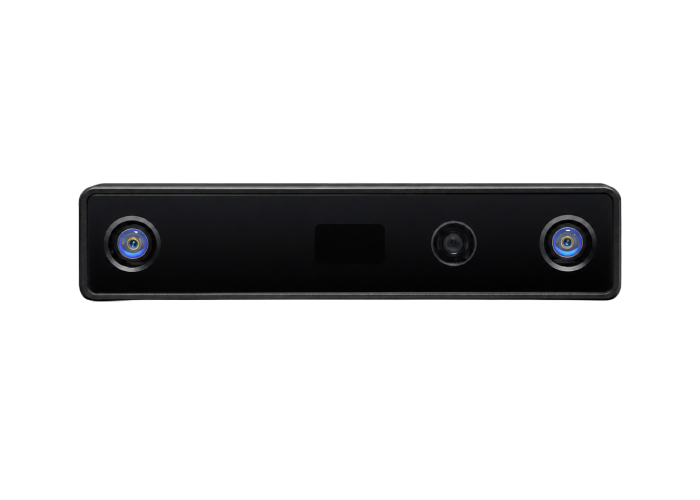
e-con Systems offers e-CAM20_CUOAGX, a camera solution to pair two global shutter sensors on a baseline tuned to your robot. It can be synchronized at the hardware level to hold up across that exact run. This gives the robot clean, reliable depth data, so it can build a map of the space around it and know exactly where it is without needing outside help like beacons or markers. Then, it can plan a safe path around whatever is actually in front of it.
- check_circleAdjustable stereo baseline
- check_circleLow-distortion lens options
- check_circle2MP global-shutter stereo pair
Depth Sensing for Obstacle Detection & Safety
A humanoid works within arm's reach of people, making missed obstacles a critical safety issue. Standard stereo depth often loses accuracy in close range, dim light, or on plain surfaces.
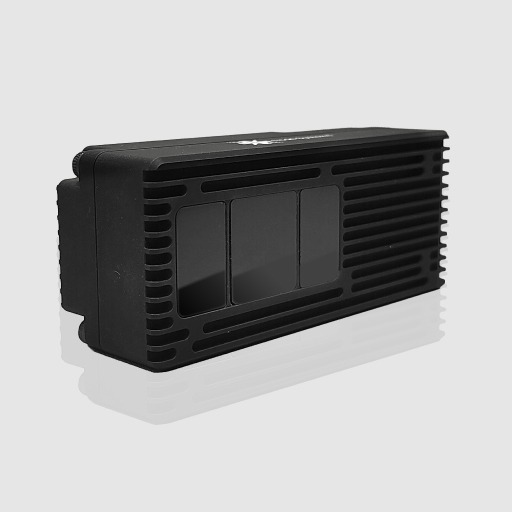
e-con Systems' DepthVista uses a 1.2MP indirect Time-of-Flight sensor to capture depth in low-light scenes and on surfaces with limited texture. Our upcoming Stereo camera solution – with an NPU – processes depth right on the camera, so detection does not add processing overhead to the robot's main computer.
- check_circle1.2MP iToF depth sensor
- check_circleDepth sensing in low-texture and low-light environments
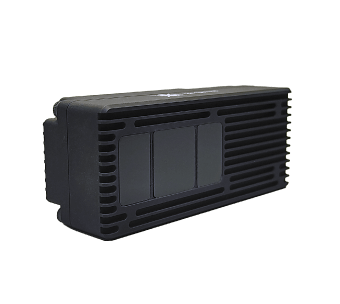
- check_circle1MP global shutter, on-camera depth processing
- check_circleOn-camera detection and classification
Object Handling & Dexterous Manipulation
Grasping needs the exact position of the object, not a map of the room. At working distances of 10 to 30 cm, the robot's hands or arms may obstruct the head-mounted camera, reducing visibility during bin picking, handovers, and tool use.
A palm-mounted camera provides a close-range viewpoint that remains available when the head camera is obstructed. e-con Systems' NileCAM25_CUOAGX is a compact 2MP global shutter camera running at 65 fps, with close-focus optics for in-hand views. One camera in each palm provides close-range visual feedback while staying synchronized with the robot's other camera streams.
- check_circle2MP global shutter at 65 fps
- check_circleCompact form factor for palm and wrist integration
- check_circleOne camera per palm (×2)
- check_circleClose-focus optics for in-hand views
- check_circleGMSL through the wrist joint
Multi-Camera Aggregation & Synchronization
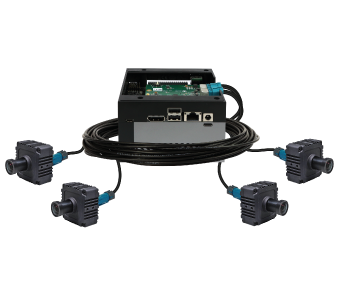
A humanoid may distribute six or more cameras among its head, torso, arms, and palms, creating separate cable routes and timing sources. That mismatch adds up: fusion, depth, and VLA models all get worse when frames arrive out of step, and most hosts run out of camera interfaces long before the robot does.
e-con Systems provides a dedicated board that aggregates camera streams and applies hardware-level synchronization within the camera architecture. It integrates up to 16 cameras on a single host interface, synchronizes them at the hardware level, and converts between formats like GMSL, MIPI, PCIe, and Holoscan. This helps deliver exactly what the host expects.
- check_circleUp to 16 cameras onto one host interface
- check_circleFrame-level hardware synchronization
- check_circleGMSL-to-MIPI, GMSL-to-PCIe, MIPI-to-Holoscan
- check_circleDelivers the format the host expects
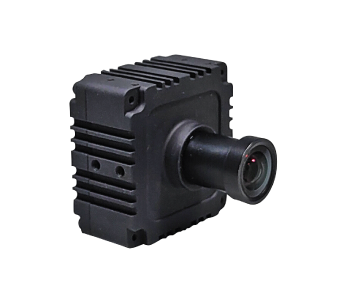
Custom GMSL Cabling for Humanoid Joints
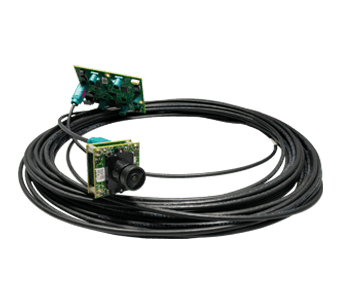
Cameras mounted in a humanoid's arms or palms require cable routes through joints that undergo repeated twisting and bending. Most of the time, the cable fails long before the camera does. High-speed video, motor noise and tight routing space share that same joint, and a link that drops frames under motion looks exactly like a broken sensor.
e-con Systems develops the cable assembly together with the camera link and validates signal integrity from the camera to the compute platform. Each custom GMSL cable assembly is built and tested for 10 million torsion and bending cycles across multiple bend radii, with strong signal integrity and EMI resistance.
- check_circleSupports 10 million torsion and bending cycles
- check_circleTested across multiple bend radii
- check_circleHigh signal integrity, EMI-robust
- check_circleCustom cable lengths from 1 m to 15 m
- check_circleUltra-thin profile for confined joints
- check_circleFAKRA and custom connector options
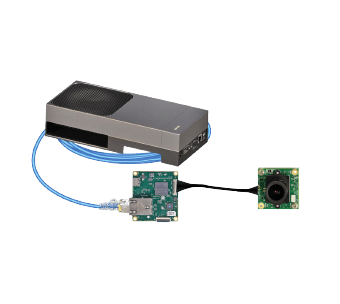
Edge AI Compute for Robot Perception
Perception only matters if the robot can act on it in time. Multiple camera streams, depth, and a VLA model all have to run inside one power and thermal budget. So, integrating cameras on a new compute platform is usually where robotics schedules slip. After all, drivers, timing, buffers, and pipelines all have to agree before anything works.
e-con Systems provides camera support for NVIDIA Jetson AGX Thor and NVIDIA IGX Thor, including drivers, multi-camera synchronization, and validated capture pipelines. That means bring-up isn't a schedule risk you have to absorb.
- check_circleDrivers and BSP included
- check_circleMulti-camera capture and sync
- check_circleCamera health monitoring
- check_circleValidated camera-to-model workflows
Data Collection & AI Training for Humanoid Robots
Vision Systems Built for Training at Scale
Humanoid robots require vast amounts of synchronized, high-quality visual data to train AI models before and during deployment. e-con Systems' humanoid camera solutions support continuous data collection across RGB, IR, and depth modalities to accelerate AI development.
Key capabilities for data collection and training:
- check_circle Compact & Lightweight Form Factor
- check_circle Battery-powered operation
- check_circle Wireless connectivity (Wi-Fi) for seamless data transfer and remote control
These capabilities help humanoid developers build robust datasets for SLAM training, imitation learning, manipulation planning, human-aware interaction, and sim-to-real validation. These datasets can be used across simulation, lab testing, and real-world deployment to reduce sim-to-real gaps.
Teleoperation & Sensor Fusion for Physical AI Humanoids
Our cameras deliver low-latency, frame-accurate visual data designed for real-time teleoperation and multi-sensor fusion—combining vision with IMU, inputs for stable humanoid control.
Multi-Camera Vision Architecture
Humanoid robots need distributed vision systems across the head, torso, arms, and peripheral modules, including end-effector (hand/palm) units for fine manipulation tasks like timestamp alignment and deterministic data streaming for time-synchronized perception. It creates spatial, temporal, and multi-modal alignment across robotic perception layers.
e-con Systems supports these through a unified multi-camera architecture.
Multi-Camera Aggregation
Multiple synchronized camera streams (RGB, IR, stereo, and depth sensing) are integrated through a distributed sensing architecture, enabling comprehensive environmental perception across the robot body.
Multi-Camera Synchronization
Frame-level synchronization means that all the cameras capture scenes at the exact same time. This ensures accurate depth reconstruction, consistent motion tracking, reliable sensor fusion for real-time AI decision-making, and high-quality dataset generation for AI training workflows.
Advantages of e-con Systems' Cameras
End-to-End Customization
From sensor selection to firmware, we customize camera solutions to meet specific demands.
Proven Reliability
Our cameras undergo rigorous testing to drive performance in demanding environments.
Integration Support Expertise
Our engineering team helps you accelerate the time-to-market with dedicated support.
Long-Term Availability
We guarantee product availability for the full lifecycle of your robotics systems.
Empower Your Humanoids with Human-Like Vision
See how our camera solutions can empower your robots with next-gen “on the move” vision.
 Employee Login