Welcome to Vision Vitals by e-con Systems, your weekly podcast about the wondrous world of embedded vision technologies.
In today's episode, we'll be discussing the role of vision systems in achieving full autonomy.
Now, in case you didn't already know, the robotaxi market is projected to grow from around 4.4 billion dollars in 2025 to nearly 189 billion by 2034. That kind of growth does not happen without a rethinking of how vehicles see and understand the world around them.
So, let's start by understanding what kind of pressure this puts on vision systems.
Our embedded vision Expert is here to take us through it.
Thanks for having me. This is a topic I find genuinely fascinating.
Host:
Glad to hear that! I'm sure our listeners do too. To kick things off, how is an ADAS vision system different from what a robotaxi needs?
Expert:
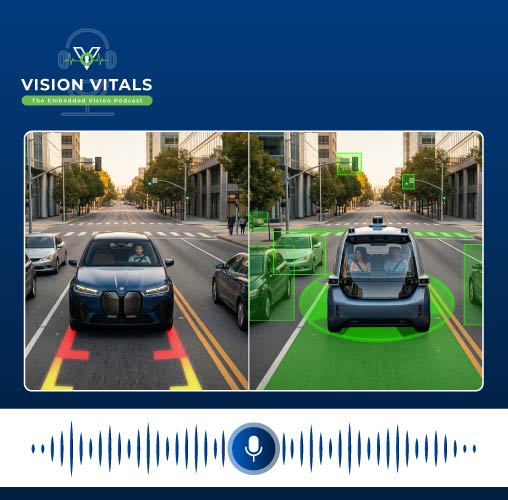
So ADAS was designed around driver assistance. The cameras feed data for things like lane departure warnings, collision alerts, and parking assistance. They operate for short durations, handle fairly narrow scenarios, and crucially, there is always a human driver in the loop to interpret what is happening and take responsibility.
A robotaxi removes that human entirely. The vehicle is running continuously in busy city traffic, interpreting dense interactions between pedestrians, cyclists, other vehicles, and so on. Every decision the vehicle makes depends on what the cameras capture, process, and pass forward. That is a completely different operating context.
Host:
So, uh, the camera layout must change too, I imagine?
Expert:
Yes, significantly. ADAS typically uses up to two forward-facing cameras. Robotaxi deployments need forward, rear, and surround-view coverage to achieve 360-degree perception. You need visibility in every direction at all times, including low-speed scenarios like parking, reversing, and navigating through tight intersections.
Host:
What about the actual imaging conditions? City environments seem like they would be very unforgiving.
Expert:
They are, and this is where it gets really demanding. A robotaxi is not doing a short test drive. It is active for long stretches across a full day, which means the cameras are dealing with everything from harsh midday sunlight to deep shadows between buildings to headlight glare at night.
With ADAS, the system triggers for specific features and then steps back. A robotaxi vision pipeline has no such relief. It has to perform consistently across the entire operating window, which raises the stress on sensors, optics, and image processing in a way that ADAS simply did not have to contend with.
Host:
Right. And these vehicles are being deployed as fleets, not individual units. Does that create its own problems?
Expert:
Absolutely, and it is a challenge that I think gets underestimated. When you are running hundreds or thousands of vehicles across different cities and climates, even small variations in camera alignment, thermal behavior, or image timing can lead to inconsistent perception outcomes across the fleet.
With a consumer vehicle, a slightly off camera might just annoy the driver. In a robotaxi fleet, that same inconsistency can mean one vehicle behaving differently from another in an identical scenario. Fleet-grade vision systems have to perform the same way, vehicle to vehicle, day after day.
Host:
There is also a regulatory dimension here, is there not? After all, these vehicles are under a lot of scrutiny.
Expert:
Very much so. Regulators, city authorities, and the public all want visibility into how these vehicles are making decisions. That means camera data has to feed incident review, system validation, and safety audits reliably.
Timestamp accuracy, synchronization, and data integrity have to be maintained across long operating periods. Any gaps in the visual record umm weaken the ability to reconstruct events or explain decisions during a review.
Host:
That really puts the stakes into perspective. Umm. How would you summarize what the jump from ADAS to full autonomy actually means for vision engineering?
Expert:
It means moving from building a system that assists a human to building one that replaces the human entirely. The tolerance for inconsistency goes to near zero. Perception has to be reliable across all lighting conditions, all weather, all traffic densities, and across an entire fleet operating at scale.
That is the bar, and it is a very different one from where ADAS started.
Host:
Really well put. Thanks for breaking that down so clearly.
Expert:
My pleasure!
Host:
And thank you to everyone listening to this episode of Vision Vitals.
To explore e-con Systems' mobility vision solutions, please visit e-consystems.com
For help finding the right vision solution for your application, reach out to camerasolutions@e-consystems.com.
We'll see you in the next episode of Vision Vitals!
Close Full Transcript


 Mr. Thomas Yoon
 +82-10-5380-0313




 Employee Login