Welcome to e-con Systems' Vision Vitals, your trusted podcast for all things related to embedded vision.
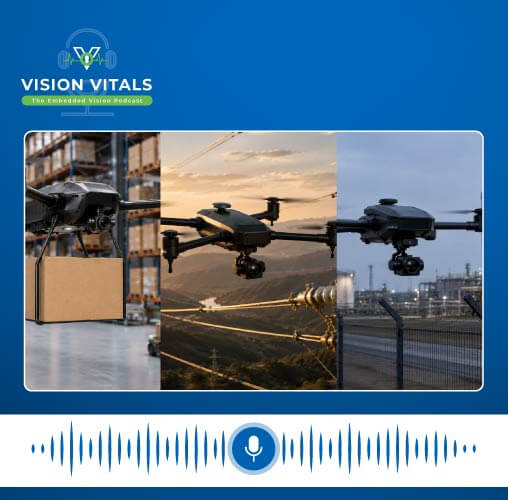
Drones are everywhere now, from monitoring crops and inspecting pipelines to delivering packages and patrolling borders. But each of those applications places completely different demands on the camera system doing the seeing.
Today, we're going through what those challenges actually look like – and how they can be overcome.
Joining me is our embedded vision Expert. Glad to have you back.
Thanks! Always good to be here.
Host:
So we have many use cases to discuss today. Let's start with smart agriculture. What sort of challenges do drones face there?
Expert:
Well, agricultural drones are doing a lot more than just taking pretty pictures from above. They're monitoring plant growth, detecting crop diseases, tracking livestock, and deciding when fields are ready for harvest. And they're covering large areas while doing it.
The challenge is that all of this requires seeing minute details from a significant height.
So the camera needs a high pixel count to pick up granular symptoms of disease on individual plants. Zoom capability is important too, especially optical zoom, which is preferred because it preserves image quality.
And then there's NIR imaging, which is used to calculate the vegetation index. Without sensitivity to the near-infrared spectrum, you're missing a big part of what makes aerial crop monitoring actually useful.
Host:
Right. Fair to say that the camera is almost doing diagnostic work?
Expert:
Exactly, yes. It's not just capturing a scene, it's providing data that drives farming decisions. The imaging quality directly affects the accuracy of those decisions.
Host:
What about surveillance? That feels like a completely different set of problems.
Expert:
Hmm, it really is. The camera orientation is a game-changer there. For instance, in agriculture, the camera is generally pointed downward. In surveillance, it can be pointed at any angle toward the horizon, at buildings or across different heights. And that introduces significant glare issues when the sun or reflective surfaces like glass and metal are in the scene.
You get hotspots and washed-out images where all the useful detail disappears.
Obviously, HDR capability is essential. A high dynamic range camera can handle a bright light source in the frame without losing the surrounding detail. And of course, resolution and zoom still matter because surveillance operators need to examine specific subjects or areas from a safe distance.
Host:
Ah, right. Now, inspection is interesting because it covers everything from oil rigs to underground mining. How do you design for environments as different as these?
Expert:
That's where it gets really demanding. Take mining applications. These drones are going into caves where there is no natural light, limited oxygen, and potentially hazardous gases. The camera has to produce usable imagery using only low-power LEDs for illumination, because if you need high-power LEDs on the drone, you're burning through the battery and cutting flight time significantly.
So you need a camera with very high sensitivity to both IR and visible light, and strong low-light performance. The sensor needs to extract as much information as possible from very little light.
Get that wrong, and the drone is essentially flying blind underground!
Host:
Now what about delivery drones? Do they need the most autonomy?
Expert:
Oh, absolutely. Autonomy is really at the heart of what makes a delivery drone viable. You need the drone to intelligently sense its surroundings in real time, without a human guiding every movement.
That means using one or more cameras to provide depth and orientation measurements continuously.
Techniques like SLAM, simultaneous localization and mapping, help the drone understand its immediate environment and navigate around obstacles. And the camera itself needs to be a global shutter model with support for fast shutter speeds, otherwise motion blur becomes a serious problem during flight.
A rolling shutter camera would introduce artifacts that could throw off the drone's spatial awareness entirely.
Host:
So across all four, the camera requirements are almost entirely different.
Expert:
Mmm, they really are. That's what makes drone imaging such a rich problem to solve.
High resolution and NIR for agriculture, HDR and zoom for surveillance, low-light sensitivity for inspection, global shutter and depth sensing for delivery.
There's no single camera that fits all of them, and getting the wrong one affects everything the drone is supposed to do.
Host:
Thanks for mapping that out so clearly. It's rather eye-opening to see how the environment influences the vision requirements.
Expert:
My pleasure!
Host:
As always, we appreciate everyone who joined us for this episode of Vision Vitals.
If you're looking for proven drone camera solutions, please visit e-con Systems dot com.
And if you want to get in touch with one of our vision Experts to speed up this process, please write to camerasolutions@e-consystems.com.
We'll see you in the next episode of Vision Vitals!
Close Full Transcript


 Mr. Thomas Yoon
 +82-10-5380-0313




 Employee Login