Welcome to Vision Vitals, where we explore the camera technologies behind embedded vision systems.
Did you know that rear view cameras once served mainly as visibility aids? However, these days, with AI processing, they contribute to object recognition, movement tracking, alerts, and vehicle-level decisions.
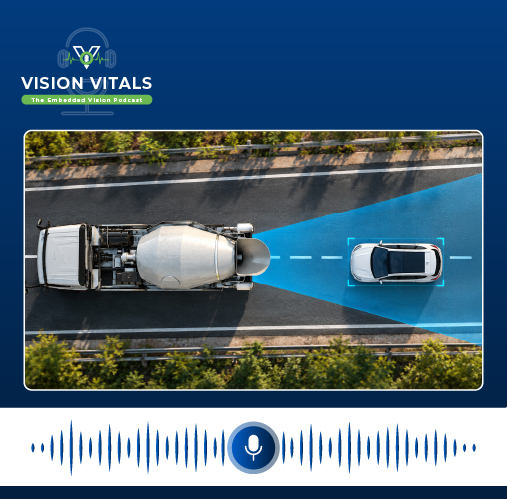
So in this episode of Vision Vitals, we're examining how AI-powered rear view cameras improve vehicle safety, which imaging features support analysis, and where those capabilities matter most.
Our embedded vision expert is joining us. Thanks for being here.
Happy to join you. Well, the interesting thing about rear cameras is that they now act as a source of visual intelligence.
HOST:
Mm, so what can an AI system understand from rear-facing video?
EXPERT:
It can recognize objects, detect movement, and follow how people or vehicles enter the area behind the vehicle. That supports reversing, lane changes, low-speed maneuvers, and umm trailer alignment.
The driver receives current visuals, while the AI layer can identify hazards and support faster reactions.
HOST:
Ah, which camera features determine how useful that input is?
EXPERT:
Umm HDR, a wide Field of View, high sensitivity, and a rugged enclosure are central. The AI model depends on the camera to preserve detail across changing light, cover the required rear and side zones and retain information in dim conditions. It also keeps them operating through vibration, debris, moisture, and pressure cleaning.
HOST:
How does HDR protect the analysis during sharp lighting changes?
EXPERT:
HDR balances bright and dark regions in the same frame. Uh, consider a truck moving from sunlight into a shaded loading dock or a dim tunnel. Glare can hide one part of the scene while shadow removes another. HDR keeps pedestrians, vehicles, and obstacles visible enough for the AI model to analyze them with fewer false detections.
HOST:
That's interesting – let's now discuss the need for a wider Field of View. Does it help change detection?
EXPERT:
A wide-angle lens covers more of the area behind and beside the vehicle, including rear corners and lateral traffic. That broader view gives the AI model more information for interpreting distance, depth, and motion paths. It can errr track people, vehicles, and stationary objects across several nearby zones instead of watching only the center.
HOST:
Oh, what keeps detection usable in night yards or underground parking areas?
EXPERT:
High sensitivity preserves detail in dim or variable lighting. This improves object differentiation when standard sensors lose information and supports detection across night shifts, stormy weather, and poorly lit operational areas.
HOST:
And what must the enclosure withstand on a working vehicle?
EXPERT:
Umm automotive-grade housing protects the camera from vibration, debris, moisture, and pressure washing. Mmm, continuous input matters because an AI system cannot track an event reliably if the camera feed drops during operation.
HOST:
Okay, where does AI-powered blind spot detection add the most value?
EXPERT:
It monitors rear-quarter and peripheral zones that mirrors may miss. The system can identify vehicles, walls, or other objects approaching from the rear corners during merges, turn exits, or lane changes. That is useful in umm dense traffic and narrow job sites.
HOST:
How does the same camera make reversing more controlled?
EXPERT:
The rear view gives the driver direct visibility, while AI adds depth awareness and object recognition. It can distinguish a stationary obstacle from a moving person or vehicle and support alerts as the truck closes in on a hazard. This is valuable during docking, yard movement, and reversing over uneven or umm poorly lit ground.
HOST:
Now, what changes when the rear camera joins a multi-camera surround-view system?
EXPERT:
Its feed contributes to a stitched 360-degree view for parking, turning, clearance checks, and moving-off maneuvers. A camera-based Moving Off Information System can also identify obstacles or pedestrians hidden low to the ground before a heavy vehicle begins moving.
HOST:
What role can rear-facing AI play during trailer hitching?
EXPERT:
Err it can analyze distance and alignment as the vehicle approaches the coupling point. The driver receives guidance without repeated guesswork or manual correction. Better alignment can shorten coupling cycles and reduce mechanical wear caused by poor contact.
HOST:
Mmm-hmm, how does pedestrian detection protect shared loading zones?
EXPERT:
AI models trained on human outlines and movement patterns can recognize someone entering the area behind the vehicle. The system can support alerts, near-miss logging, incident review, and umm safety reporting where people and equipment operate close together.
HOST:
Could you leave us with the main safety takeaway?
EXPERT:
Of course! So basically, AI-powered rear-view cameras extend rear visibility into active perception. They support blind spot detection, safer reversing, surround-view awareness, trailer alignment, and pedestrian recognition across changing conditions.
HOST:
Interested in knowing about our rear-view camera solutions? Please visit our e-con Systems dot com to know more!
If you need any other information relating to our camera solutions, you can write to camerasolutions@e-consystems.com.
Thank you for listening to Vision Vitals.
We'll meet again in the next episode!
Close Full Transcript


 Mr. Thomas Yoon
 +82-10-5380-0313




 Employee Login