Welcome back to e-con Systems' Vision Vitals, your weekly podcast on embedded vision.
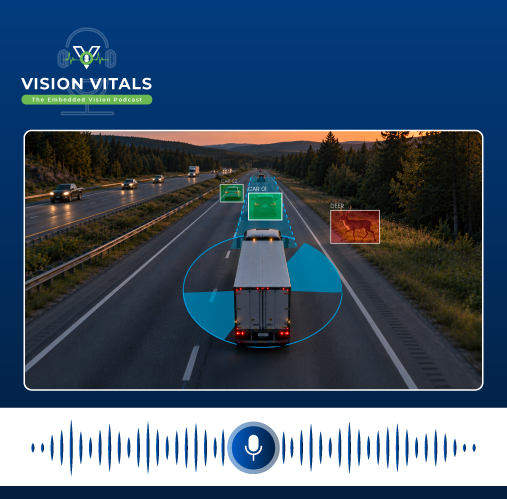
A forward-facing ADAS camera may be positioned behind the windshield, yet it has to read distant traffic signs, signals, lane markings, pedestrians, and other road information as lighting changes around the vehicle.
In this episode of Vision Vitals, we're looking at why High Dynamic Range, or HDR, and LED Flicker Mitigation, or LFM, are crucial for forward-facing ADAS cameras.
We'll also examine resolution and host connectivity.
Joining me is our in-house embedded vision Expert. Good to have you here.
Host:
To kick things off, let's talk about why a forward-facing ADAS camera usually uses a errr narrow field of view?
Expert:
Umm a narrow field of view concentrates the camera on objects farther down the road. That supports long-distance tasks such as reading traffic signs, tracking lane markings, and identifying pedestrians. The windshield position also supports that forward reach. The challenge is that distant objects occupy less of the image, so the camera has to retain umm enough detail for the ADAS processor to interpret them.
Host:
Uh-huh, what happens when bright sunlight and deep shadow appear in the same frame?
Expert:
That is where HDR becomes important. HDR captures multiple exposures of the same scene and combines them into one image. Bright and dark regions remain visible together instead of one area becoming overexposed or another becoming too dark.
Umm a vehicle leaving a tunnel is a good example because the road outside may be bright while the tunnel entrance remains dark.
Host:
And how does that change what the ADAS system can detect?
Expert:
Er, the processor receives a more balanced image with usable detail across the scene. Lane markings, obstacles, traffic signs, and pedestrians remain easier to identify under mixed lighting. HDR also supports urban scenes with glare, headlights, street lamps, shadows from buildings, and reflective surfaces.
Host:
Oh, where does LED flicker enter the picture?
Expert:
LED lights pulse at a frequency that may not match the camera sensor's capture timing. Because of that mismatch, a traffic light, streetlight, or electronic sign can appear to flicker, distort, or disappear in certain frames. That missing or broken information can interfere with ADAS interpretation.
Host:
So, what does LFM change inside the camera?
Expert:
Umm, LED Flicker Mitigation adjusts sensor operation to account for the pulsing frequency of LED lighting. The camera then captures the light source more consistently instead of recording interrupted output. This is useful in cities, tunnels, and highways where LED traffic signals, signs, and streetlights are common.
Host:
Mmm-hmm, why are HDR and LFM both especially important at night?
Expert:
Night scenes can contain very dark road areas beside bright headlights, illuminated signs, and LED streetlights. HDR manages the contrast between those regions, while LFM addresses the pulsing of LED sources. Together, they help preserve pedestrians, obstacles, signs, and signals without glare or flicker removing useful visual information.
Host:
What role does resolution play when those objects are farther away?
Expert:
Higher resolution provides more detail for distinguishing traffic signs, road markings, pedestrians, and smaller objects at a distance. As an object becomes farther away, it occupies fewer pixels. Additional image detail gives the ADAS processor more visual information for identification.
Host:
Ah, once the frame is captured, how quickly must it reach the vehicle's processing unit?
Expert:
The host connection needs to transfer the visual data with low delay. A strong connection keeps the processor supplied with current frames so decisions are based on the latest road scene. Smooth data transfer also prevents the imaging benefits of HDR, LFM, and high resolution from being weakened by latency.
Host:
Before we wrap up, what should engineers evaluate together when choosing a forward-facing ADAS camera?
Expert:
They should examine high-contrast performance, LED lighting, night scenes, long-distance detail, resolution, and host connectivity as one system. The sensor must capture usable information, and the connection must deliver that information quickly to the processor.
Host:
Hmm, could you give us the final takeaway from today's discussion?
Expert:
HDR preserves detail across bright and dark regions, LFM keeps LED signals and signs consistently visible, high resolution supports distant-object identification, and strong host connectivity keeps the processing unit supplied with current frames.
Host:
Thank you. This was an insightful session!
Also, thank you to each one of you for listening. We appreciate your support!
To explore e-con Systems' camera solutions, please visit e-con Systems dot com. Or write to camerasolutions@e-consystems.com if you want to talk to an Expert about the type of vision power your application needs.
Thanks for listening, and join us again for next week's episode of Vision Vitals.
Close Full Transcript


 Mr. Thomas Yoon
 +82-10-5380-0313




 Employee Login