Welcome back to Vision Vitals, our weekly conversation on embedded vision technologies.
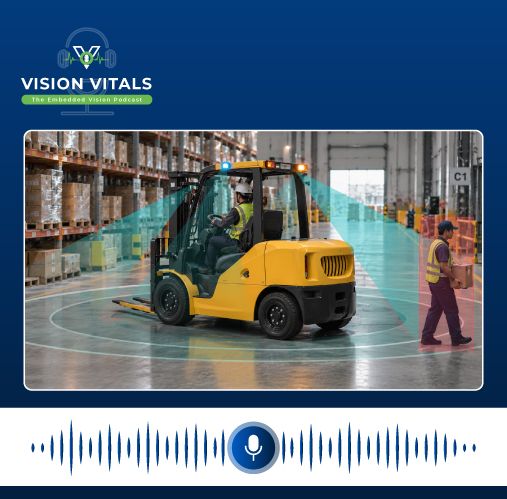
In this episode of Vision Vitals, we examine how embedded vision cameras improve forklift safety. Imaging performance, as you can imagine, is extremely critical for these vehicles, from reducing blind spots to preserving motion detail.
A forklift may reverse out of a narrow aisle, turn beside a storage rack, and position a heavy load while people and other vehicles move nearby. Even one poorly judged movement due to lack of effective imaging can quickly become a safety incident.
Our in-house vision expert is here to explain what the camera system needs. Thanks for joining me.
Glad to join you, you're right about how critical imaging is for forklifts, given they also deal with changing light and close-range decisions in one compact operating area.
Host:
Before we get into camera features, where do the main visibility risks begin?
Expert:
The vehicle body, mast, load, and surrounding racks can hide pedestrians, obstacles, and other vehicles. Rear and side blind spots become especially risky during reversing and turning.
Poor visibility also affects load placement. The operator may make several adjustments before setting a load down, slowing the task and increasing the chance of unstable positioning.
Host:
Once cameras are added, what changes for the operator?
Expert:
A rear camera can show the path behind the forklift, while side cameras reveal areas hidden during turns. Live video makes nearby movement easier to identify before the forklift enters that space.
In autonomous forklifts, the same visual input can also support mapping, path planning, localization, and obstacle avoidance.
Host:
Forklifts are constantly moving and stopping, right? So what keeps the video useful during that motion?
Expert:
A global shutter sensor captures the full frame at the same moment, reducing motion-linked distortion when the forklift, a pedestrian, or another vehicle moves through the scene.
A high capture rate also matters. At 60 frames per second, the system receives more current visual information during fast movement.
Host:
Moving on to warehouses, how exactly does the camera respond to bright loading areas and darker aisles?
Expert:
An onboard image signal processor adjusts camera settings as lighting changes, keeping the scene usable when the forklift moves between differently lit zones.
Global shutter capture protects scene geometry during motion, while image processing responds to illumination changes.
Host:
But how does the system expand from one view to full awareness?
Expert:
Several synchronized cameras can cover separate blind zones and present a 360-degree picture of the nearby area.
This is where Precision Time Protocol comes in. It can synchronize Ethernet cameras at sub-microsecond levels, so frames from different positions represent the same moment.
Host:
What goes wrong when those feeds fall out of step?
Expert:
The combined view can become misleading because distances are short and events unfold quickly. A pedestrian may move from a side view toward the rear view during a turn. Synchronized frames keep that movement coherent across the combined picture.
Host:
Can the system do more than show the hazard?
Expert:
Yes. Low-latency video can feed a monitoring or AI system that watches defined regions of interest. If a pedestrian enters one, the system can alert the operator immediately.
The camera output can also connect to an emergency light or buzzer. Depending on the architecture, AI processing may run on an external unit or inside the camera.
Host:
Now the camera still has to become part of the forklift. Which interface choices make deployment easier?
Expert:
A GigE interface can transmit high-quality video over distances up to 100 meters. MJPEG, H.264, and H.265 compression reduce the data burden, while Power over Ethernet combines data and power on one connection.
Host:
What about the ability of cameras to survive harsh industrial environments?
Expert:
An IP67-rated enclosure protects against dust, dirt, and water ingress. ISO 16750 and ISO 20653:2013 support operation across demanding industrial conditions and extreme temperatures.
Host:
Does better vision also change day-to-day warehouse performance?
Expert:
It does. Better visibility can reduce repeated fork adjustments, speed up load placement, lower inventory-damage risk, and give safety systems a more complete view of the surroundings.
Host:
So embedded vision improves forklift safety through clear motion capture, changing-light support, synchronized coverage, real-time alerts, practical connectivity, and rugged hardware.
I appreciate the explanation.
Expert:
Happy to be part of the conversation.
Host:
And thanks to everyone listening. We truly appreciate your support for this podcast!
Please visit e-consystems.com to explore our portfolio.
And if you're looking for support with forklift safety camera integration or any other vision solution, you can always write to camerasolutions@e-consystems.com.
Join us again for the next episode of Vision Vitals.
Close Full Transcript


 Mr. Thomas Yoon
 +82-10-5380-0313




 Employee Login