Welcome to e-con Systems' Vision Vitals, your weekly podcast on embedded vision.
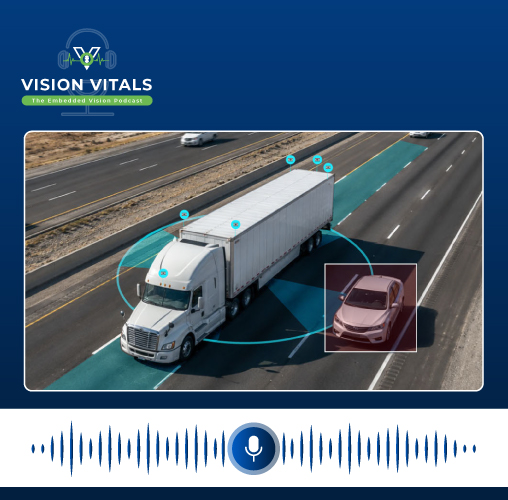
Fleet operators manage delivery accuracy, driver activity, vehicle diagnostics, cargo conditions, and road events at the same time. A single camera captures one view, while fleet decisions increasingly depend on several views working together.
In this episode of Vision Vitals, our in-house vision Expert explains why multi-camera systems are becoming central to smarter fleet management and what goes into choosing the right setup.
Great to have you back.
Thanks! Umm, this is an interesting topic because fleet imaging has gone past basic video recording.
Host:
Why does one camera fall short for modern fleets?
Expert:
A fleet vehicle has several points of exposure at once. There may be blind spots around the vehicle, changing traffic ahead, driver activity in the cabin, and cargo conditions farther back.
Multi-camera systems capture concurrent streams from several angles and send them into a unified processing unit. Fleet teams then gain front, rear, and side coverage in real time, along with a shared source of imaging data for analysis.
Host:
So the value comes from seeing events together?
Expert:
Exactly. Event-based footage can support incident reporting, cabin cameras can monitor driver activity, and exterior cameras can support object detection for automated decisions.
Combined streams give fleet operators stronger input for route planning, safety protocols, audits, and regional safety requirements. They can also reduce avoidable downtime by gaining more visual information around an event.
Host:
So how many cameras does a fleet system need?
Expert:
Well, two or three cameras can support basic front-and-rear monitoring. Fleets seeking broader coverage may use four or more.
Each added camera can widen horizontal coverage, improve depth perception, and reduce distortion linked to one wide-angle lens. The Host platform must also process every stream concurrently, so camera count and processing capacity go together.
Host:
Right. How do all those frames stay aligned?
Expert:
Hardware synchronization makes that possible. Every camera triggers at the same instant through an external signal, such as PWM pulses, producing aligned frames across the sensors.
Without alignment, stitching or analyzing footage may produce inconsistent imaging output. Errr, that becomes a serious issue when vision data feeds object classification or path prediction.
Host:
What role does the camera interface play?
Expert:
Interfaces differ in bandwidth, latency, and transmission distance.
USB can serve local setups with modest frame rates, while MIPI can suit compact systems with short cable distances. Larger trucks may place cameras more than two or three meters from the processor. GMSL2, FPD-Link III, or GigE can support high-speed transmission across longer distances while preserving image integrity and timing.
GigE also supports network-based transmission. GMSL2 over coaxial cable can reach up to 15 meters, which suits trailers, buses, and off-road machines.
Host:
What should teams examine on the processing side?
Expert:
The processing module has to match the multi-camera load. NVIDIA Jetson platforms such as AGX Orin or Xavier are widely used for embedded AI, multi-stream processing, and GMSL2 compatibility.
Platforms from NXP, Qualcomm, and Texas Instruments can also serve fleet systems. Selection parameters include TOPS, thermal design power, available ports, support for custom algorithms, and the SDK stack.
Host:
Okay, which camera features keep footage usable on the road?
Expert:
High resolution improves object boundary clarity, and higher frame rates reduce motion blur around fast-moving vehicles.
HDR handles sudden exposure changes, such as entering a tunnel or facing direct sunlight, by balancing bright and dark areas in one frame. Low-light sensitivity supports night operations and underlit warehouses.
Host:
And what happens in darkness or low-contrast areas?
Expert:
NIR-compatible sensors improve detection during night driving or inside dim cargo spaces.
RGB-IR sensors combine an IR channel with visible-spectrum capture. The same sensor can provide full-color daytime imaging and stronger visibility under low-light NIR conditions.
Host:
External cameras also face rain, dust, and vehicle cleaning. How is that handled?
Expert:
IP67-rated enclosures protect against dust, heavy rain, and brief immersion. IP69K adds resistance to high-temperature, high-pressure cleaning.
Those protections support commercial vehicles operating through changing weather, dirty roads, and demanding cleaning routines.
Host:
That brings us back to the title. Why are these systems becoming non-negotiable?
Expert:
Because smarter fleet management depends on several kinds of visual data arriving together, at the right time, from across the vehicle.
Camera count, synchronization, interface, processing, image quality, cable reach, and enclosure protection all shape how useful that data becomes. Multi-camera imaging gives fleet teams the coverage and aligned information required for automation and human oversight.
Host:
Thanks for sharing your Expert insights. There certainly was lots of learning in today's episode!
Expert:
My pleasure! I enjoyed the discussion.
Host:
So did I.
And thank you to everyone listening.
Visit e-consystems.com to learn more about our multi-camera solutions for fleet management.
For support selecting and implementing the right multi-camera setup for your vision system, write to camerasolutions@e-consystems.com.
We'll see you in the next episode of Vision Vitals!
Close Full Transcript


 Mr. Thomas Yoon
 +82-10-5380-0313




 Employee Login