Welcome to Vision Vitals, your weekly podcast about all the things that make embedded vision an integral part of our world.
In this episode of Vision Vitals, we look at what a camera system needs to provide modern forklifts with uninterrupted 360-degree visibility.
Our in-house vision Expert is here to walk us through it. Good to have you with us.
Glad to be here. Ah, mining vehicles certainly make surround-view design a demanding engineering problem.
Host:
Let's begin with the vehicle itself. Why does its size create such a difficult visibility problem?
Expert:
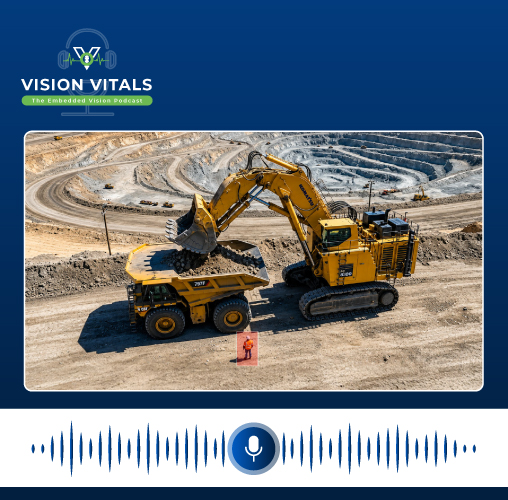
Large mining vehicles have broad blind zones around their body. In an open-pit mine, nearby personnel, smaller vehicles, or obstacles can disappear from the operator's direct view.
The vehicle may cross uneven ground while dust reduces visibility and lighting changes across the route. Even a brief visual gap can affect a turn, reverse movement, or close-range maneuver.
Host:
Mm, so a view in one direction leaves too much unseen. In that case, what does 360-degree coverage require in practice?
Expert:
It requires several cameras positioned around the vehicle so their fields of view cover the major blind zones. Those feeds then have to reach one processing system and appear as a unified surround view for the operator.
The goal is continuous visibility rather than disconnected camera windows. Each camera covers one part of the scene, and the combined output shows nearby movement and obstacles.
Host:
A unified view sounds simple on a display. Er, what makes it difficult behind the scenes?
Expert:
Timing is a major part of it. Every camera captures its own stream. If those streams reach the processor at different moments, the combined image can show lag, visible stitch lines, or motion artifacts.
Multi-camera synchronization keeps the feeds aligned as events unfold. When the vehicle or a nearby object moves, the surrounding views represent the same moment. The operator receives a coherent image rather than sections that appear ahead of or behind one another.
Host:
Oh, and on a moving vehicle, even a small timing gap could distort what the operator thinks is happening.
Expert:
Yes. Hm, image continuity matters because the operator may be judging distance and movement during a high-risk maneuver. A synchronized output reduces visual confusion and makes the surround view easier to interpret quickly.
Host:
Mining sites also bring dust, moisture, shock, and vibration. How does the camera hardware cope with that combination?
Expert:
The cameras need rugged enclosures designed for those conditions. An IP67-rated enclosure protects the camera from dust and water exposure. It also supports operation where moisture is present and where the vehicle experiences mechanical shock.
That protection has to cover every camera. One failed or obscured feed can reopen a blind zone around the vehicle.
Host:
There's another issue here. These vehicles already have an existing design. How much does integration shape the final system?
Expert:
Quite a lot. Every camera module has to slot into the existing system without major hardware redesign. The synchronized feeds also have to reach the operator as one combined output.
That approach can speed up deployment and reduce disruption to the vehicle design.
Host:
Uh, that means the design has to solve two problems at once, right?
Expert:
That's right. Coverage alone is only one requirement. The system also needs synchronized processing, rugged protection, and integration that suits the vehicle. Those parts determine how reliably the operator receives the full view.
Host:
Once those pieces come together, what changes for the operator?
Expert:
The operator gains greater situational awareness around the vehicle. Nearby personnel, vehicles, and obstacles become easier to identify before or during a maneuver.
Such a clear view can support faster decisions in high-risk areas. It can also reduce accident risk, vehicle downtime, and maintenance overhead.
Host:
Mmm-hmm. So the core achievement is uninterrupted visibility that remains usable through movement, dust, water exposure, and vibration.
Expert:
Yes, that captures it. A full 360-degree view depends on more than placing cameras around a large vehicle. The feeds have to be synchronized, protected, integrated, and presented as one continuous visual output.
Host:
That gives us a clear picture of the engineering involved behind the imaging.
Thank you so much for helping dissect this topic.
Expert:
Happy to be here. I'm glad we could have this conversation!
Host:
And thanks to everyone listening.
At e-con Systems, we design rugged, synchronized multi-camera solutions for mining and other off-road vehicles. Please visit e-consystems.com to explore these cutting-edge solutions.
You can also write to camerasolutions@e-consystems.com to have a direct conversation about the type of multi-camera support you need.
Join us again for the next episode of Vision Vitals!
Close Full Transcript


 Mr. Thomas Yoon
 +82-10-5380-0313




 Employee Login