You're listening to e-con Systems' Vision Vitals, the podcast where we unpack the camera technologies behind embedded vision.
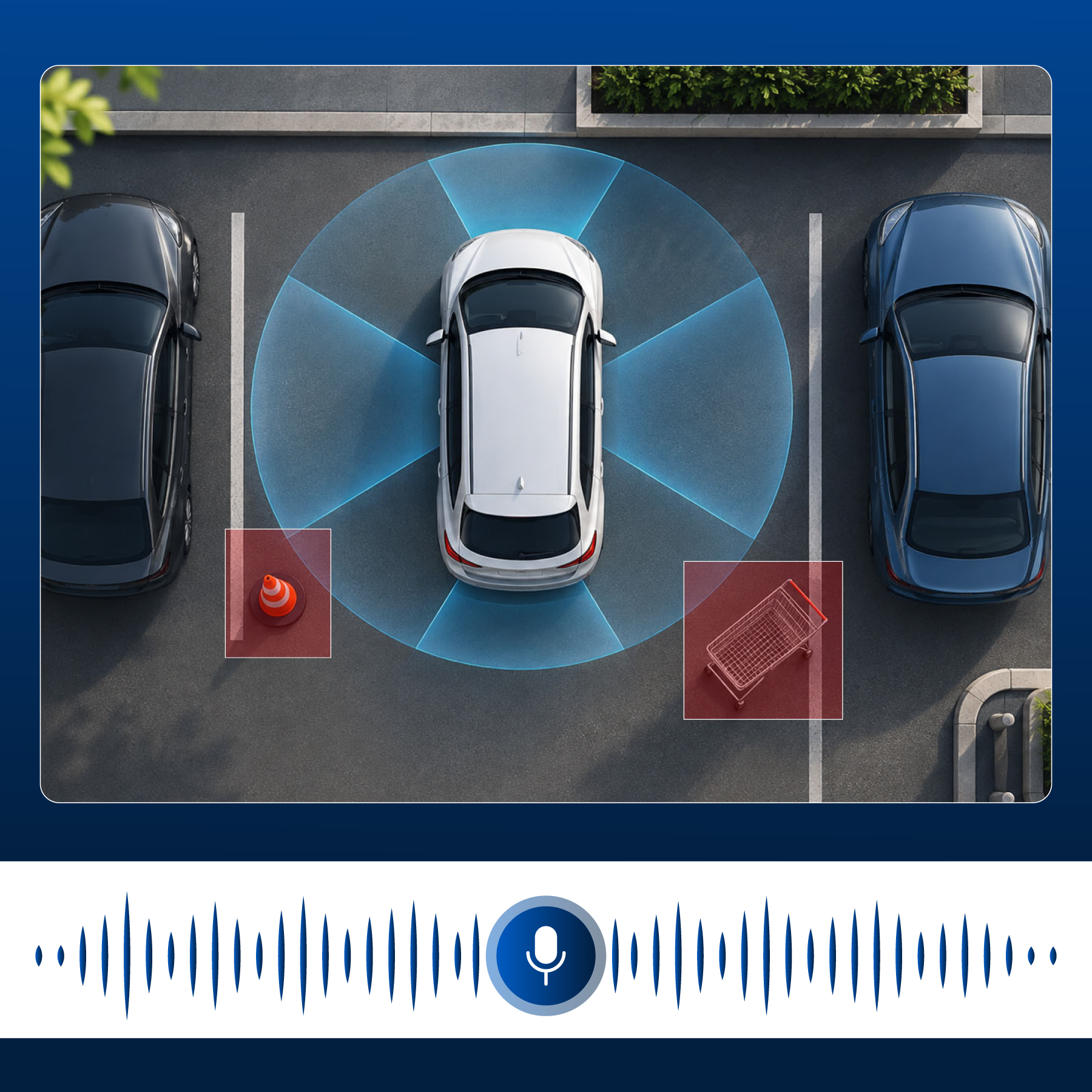
Mirrors and a backup camera cover only selected areas around a vehicle, leaving low obstacles, side zones, and nearby pedestrians harder to see during parking or tight maneuvers.
In this episode of Vision Vitals, we're exploring how umm surround-view cameras create a 360-degree view, how several camera feeds become one image, and which technical features keep that image useful.
Our embedded vision expert is here with us. Welcome back.
Thank you. Surround view is a good example of multiple cameras operating as one coordinated imaging system.
Host:
Ah, which blind zones are hardest for mirrors and a single rear camera to cover?
Expert:
They can miss low-ground obstacles, areas close to the sides of the vehicle, and objects near corners or wheels. Those gaps become umm more serious in dense traffic, narrow parking spaces, and locations with frequent pedestrian movement.
Surround-view cameras cover the front, rear, and sides and bring those angles into one centralized view.
Host:
How are the separate camera feeds turned into a single 360-degree image?
Expert:
Cameras are mounted around the vehicle, with each one capturing a specific angle. Their feeds are synchronized and processed by algorithms that merge and stitch the streams into one representation. This process umm continues as the vehicle moves, so the display reflects the changing positions of nearby objects.
Host:
FHmm, what goes wrong when the feeds are not synchronized closely enough?
Expert:
Well, movement captured at different times can create mismatched boundaries or a delay between the outside scene and the display. Incorrect camera alignment can also make stitched areas misleading. The system needs closely matched capture times, correct alignment, and immediate processing.
Host:
Where does that coordination make the greatest difference for the driver?
Expert:
Parking, reversing, and multi-point turns are common examples. The driver can see obstacles around the vehicle instead of estimating their location near a bumper, wheel, or side panel. The same view supports parallel parking, reverse parking, movement through confined spaces, and detection of approaching pedestrians while backing out.
Host:
Oh, what determines how clear and current that stitched view appears?
Expert:
Resolution and frame rate are major factors. High resolution reveals smaller obstacles and nearby details. A high frame rate keeps visual feedback current while the vehicle is moving. If the display lags, an object may already have changed position by the time the driver sees it.
Host:
And how should the system handle one camera facing sunlight while another faces a darker area?
Expert:
Mmm, High Dynamic Range helps balance those differences. HDR protects detail in bright and dark parts of the stitched image, supporting low-light scenes, nighttime driving, and direct sunlight. This is important because cameras mounted on different sides of a vehicle can face very different lighting at the same moment.
Host:
Uh, what kind of data connection is needed when several high-definition streams arrive together?
Expert:
High-speed interfaces such as GMSL or GigE transfer video to the processing unit with low delay. A surround-view system receives and stitches multiple streams continuously, so the interface must move that data without interruptions. Fast transmission keeps the display current during reversing, turns, and parking.
Host:
What protection do exterior cameras need against road and weather conditions?
Expert:
They need resistance to water, dust, road spray, dirt, heavy rain, and snow. IP67 or IP69K-rated enclosures support exterior use. This is errr especially important in a surround-view system because one unavailable camera creates a gap in the combined image.
Host:
Aha, how do platform compatibility and compliance affect vehicle integration?
Expert:
Platform support helps manufacturers integrate surround-view systems across different vehicle classes, from compact cars to large trucks. Compliance requirements also shape deployment. The source highlights ISO 11452, ISO 16750, ISO 13766, and umm ISO 14982 for electromagnetic compatibility, environmental resilience, and operational safety.
Host:
What should engineering teams check before finalizing a surround-view camera system?
Expert:
They should review camera placement, coverage, synchronization, alignment, resolution, frame rate, HDR, interface bandwidth, enclosure protection, platform support, and the required standards. Each item influences the quality and timing of the stitched view.
Host:
Er, what is the clearest way to summarize the safety value of the complete system?
Expert:
A surround-view system reduces blind zones by combining synchronized front, rear, and side images into one current view. Good imaging, fast data transfer, rugged protection, and compatible processing support keep that view usable during parking and other umm close-range maneuvers.
Host:
Thank you for sharing your expert views on this very interesting topic!
Expert:
It's my pleasure!
Host:
For details on what surround-view camera solutions we offer, please visit our website at e-consystems.com
You can also write to camerasolutions@e-consystems.com if you need any other information.
A big “thank you” to each of you for tuning in!
We'll continue the conversation in the next episode of Vision Vitals.
Close Full Transcript


 Mr. Thomas Yoon
 +82-10-5380-0313




 Employee Login