Welcome back to Vision Vitals from e-con Systems. Today we're looking at edge AI cameras in smart-city traffic enforcement. If a city wants to watch a restricted roadside zone, how can a camera move from simply recording vehicles to identifying activity that deserves review?
Of course, we have one of our camera experts to help us better understand this.
Thank you. Thrilled to be here. And yeah, the difference between recording and analyzing is really where edge AI changes the workflow. An onboard processor can examine information while the event is happening instead of treating every frame as something that has to be sent elsewhere first.
Host:
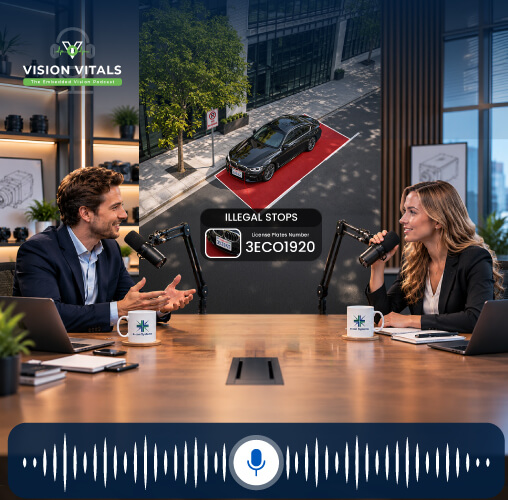
Let's put that into the context of a no-parking zone or an illegal stop. What does the camera actually have to understand?
Expert:
There are core capabilities behind that kind of traffic analysis. For instance, video analytics can work with defined detection zones, while AI models analyze vehicle motion, speed and direction in real time.
So in a restricted roadside application, those are the inputs the system can use to examine what a vehicle is doing within the monitored area.
Host:
Hmm. So the zone itself is critical since the system is not just looking at every vehicle anywhere in the frame?
Expert:
Right. Defined detection zones give the analysis a specific area of interest. Vehicle movement can then be assessed within that area. The important point is that the camera system has information about the vehicle's motion and direction rather than simply producing continuous footage.
Host:
And I assume that is where false-trigger filtering becomes important, right?
Expert:
Exactly. Onboard processors can validate multiple inputs before sending an event for review. That helps filter false triggers at the edge. In the case of a red-light camera, the AI examines traffic light state, motion, speed and direction.
The same edge-processing principle is useful when a traffic application needs to decide which activity inside a defined zone should move forward for review.
Host:
So is the edge AI acting as a first screening stage?
Expert:
Yes. And that has two practical effects. It reduces bandwidth load because every piece of raw information does not need to travel upstream for initial analysis, and it shortens review cycles because events can be pre-screened before they reach the central system.
Host:
Okay. Once an event has been identified, what information can be attached to it?
Expert:
Captured images can be time-stamped and geo-tagged. AI models can also classify vehicle type, confirm license plate validity and sort incident priority. That creates a much richer event record than a generic video clip.
Host:
That plate point seems particularly useful in enforcement.
Expert:
It is. License plate recognition systems can link plate information with databases, where flagged plates can generate alerts. From the imaging side, high pixel density helps keep plates visible, including under poor lighting or adverse conditions.
Host:
But this is happening on streets where vehicles may be moving or passing through different lighting conditions. Then, what keeps the evidence usable?
Expert:
Several camera features contribute. High-resolution imaging supports plate detail and post-processing tasks such as vehicle classification. Global shutter captures all pixels simultaneously, which prevents distortion when vehicles are moving quickly.
Infrared or visible strobes can illuminate vehicles during low-light incidents and synchronize with the shutter to freeze motion without overexposing the frame.
Host:
In that case, if the image attached to it is blurred or the plate can't be read, does the rest of the workflow become much harder?
Expert:
Totally. And camera calibration also has to stay correct. Periodic checks confirm that vehicles are captured at the intended point and that the recorded evidence remains usable for review.
Host:
What about connectivity? Smart-city systems sound very network-dependent, but streets are hardly controlled environments.
Expert:
That's why local storage is important. The camera system can preserve violation data locally if the network goes down, and then transfer it when connectivity returns. Redundant communication options include dual cellular channels or a combination of wired and wireless links.
Host:
So an interruption does not automatically mean the event disappears?
Expert:
Correct. And once the data moves upstream, open protocols such as ONVIF, HTTPS, FTP and REST APIs can connect the camera system with municipal traffic systems, ticketing databases and analytics dashboards.
Host:
There's also a human-review element here, right?
Expert:
Right. Incidents are reviewed by a human officer in many regions before an enforcement notice is issued. Edge AI can pre-screen events, classify information and reduce the amount of material that reaches reviewers. The final enforcement workflow still depends on how the municipal system is configured and the applicable requirements.
Host:
I suppose the intelligence at the edge is really about turning continuous traffic imagery into information-rich events?
Expert:
Yes. Defined zones focus the analysis. Motion, speed and direction provide real-time context. AI can validate inputs, classify vehicles and work with plate information. Local storage and connectivity then keep the event available for the systems and people that handle the next stage.
Host:
And that gives us a much clearer picture of what an edge AI camera contributes to monitoring restricted stopping areas. It is analyzing activity at the camera, filtering events and preparing the visual record for review rather than simply streaming everything upstream.
Thanks for sharing your insights, as always.
Expert:
Well, it's always a pleasure to be here!
Host:
You've been listening to Vision Vitals from e-con Systems.
If you're looking for the right camera for your smart traffic application, connect with our vision experts at camerasolutions@e-consystems.com.
We'll see you in the next episode.
Close Full Transcript


 Mr. Thomas Yoon
 +82-10-5380-0313




 Employee Login