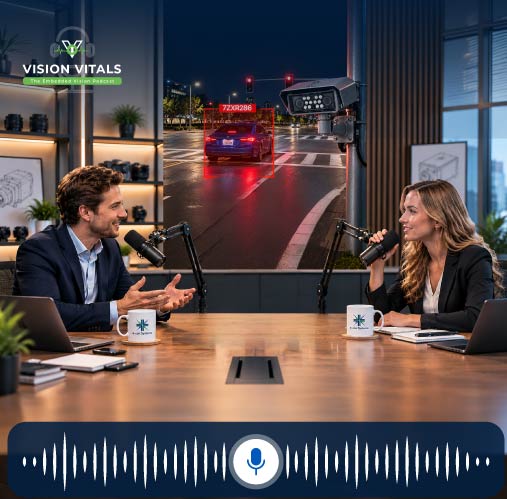
You're listening to Vision Vitals – e-con Systems' embedded vision podcast. Today, I've asked one of our camera experts to join me to help answer an important question. This is something drivers all over the world have probably wondered about after passing through a busy intersection. And it's something that product developers must understand.
What is a red-light camera seeing, and how does that image become usable evidence of a violation?
Thanks for joining me.
Glad to be here. Red-light enforcement is a good example of how demanding traffic imaging can be because of what the red-light camera is dealing with.
Host:
Let's start there. When we say "red-light camera," what are we actually referring to?
Expert:
It's a camera deployed at an intersection as part of an automated traffic enforcement system. Its role is to provide the visual information used to identify and document vehicles involved in red-light violations.
The camera needs to capture the vehicle clearly enough for the system to build a reliable event record. Depending on the deployment, that can include details such as the vehicle, its position within the intersection, and its license plate.
Host:
So the camera provides the visual evidence, while the larger monitoring system determines what that imagery means?
Expert:
Correct. That distinction is important. The camera provides frame-by-frame visual data to the traffic system. In red-light enforcement, the imagery supports automated observation and documentation of the event.
From the camera perspective, the challenge is making sure those frames contain usable information. A vehicle could be moving quickly through a wide intersection, another vehicle could partially block it, and lighting could vary considerably within the scene.
Host:
Now, if the system needs to identify one vehicle in a large intersection, how much does resolution affect the result?
Expert:
Quite a lot. Consider a camera looking over several lanes. The vehicle of interest may occupy a relatively small part of the complete image.
A 4K camera produces 3840 by 2160 pixels, giving each single frame a dense pixel grid. That provides enough spatial data to isolate individual vehicles and capture license plates while still monitoring activity over a wider area.
Host:
But red-light enforcement doesn't automatically mean 4K?
Expert:
No. A narrower enforcement zone may have different imaging requirements. If the camera covers a single lane or an intersection with a limited span, 1080p Full HD can provide sufficient image coverage and image quality.
The required resolution depends on how much area the camera needs to see and how much detail the surveillance system needs from that area.
Host:
I imagine field of view becomes part of that decision as well.
Expert:
Absolutely. At a large intersection, you may need a wide field of view to observe several lanes. But extending coverage creates another requirement. Vehicles near the edges of the image still need to remain sharp and distinguishable.
That's why resolution and field of view have to be considered together. Covering the intersection has limited value if the details necessary for enforcement become difficult to identify within that image.
Host:
And then the vehicle itself is moving. How do you keep that from turning into a distorted plate or a blurred car?
Expert:
Shutter type can play a major role. With a rolling shutter camera, different parts of the frame are captured at slightly different times. When a vehicle is moving quickly, that can introduce motion artifacts or frame distortion.
A global shutter sensor captures the entire frame at once. That makes it useful when the system needs clear images of moving vehicles or license plates that don't have the streaks or distortions associated with fast motion.
Host:
Okay. Now imagine the same intersection late in the afternoon. You have sunlight reflecting off a windshield, but another part of the road is under an overpass. What happens then?
Expert:
That's where HDR becomes important. Traffic scenes can contain very bright and very dark areas within a single frame.
HDR combines multiple exposures to balance those areas. That helps preserve visual information such as license plates, vehicle outlines, and road markings instead of losing them in bright glare or deep shadow.
Host:
So even with plenty of resolution, poor exposure could still leave the system with weak evidence.
Expert:
Exactly. High resolution by itself doesn't determine traffic camera performance. The image has to remain usable under the conditions found at the intersection.
Sensor size can contribute here as well. A large-format sensor combined with high-definition output helps preserve image information when outdoor lighting fluctuates. It can also support sharper capture when vehicles are moving or partly obstructed.
Host:
What changes once the sun goes down?
Expert:
Low-light sensitivity becomes much more important. Red-light enforcement and traffic monitoring continue at night, including in zones with limited artificial lighting.
A camera with high sensitivity under low illumination can continue producing usable images in those conditions. That helps the traffic system keep visual records throughout the day and night.
Host:
So, if we follow the complete process from the camera's side, it's recording the intersection continuously, preserving the vehicle within that larger scene, and providing the frames needed to document the event.
Expert:
Yes. And each imaging feature addresses a different part of that job. Resolution preserves detail. Field of view determines how much of the intersection can be observed. Global shutter helps with fast motion. HDR deals with strong lighting differences, while low-light sensitivity supports nighttime operation.
Those factors come together to provide the visual data that the traffic enforcement system needs for a reliable record.
Host:
Does this also explain why simply putting a high-megapixel camera at an intersection doesn't settle the problem?
Expert:
Absolutely. The camera has to suit the actual traffic scene. A multi-lane intersection and a single-lane enforcement point place different demands on coverage. Vehicle speed changes the motion requirements, while the location and time of operation influence lighting requirements.
Host:
That gives us a much clearer picture of what the camera contributes to red-light enforcement.
Thanks for walking us through it.
Expert:
Thanks. It was great talking about it.
Host:
And thanks to everyone out there for listening to this episode of Vision Vitals from e-con Systems.
If you're evaluating cameras for traffic enforcement or other smart traffic applications, please visit e-consystems.com.
You can also connect with our vision experts by writing to camerasolutions@e-consystems.com.
See you in the next episode, folks!
Close Full Transcript


 Mr. Thomas Yoon
 +82-10-5380-0313




 Employee Login