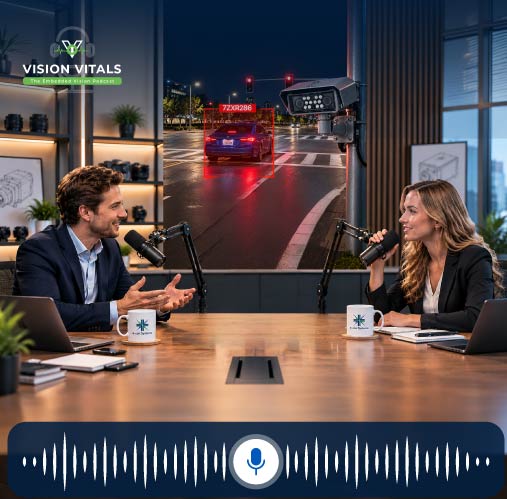
Welcome to Vision Vitals, the e-con Systems podcast where we unravel the imaging technologies behind applications. I'm joined today by one of our camera experts from e-con Systems.
I want to start today's episode at a literal and metaphorical intersection! After all, managing traffic involves a lot more than simply watching vehicles go by.
We hear about red-light cameras, traffic sensors, radar and video analytics. Are these different ways of doing the same job, or are they solving different parts of the problem?
Yes, they are looking after different aspects of it. In the case of a red-light enforcement system, the sensor section is mainly responsible for detecting the position and movement of vehicles. The camera section, on the other hand, records the visual evidence, which acts as a record of the incident.
Although they can seem similar, their roles are different.
Host:
So if a vehicle approaches a stop line after the signal turns red, what happens first?
Expert:
The process of detection may start using sensors, radar or laser units situated close to the stop line; these devices monitor the vehicle's position and the way in which it is moving after the signal phase has turned red. The triggering logic is linked to the traffic signal controller, enabling the system to correlate the vehicle's position with the actual state of the signal.
Host:
Right. And that correlation is what separates a normal vehicle movement from a possible violation?
Expert:
Certainly so. In the case where the vehicle goes over the stop line while the light is red, the system has the capability to start taking images, which is exactly where the camera plays a key role. Generally, most setups make use of two camera views, one of which captures the front of the license plate and the other shows the position of the vehicle in the intersection.
Some systems also maintain a video buffer that starts slightly before the trigger, which gives reviewers context around the event.
Host:
Hmm. That means a traffic sensor does not replace the need for visual evidence?
Expert:
Yes, that's right. In order to carry out enforcement action, there must be a record that can be examined. The images captured can be given a timestamp, include a geographic tag and be linked to the state of the traffic light. In a number of areas, human review takes place before an enforcement notice is issued.
The sensor provides the information that serves as the trigger. The camera offers the imagery, which supports the review.
Host:
Where does video analytics fit?
Expert:
That's another important distinction. A red-light camera system can integrate with in-ground loop sensors, radar or virtual triggers based on video analytics. Each input channel can track vehicle motion through defined detection zones. So the trigger does not always have to come from a physical sensor in the road.
Host:
Okay, that makes the line between the two sound a little less rigid!
Expert:
It does, especially once edge processing enters the system. Onboard processors can validate multiple inputs and filter false triggers before an event is sent for review. AI models can analyze the traffic light state along with vehicle motion, speed and direction in real time. So, yeah, the camera system can do far more than simply record whatever another device tells it to record.
Host:
Then when would you still want both a camera and a separate traffic sensor?
Expert:
When the deployment benefits from multiple trigger sources. Multiple inputs can improve detection consistency for different intersection geometries. A physical sensor or radar can contribute vehicle-position and motion information, while the imaging system records the incident and adds visual context.
Edge AI can then validate those inputs before the event moves further into the enforcement workflow.
Host:
And the camera itself still has to cope with a pretty difficult scene.
Expert:
Absolutely. A trigger is useful only if the resulting evidence is usable. High-resolution sensors such as 5MP or 8MP devices can capture plate detail from moving vehicles. Global shutter is important because all pixels are exposed simultaneously, which prevents the skew that can appear with fast motion. Infrared or visible strobes can also be synchronized with the shutter for low-light incidents.
Host:
So there's really a chain here. Detect the movement, relate it to the red phase, capture the vehicle and then make sure the image is good enough to review.
Expert:
Yes, and calibration is critical throughout that chain. Camera angles, trigger timing and sensor alignment have to remain correct so the vehicle is captured at the right point of violation. Periodic checks also help confirm that the recorded evidence remains suitable for the enforcement process.
Host:
What happens after the event is captured?
Expert:
The images can be stored locally and then sent to a central enforcement server or cloud platform. Local storage is especially useful if network connectivity drops because it can buffer the violation data until the connection returns. Systems may also use redundant communication links.
Onboard AI can classify the vehicle, confirm license plate validity and sort incident priority before the event reaches the review stage.
Host:
Ah, so the useful comparison is less 'camera versus sensor' and more 'what information does each component contribute?'
Expert:
That's a good way to look at it. Sensors, radar and virtual triggers can contribute detection information. The camera records visual evidence. Edge processing can validate the event and reduce false triggers. When those elements are combined, the system can connect signal state, vehicle movement and imagery within one enforcement workflow.
Host:
And that answers the second half of the question too. You need both when the intersection calls for complementary trigger information and visual evidence rather than expecting one device to do every job.
Expert:
Well summarized!
Host:
Well, folks, that's it for this episode of Vision Vitals. Thanks to our camera expert for breaking down where traffic sensors stop, where imaging begins and why the two can work together in red-light enforcement.
If you're looking for the right camera for your traffic application, connect with the vision experts at e-con Systems at camerasolutions@e-consystems.com.
Thanks for listening.
See you in the next episode!
Close Full Transcript


 Mr. Thomas Yoon
 +82-10-5380-0313




 Employee Login