Welcome to Vision Vitals from e-con Systems.
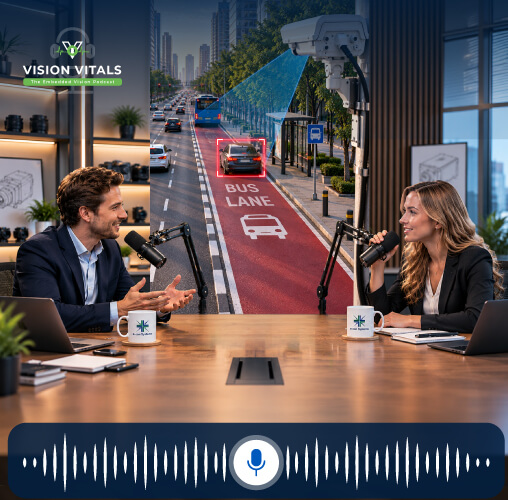
Bus lanes may be clearly marked, yet enforcement has to cover a far wider area than a painted strip of road. I have one of our camera experts with me today to look at the imaging side of that problem.
When a city wants continuous coverage along an entire corridor, what makes vision-based bus lane enforcement workable at that scale?
Several parts have to work together. Bus lane enforcement regulates access to dedicated lanes so authorized vehicles can use them. Scheduled buses and emergency services are typical examples.
In some cities, cyclists or taxis with specific permits may also have access. The vision system then has to identify a vehicle and classify its type. It also has to establish the vehicle's position against the lane boundary before creating evidence tied to that vehicle.
Host:
So where does that process begin? Is the camera continuously watching the lane?
Expert:
It can be. A roadside camera or a bus-mounted movable camera captures footage either continuously or through motion-based triggering. That video goes to an edge AI vision box. The AI identifies vehicles in the frame, classifies them and maps their position against the lane boundaries.
Once the system determines that an unauthorized vehicle has entered the bus lane, the event can be logged and an evidence package sent to the backend management system.
Host:
Hmm, and doing the analysis at the edge seems important when you have vehicles passing through quickly.
Expert:
Very much so. Edge processing keeps latency low because the initial decision can happen locally instead of waiting for video to travel to a centralized cloud server. The vision box runs the detection and classification stages on the unit, followed by the violation logic. In high-throughput traffic, a vehicle may remain in the relevant area for only a few seconds, so local processing helps the system act within that brief window.
Host:
Detecting the wrong vehicle in the lane is one part of it. How do you connect that violation to a specific vehicle?
Expert:
That is where ANPR or ALPR comes in. High-resolution cameras work with onboard OCR software to read the license plate in real time. The sequence includes vehicle detection, license plate detection, plate recognition, vehicle classification and the violation decision.
After the plate has been converted into machine-readable text, it can be checked against a database of authorized vehicles. If there is no exemption, the system can generate an enforcement record.
Host:
What actually goes into that record?
Expert:
The evidence package includes a high-resolution image of the license plate, the plate number in text form, the exact date and timestamp, and location metadata associated with the camera unit. That information can be transmitted to a remote server for traffic authorities.
Local buffering in the edge unit also preserves records during a temporary network interruption, so a temporary connectivity issue can occur without automatically losing the event.
Host:
Okay. How does that setup expand from one location to a long urban route?
Expert:
Fixed roadside poles are the established option, with camera height and angle selected around plate legibility. Another approach uses existing traffic signals or streetlights as mounting points. Since those structures already appear at regular intervals along urban roads, attachment can reduce civil work.
Automatic vehicle detection also removes the need for in-road sensors, eliminating excavation.
Host:
How does the distributed model work along the corridor?
Expert:
Yes. Units can be placed at multiple points along a bus corridor. Some configurations combine bus-mounted cameras with fixed intersection cameras, so detections can be cross-verified and coverage can extend along the route. This gives authorities continuous visibility over a larger section of the corridor.
Host:
City streets are messy, though. What tends to challenge the vision system after it leaves an ideal test scene?
Expert:
Occlusion is a major issue. A larger vehicle can block the view of a smaller one, and even slight ambiguity near the boundary between a bus lane and a general traffic lane can affect a violation decision. Multi-angle coverage and overlapping camera placement can help when drivers or other vehicles obstruct the view.
Host:
Lighting must create another set of problems.
Expert:
It does. Headlight glare, reflections from wet roads and direct sunlight can reduce the image quality needed for plate reading. HDR and active infrared illumination can help deal with those conditions. Night operation can also use optional IR capability, depending on the deployment.
Host:
What happens during rush hour when the system is dealing with several vehicles?
Expert:
Peak traffic creates a processing challenge because multiple vehicles may need to be tracked and classified simultaneously. That can make violation detection harder and may introduce processing delays.
Host:
Ah, city scale means keeping that entire workflow dependable while the operating conditions keep changing.
Expert:
Yes. Detection has to remain dependable throughout the corridor. The same applies to vehicle classification and lane-position assessment. Plate recognition and evidence handling also have to continue under occlusion or difficult illumination.
Peak traffic adds processing pressure, while concealed plates create another practical problem. Automated enforcement can then overcome the geographic and time limits of relying on people at individual locations.
Host:
Which gives authorities corridor-wide visibility around the clock.
Expert:
That's the practical advantage. Vision-based systems can detect violations regardless of staffing levels or time of day throughout the corridor. The intended result is fewer unauthorized intrusions into bus lanes, better support for bus schedules and broader visibility into violations without a proportional increase in enforcement overhead.
Host:
How can that edge processing work when several camera views cover a bus corridor?
Expert:
Darsi Pro from e-con Systems is one example. This Edge AI compute box, based on NVIDIA Jetson Orin NX, supports up to eight GMSL2 cameras. e-con Systems has demonstrated it powering an Edge AI ALPR solution for real-time traffic monitoring and enforcement. In a bus lane setup, it connects roadside camera feeds with traffic analysis and ALPR.
Host:
That makes the scale question much clearer. The camera captures the lane, edge AI handles the immediate analysis, ANPR or ALPR identifies the vehicle, and the evidence reaches the backend for enforcement. Thanks for taking us through the full chain.
Expert:
Glad we could dig into it.
Host:
This has been Vision Vitals from e-con Systems. If you're looking for the right camera for a smart traffic application, connect with our vision experts at camerasolutions@e-consystems.com.
As always, thanks for listening.
Catch you on the next episode!
Close Full Transcript


 Mr. Thomas Yoon
 +82-10-5380-0313




 Employee Login