Welcome back to Vision Vitals, where we explore the embedded vision technology that's making our world safer and smarter. I'm your host, and today we're hitting the road—literally! We're talking about one of the most widespread and, let's be honest, sometimes misunderstood pieces of vision tech out there: the speed camera.
We see them on highways, in school zones, on city streets… but how do they actually work? And more importantly, how do they tangibly make our roads safer? It's not just about issuing tickets; there's a whole system of detection, data, and… behavior change at play.
To help us understand the tech behind speed cameras, I'm joined by our embedded vision expert. Welcome back.
Thanks for having me. It's a great topic. Umm… you know, when people think of speed cameras, they often just think of a flash and a fine. But under the hood, it's fascinating. And really sophisticated, as well. It's an example of real-time machine vision doing a critical public safety job.
Let's start there, under the hood. In simple terms, how does a modern speed camera system actually work? What's happening from the moment a car approaches to the moment… well, an email gets trigerred with a ticket?
Speaker:
Yeah, that's right. So, the core task is deceptively simple: accurately measure a vehicle's speed and, if it's over the limit, get a legally admissible image. But doing that reliably 24/7, in rain, shine, or low light… that's where the engineering comes in.
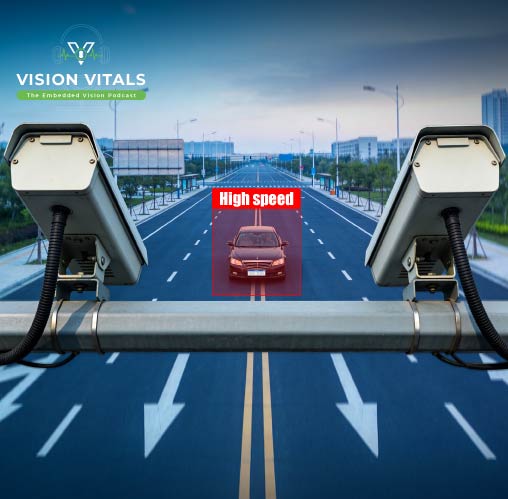
Basically, the system is continuously monitoring. Using sensors, often radar or LiDAR initially to detect presence and measure speed, it identifies a vehicle that's exceeding the threshold. That's the trigger. Then, a high-resolution global shutter camera module activates.
Host:
And “global shutter,” that's important here, right? Because cars are moving fast.
Speaker:
Exactly. A rolling shutter would cause skew, you know, where fast-moving objects look kind of bent. A global shutter captures the entire frame at once, so the license plate and vehicle are crisp and clear, even at high speed.
Umm… the system captures a sequence of images or a short video clip. This isn't just a picture; it's evidence. The image is stamped with crucial metadata: the exact time, GPS location, measured speed, lane… all embedded right into the frame.
Host:
So the image has the story embedded right into it. But then it has to read the story, too. The license plate, right?
Speaker:
That's right. That's where onboard processing often comes in. Optical Character Recognition, or OCR, software automatically extracts the license plate number from the image. Then, that data packet, which includes the images and the violation data, is securely sent to a central server for the authorities. The whole process, from detection to data transmission, is automated.
It's… you know, a perfect example of an edge AI vision system: sensing, processing, and acting locally and in real time.
Host:
That makes sense. So the technology itself is a deterrent. But let's talk about outcomes. From your perspective, what are the key ways this technology actively creates safer roads, beyond just the fear of a ticket?
Speaker:
Umm, well, the most direct one is reducing excessive speed. It's a behavioral thing. The consistent, automatic presence of a camera changes driver habits. People see them, or know they're there, and they ease off the accelerator.
It's a constant visual reminder of the rules. And studies consistently show that in camera-enforced zones, average speeds drop, and the number of extreme speeders… well, it plummets.
Host:
So this could logically lead to fewer accidents?
Speaker:
That's the second big point, absolutely. Speed is a massive factor in both the likelihood and the severity of a crash. By lowering speeds, you directly lower the risk of accidents, especially fatal ones.
The kinetic energy in a collision increases dramatically with speed. So, even small reductions in average speed can lead to a significant drop in serious injuries and fatalities. The cameras are addressing the root cause.
Host:
It's interesting because it's not just about punishing bad behavior, but about creating a calmer, more predictable traffic environment overall.
Speaker:
Yes, and that's a great way to put it. Which leads to another benefit: enabling better traffic flow. It sounds counterintuitive: slower speeds meaning better flow? But think about it. When everyone is driving at a consistent, legal speed, you have fewer panic brakes and fewer aggressive lane changes.
Traffic becomes more uniform and steady. This reduces the stop-and-go waves that cause congestion, making the whole system more efficient and, frankly, less stressful for everyone.
Host:
That's a point I hadn't fully considered. You're also freeing up law enforcement resources, right?
Speaker
Oh, for sure. That's a huge operational benefit. By automating the basic, but time-consuming, task of speed monitoring, it supports law enforcement. Police officers can then focus on things that absolutely require a human presence: impaired driving, reckless aggression, and criminal patrol.
The camera handles the routine violation, allowing officers to focus on complex, high-risk situations.
Host:
And all these cameras are generating a ton of data. Is data valuable beyond just issuing tickets?
Speaker:
Incredibly valuable. This is a big one. These systems are essentially a massive, always-on traffic data network. They log volumes, speeds, patterns—transforming traffic data into insights. City planners and traffic engineers can use this data to see where near-misses might be happening, where congestion builds, where road design might need changing.
It allows for proactive, data-driven decisions about everything from traffic light timing to where to put a new crosswalk. Basically, the camera becomes a sensor for smart city planning.
Host:
And I suppose in the event of an incident, that time-stamped, geo-tagged image is a powerful piece of objective evidence?
Speaker:
Exactly. It can provide insurance or legal evidence to reconstruct events clearly. Establishing the precise speed of a vehicle at a specific moment can be crucial for investigations. It removes the "he said, she said" and provides factual, visual data.
Host:
So, pulling it all together… for our listeners who are system integrators or developers working in smart traffic or public safety, what should they be looking for at the hardware level when architecting an effective speed camera system?
Speaker:
Umm, that's a great final question. You need to start with a foundation of reliability. The camera module itself is critical. You need high resolution for plate readability at distance, a global shutter to eliminate motion blur, and excellent low-light performance for 24/7 operation.
The quality of the sensor, like the Sony Pregius S, is key for clean, low-noise images in challenging light.
Then, the processing backbone has to be robust enough to handle the real-time AI tasks, such as the detection and the OCR, often at the edge. It needs to be an industrial-grade system built for constant operation in variable weather.
Remember - it's not a consumer webcam; it's a mission-critical vision sensor. The goal is to create a system that authorities can trust to be accurate and unwavering, because public safety literally depends on it.
Host:
It's clear there's a lot more to these ubiquitous cameras than meets the eye. They're a critical part of modern traffic management and a powerful tool for saving lives through technology.
Thank you for breaking down the how and the why behind speed camera tech for us today.
Ultimately, this empowers teams to focus on application logic and deployment rather than infrastructure assembly.
Speaker:
My pleasure. It's always rewarding to talk about vision systems that have such a direct, positive impact on everyday safety.
Host:
And that's it for this episode of Vision Vitals. We've seen how speed cameras are far more than simple enforcement tools. They're data-gathering, behavior-influencing, life-saving pieces of embedded vision.
Thanks for listening. Until next time, and well, drive safely!
You can find more details about reliable speed cameras on e-con Systems' website.
If you'd like to learn more about how this kind of vision solution can help your team and your customers, please drop us a line at www.e-consystems.com.
We'll see you next time on Vision Vitals!
Close Full Transcript


 Mr. Thomas Yoon
 +82-10-5380-0313




 Employee Login