And we’re back once again with Vision Vitals – your go-to wormhole to dive into the world of embedded vision.
In today’s episode, we’re focusing on a topic about the very beginning of every Edge AI vision system’s lifecycle.
Edge AI vision deployments often operate far from controlled environments. They run in vehicles, factories, public infrastructure, and remote sites. In these conditions, trust starts long before applications load or inference begins. It starts at boot.
Our vision expert joins us to explain why Secure Boot plays such a big role in protecting Edge AI vision deployments, especially on Jetson-based platforms.
Happy to be here. What makes Secure Boot so interesting is that it tends to stay invisible when it works, yet it shapes everything that follows in an Edge AI system.
When Edge AI vision systems move out of controlled labs and into the field, what changes about their security exposure at power-on?
Speaker:
Once a system leaves the lab, physical access becomes a real factor. Devices may sit in unattended locations, inside vehicles, or within shared industrial spaces. Power cycling, storage access, or firmware replacement attempts become possible.
At power-on, the system has zero context about what code sits on storage. If that moment lacks protection, modified firmware or kernels can take control before any runtime safeguards activate.
Field deployment shifts the threat surface from theoretical to practical. That makes the very first execution step a point of high risk.
Host:
Why does the boot sequence represent such a fragile moment for an Edge AI vision device?
Speaker:
The boot sequence determines which software gains authority over hardware. Firmware configures memory, initializes peripherals, and sets the environment where the operating system and AI workloads later run.
If an untrusted component loads during boot, it gains deep access.
After the control is transferred to compromised code, recovery becomes extremely difficult. The system starts from an unsafe foundation.
Host:
How does Secure Boot shift security enforcement earlier than runtime protections or application-level checks?
Speaker:
Secure Boot enforces trust before execution begins. Each stage verifies the integrity and authenticity of the next stage prior to handing over control.
Rather than reacting to suspicious behavior after startup, the system prevents execution altogether when verification fails. That approach blocks threats at the earliest possible point. This early enforcement reduces reliance on runtime defenses, which operate after damage may already occur.
Host:
BootROM code resides directly inside the silicon. It remains unchanged throughout the device’s lifetime. That immutability makes it a reliable trust anchor.
Speaker:
At power-on, BootROM verifies the first bootloader stage using cryptographic checks tied to hardware-stored keys. Only verified code gains execution rights. Since BootROM sits below all updatable software, it forms the root of the trust chain.
Host:
As the system progresses through MB1, MB2, and UEFI, how does validation persist across each handoff?
Speaker:
Each stage validates the next one before transferring control. MB1 verifies MB2. MB2 verifies UEFI. UEFI then validates the kernel and boot-critical binaries.
Every handoff depends on successful cryptographic verification. A single failure stops the boot process immediately. This chained validation ensures continuity of trust from silicon all the way to the operating system.
Host:
On NVIDIA Jetson Orin NX and Orin Nano, how do silicon fuses and key hashes lock execution to approved binaries?
Speaker:
Public key hashes get stored in hardware fuses during production. These fuses define which signing keys the platform accepts.
When Secure Boot runs, the system compares signatures against those fused references. Code signed with any other key fails verification.
With fuses all set, execution remains bound to approved binaries, even under physical access or storage replacement attempts.
Host:
How does the platform key hierarchy govern which firmware, drivers, and kernels may execute?
Speaker
The hierarchy starts with a Platform Key that establishes overall trust. Key Exchange Keys then manage updates to the signature databases.
Signature databases define which binaries the system accepts or rejects. The structure supports controlled updates while preserving trust boundaries. Through this hierarchy, the platform maintains flexibility without surrendering execution control.
Host:
What operational outcome occurs when a single component fails verification during startup?
Speaker:
Basically, the boot process halts immediately. Execution stops before compromised code can interact with hardware or memory.
While that may appear disruptive, it protects the system from entering an unsafe state. From a deployment perspective, a halted device proves safer than a silently compromised one. Such behavior signals a clear integrity violation that operators can investigate.
Host:
For Edge AI vision systems that receive field updates, how does Secure Boot preserve firmware continuity and block unsafe rollback paths?
Speaker:
Secure Boot accepts updates only when they carry valid signatures tied to the authorized keys. Older or altered firmware images lack acceptance after the keys or policies change.
This prevents rollback to vulnerable versions and keeps updated paths consistent. OTA workflows remain controlled from power-on through runtime. For long-lived Edge AI vision deployments, that continuity protects both system behavior and deployed AI workloads.
Host:
Finally, how does e-con Systems approach Secure Boot when delivering Edge AI Vision Box deployments for real-world industries?
Speaker:
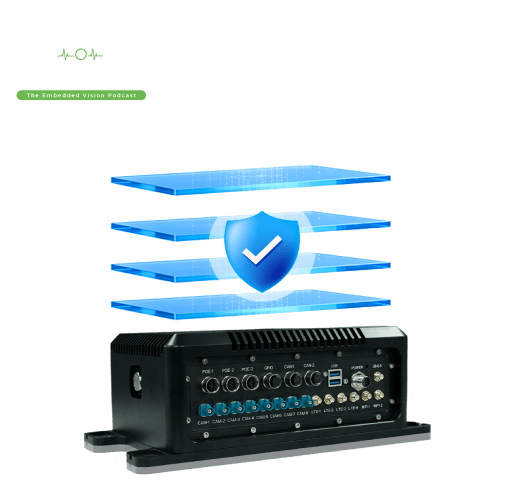
e-con Systems brings long-term experience in OEM camera development into the way security gets handled at the system level. Darsi Pro, our newest Edge AI Vision Box, reflects that by treating Secure Boot as part of the validation pipeline rather than a later software add-on.
From camera module selection through driver integration and image processing readiness, security checks remain aligned with system bring-up. For deployments spanning mobility, ITS, retail, and industrial automation, this approach gives a tighter path from integration to deployment, with startup trust embedded directly into the platform lifecycle.
Host:
And that brings us to the close of today’s episode of Vision Vitals.
Secure Boot may operate quietly at startup, yet it defines whether Edge AI vision systems begin life in a trusted state. By anchoring execution to hardware-rooted trust, it becomes possible to protect firmware, sensors, and AI workloads before inference even begins.
Thank you for joining us. We look forward to continuing these conversations around building dependable vision systems in the next episode.
You can explore the full specifications and deployment details of Darsi Pro on e-con Systems website.
For deeper technical discussions or integration queries, please reach out to us by writing to www.e-consystems.com.
That’s all folks – catch you in the next episode!
Close Full Transcript


 Mr. Thomas Yoon
 +82-10-5380-0313




 Employee Login