Welcome, folks, to Vision Vitals, your virtual hangout for grounded conversations around embedded vision systems.
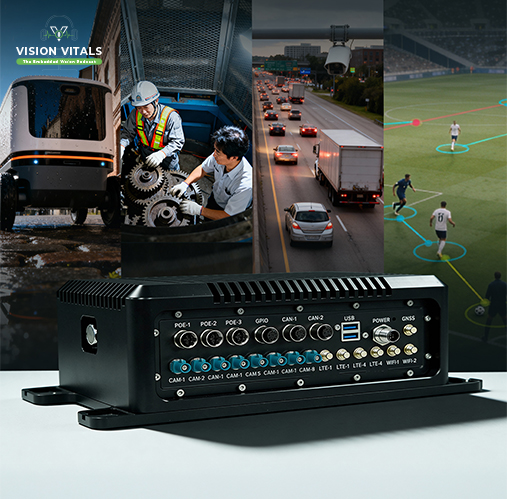
TToday's episode looks at how AI Vision Boxes move beyond demos and specs, and into real deployments. We focus on their major applications - including autonomous mobile robots, intelligent transportation systems, surveillance systems, sports broadcasting systems, and industrial automation systems.
To offer expert insights into where AI Vision Boxes actually fit, I'm joined by our resident imaging expert.
As always, it's a pleasure to contribute to Vision Vitals. This is a useful topic because AI Vision Boxes tend to show their value only after systems leave the lab and start operating continuously.
Firstly, how should teams understand the role of an AI Vision Box at an application level?
Speaker:
At an application level, an AI Vision Box acts as the perception backbone for systems relying on sustained visual input. These systems usually combine multiple cameras, LiDAR, other sensors, and AI workloads, which run for long durations.
Instead of stitching together separate compute units, camera interfaces, and synchronization logic, teams use one consolidated unit to handle vision intake, processing, and connectivity in the field.
The consolidation matters once applications face real motion, changing lighting, and long operational cycles.
Host:
Let's kick-start the application talk with Autonomous Mobile Robots. Where does an AI Vision Box fit into AMR use cases?
Speaker:
AMRs depend heavily on vision for navigation, mapping, and obstacle detection. In warehouses or semi-structured environments, robots rely on multiple camera viewpoints to understand space and movement.
An AI Vision Box supports those multi-camera pipelines by processing synchronized video streams in real time. It supports visual SLAM, free-space detection, and object recognition tasks. The key use case benefit is sustained perception. Robots maintain a consistent, low latency environmental understanding even as lighting changes, perception load increases or traffic rises.
Host:
And how does it extend into delivery robots and warehouse vehicles?
Speaker:
Delivery robots and warehouse forklifts rely on similar perception stacks but operate in tighter spaces or mixed indoor and outdoor routes. Vision supports pallet detection, surround-view monitoring, and safety-focused functions.
An AI Vision Box handles multiple camera feeds while running AI workloads that track obstacles and adjust routes. This helps vehicles maintain predictable movement even when conditions change, such as glare near loading bays or motion near busy zones.
The result is safer operation and smoother task execution during long shifts.
Host:
Moving into Intelligent Transportation Systems, how do AI Vision Boxes support smart city deployments?
Speaker:
ITS applications depend on continuous visual analysis of roads and intersections. The cameras capture vehicle flow and lane usage, providing inputs to adaptive traffic signal control systems. An AI Vision Box processes these feeds at the edge, enabling applications such as traffic analytics, adaptive signal control inputs, and automated monitoring.
Since processing happens locally, systems react faster and rely less on centralized infrastructure. For cities, this supports scalable deployments where multiple intersections or corridors operate under the same vision architecture.
Host:
Traffic scenes shift second by second, right? Is this why ITS deployments must rely on AI Vision Boxes?
Speaker:
Traffic scenes are highly dynamic, which means that vehicles move at varying speeds, lighting changes throughout the day, and outdoor conditions introduce constant variability. AI Vision Boxes are designed to process multiple high-bandwidth camera streams and run AI inference reliably under these conditions.
By maintaining consistent throughput even during peak traffic periods, they ensure analytics remain accurate and dependable, especially when outputs drive enforcement actions or traffic planning decisions.
Host:
Surveillance systems already rely on cameras heavily. How does AI Vision Boxes change the equation?
Speaker:
Traditional surveillance focused on recording. Modern systems rely on real-time analysis.
AI Vision Boxes support dense camera layouts and run analytics directly at the edge. They enable use cases such as event detection, activity analysis, and continuous monitoring in both indoor and outdoor settings.
With rugged hardware and long-duty operation, surveillance systems remain active in environments where uptime and reliability matter more than short bursts of performance.
Host:
Since surveillance systems rarely get shut down, do their continuous operations influence the choice of an AI Vision Box?
Speaker
Absolutely. Surveillance systems often run around the clock. Heat, dust, and vibration become constant factors.
An AI Vision Box supports those conditions by handling sustained workloads without frequent intervention. Analytics remain active over long periods, which supports consistent monitoring and reduces gaps in coverage.
Host:
Now, how are AI Vision Boxes used in live sports broadcasting systems?
Speaker:
Sports broadcasting systems rely on multiple synchronized camera angles and fast-moving scenes. AI supports applications such as player tracking, motion analysis, and enhanced viewing experiences.
An AI Vision Box processes synchronized camera feeds in real time, which helps maintain alignment during rapid motion. It supports analytics and broadcast enhancements that depend on timing consistency. Edge processing also reduces latency, which matters during live events where delays affect production workflows.
Host:
Turning to industrial automation, how do AI Vision Boxes boost factory environments?
Speaker:
Industrial automation uses vision for inspection, safety monitoring, and process tracking. Cameras observe fast-moving equipment, varying materials, and changing lighting conditions.
AI Vision Boxes support these use cases by handling global shutter imaging, HDR scenes, and multi-camera setups. AI workloads run continuously, analyzing visual data during production cycles. Their rugged form factor is well suited for factory environments where dust, vibration, and temperature variation remain constant.
Host:
Across all these industries, multi-sensor fusion keeps appearing. Why does it matter so much at the application level?
Speaker:
Applications rely on perception accuracy. When camera and sensor data align temporally, systems interpret scenes correctly. AI Vision Boxes support structured input streams where timing remains consistent. It benefits navigation in robots, analytics in traffic systems, and inspection in industrial setups.
Once timing aligns, AI models operate closer to how they were trained, which improves real-world behavior.
Host:
Before we close, how does e-con Systems' Darsi Pro fit into these application-driven discussions around AI Vision Boxes?
e-con Systems' Darsi Pro was created with these applications in mind. It brings multi-camera support, synchronized sensor handling, and AI-ready processing into one unit. For teams working on AMRs, ITS, or industrial automation, it reduces integration friction. Instead of assembling separate components, they start with a platform that supports real-world vision workloads from the outset.
Ultimately, this empowers teams to focus on application logic and deployment rather than infrastructure assembly.
Host:
And that closes today's episode of Vision Vitals.
As vision systems scale into real deployments, several applications will start relying more on consistent perception and sustained AI processing - leading to the growing popularity of AI Vision Boxes.
If you want more information on Darsi Pro and its use cases, detailed information is available on www.e-consystems.com.
If you want to discuss system architecture, integration paths, or application fit, our team can be reached at camerasolutions@e-consystems.com
Thank you for listening. We'll be back soon with the next episode of Vision Vitals!
Close Full Transcript


 Mr. Thomas Yoon
 +82-10-5380-0313




 Employee Login