Welcome to e-con Systems' Vision Vitals, where we break down how embedded vision systems work in the real world.
Today's episode looks at a question that keeps surfacing across robotics, mobility, and automation programs. What exactly is an Edge AI compute box, and why has it become such a central part of modern vision systems?
We'll walk through what defines an AI Vision Box, the pressures pushing industries toward it, and why unified vision platform keeps replacing fragmented setups
We've brought in a vision specialist to break down what drives these AI vision boxes and why the world of embedded systems needs them.
Speaker:
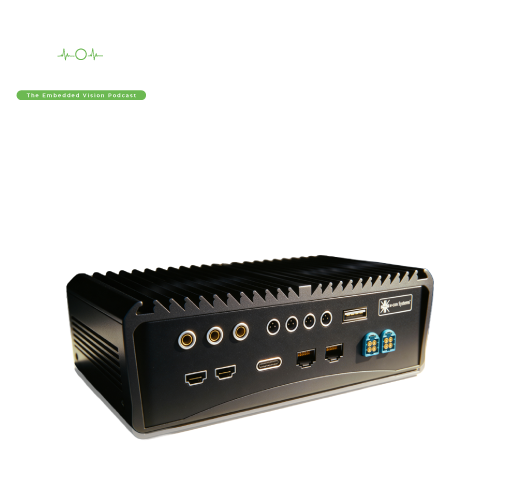
An Edge AI compute box is a single unit that brings edge AI compute, camera interfaces, and sensor connectivity into one rugged enclosure. It brings processing closer to where visual data is generated, so perception tasks happen directly on the device. Vision pipelines run locally, supporting real-time analysis in environments where response time and system reliability matter.
The box functions as the perception core for systems that depend on continuous imaging, synchronized camera inputs, and sensor fusion in deployed environments. It supports workloads such as object detection, tracking, and scene interpretation while remaining physically close to the cameras and sensors capturing data.
In real deployments, the compute box becomes the central point where perception logic lives. Camera feeds, sensor signals, and inference workloads converge inside a single system, which simplifies timing, coordination, and processing flow. This setup suits applications where predictable response and uninterrupted operation matter more than centralized processing.
Host:
Why did traditional camera-plus-compute setups start causing friction?
Speaker:
Vision systems were often assembled in stages. Teams defined their applicate use case, then selected compute boards based on the performance needed, paired them with the camera modules, and then integrated various sensors later as requirements evolved. That approach created friction once projects moved past early development and into testing, validation, or deployment.
Early prototypes could absorb manual tuning and workarounds. As systems scaled, those workarounds turned into blockers. Camera drivers needed rework, compute platforms required adjustment for higher throughput, and synchronization issues appeared as camera counts increased.
Host:
Is that why industries started pushing for unified vision platform?
Speaker:
Many companies reached a stage where one-stop vision platforms were more productive and reliable than stitching components together internally. A unified box reduced integration effort and removed uncertainty from development and rollout phases.
Instead of coordinating multiple vendors and hardware paths, teams could focus on application performance and system logic. Integration timelines are shortened because the core vision hardware comes already aligned.
So, teams looked for unified platform that:
- Reduced dependency on multiple vendors
- Shortened development and validation timelines
- Reflected deployment conditions earlier in the cycle
- Shipped in a production-ready state
Host:
How did advances in edge AI compute influence this shift?
Speaker:
Edge AI compute platforms continued increasing in capability, making it possible to handle more perception tasks locally. Vision pipelines expanded, supporting heavier models and richer processing chains. Real-time inference moved closer to where data originates.
As compute power grew at the edge, system design priorities shifted. No longer treating edge hardware as a relay, teams began treating it as the primary processing layer. This is when:
- Multi-camera workloads became practical
- Latency dropped by processing data locally
- Network load reduced as raw video stayed on-device
- And perception systems responded faster in dynamic settings
These changes highlighted the mismatch between advanced compute capability and fragmented vision hardware that could not scale alongside it.
Host:
What role do cameras really play in how an AI Vision Box performs?
Speaker:
Overall system output depends as much on camera performance and ISP tuning as on compute power. Many vision boxes focus mainly on compute, while camera integration, tuning, and validation are left to system integrators.
Camera performance directly shapes how perception models interpret a scene. For example, the dynamic range, the shutter type, and the level of multi-camera synchronization influence detection accuracy and reliability, especially in motion-heavy use cases.
Camera performance directly shapes how perception models interpret a scene. For example, the dynamic range, the shutter type, and the level of multi-camera synchronization influence detection accuracy and reliability, especially in motion-heavy use cases.
This becomes critical in environments such as warehouses, roads, and industrial sites, where lighting shifts, movement patterns change, and scene complexity increases throughout operation.
Host:
What role does multi-sensor readiness play in modern vision systems?
Speaker:
Vision rarely works in isolation. Mobility and robotics platforms depend on inputs from LiDAR, radar, and other sensors feeding a shared perception flow. An AI Vision Box prepared for these peripherals simplifies system architecture and reduces late-stage integration work.
Sensor readiness affects how smoothly different data streams come together. When timing, connectivity, and processing paths are aligned early, perception pipelines remain stable as systems scale.
Sensor-ready design supports:
- Multiple perception inputs feeding one processing pipeline
- Better alignment between vision and non-visual sensors
- Cleaner system expansion as applications scale
Host:
Where does e-con Systems' Darsi Pro fit into this picture?
Speaker
e-con Systems' Darsi Pro is a production-ready AI Vision Box from e-con Systems, powered by the NVIDIA Jetson Orin NX module. It supports a wide range of e-con Systems GMSL camera modules, including STURDeCAM31, STURDeCAM88, and STURDeCAM57.
Set to launch at CES 2026 in Las Vegas, this edge AI vision box brings compute, camera interfaces, and sensor pathways together in one platform - already prepared for real deployment conditions. It supports multi-camera vision workloads and is ready for multi-sensor integration, meeting the demands of edge computing across mobility, robotics, ITS and other AI vision applications.
Outro
Well, that brings today's Vision Vitals conversation to a close.
Looking back, we learned that edge AI compute boxes bring cameras, compute, and sensor inputs together in a way that mirrors real deployment needs. This approach cuts down integration effort, shortens validation cycles, and reduces uncertainty between development and rollout.
If you're comparing Edge AI compute boxes and want a grounded take from experts who work with them day in and day out, please write to www.e-consystems.com We'll be happy to tell you more about Darsi Pro.
As always, thanks for spending your time with Vision Vitals. We'll be back soon with more real-world imaging conversations.
Close Full Transcript


 Mr. Thomas Yoon
 +82-10-5380-0313




 Employee Login