Welcome to e-con Systems' Vision Vitals, your weekly podcast on embedded vision.
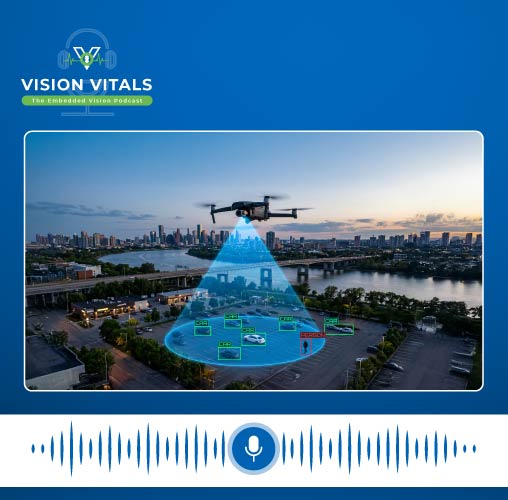
A surveillance drone may be looking across a border, above a crowd, or over a crop field. Yet the aerial view has value only when the camera preserves detail as height, distance, lighting, and flight conditions change.
Our in-house vision expert joins us today to explain how these drones operate. More importantly, what they need to ensure seamless performance.
Great to have you with us.
Thanks! I'm excited for this one because aerial surveillance brings several camera requirements together.
Host:
So what do surveillance drones actually handle?
Expert:
Well, surveillance drones, or UAVs, come with multiple cameras and sensors for aerial monitoring across industries. They collect real-time data that can improve situational awareness and response.
A bird's-eye view can support border patrol, monitoring illegal activities, and crowd control. In agriculture, drones can assist with crop monitoring, irrigation management, and pest control by capturing data on crop health and soil conditions.
Host:
but why would a drone need multiple cameras?
Expert:
Multiple cameras capture several angles and perspectives at the same time. The processor and software then synchronize those outputs.
That can enhance resolution, reduce distortion, and widen the field of view. It also supports 3D mapping, object tracking, and real-time image analysis.
Host:
Aha, so a wider view is one side of the job. What happens when the operator needs a closer look from a distance?
Expert:
Uh huh. That is where zoom comes in. Zooming helps the drone capture detailed imagery while staying away from the target or location.
High-resolution cameras also support zoom and cropping while retaining detail. Umm, that matters when the drone must concentrate on one area within a larger scene.
Host:
Right. Since the drone is flying, how much does shutter speed affect the result?
Expert:
Quite a lot. Faster shutter speeds reduce motion blur and help produce crisp frames while the drone is in motion.
Ideal shutter speeds often range from 1/500 to 1/2000 of a second. That can help with target identification, changing light conditions, and data collection across varied terrain.
Host:
And does the shutter type change the image too?
Expert:
Oh yes. Mechanical shutters can reduce rolling shutter effects that may distort fast subjects. Electronic shutters bring reduced operational noise and avoid mechanical wear.
The choice depends on the surveillance task.
Host:
Okay, what does 3D imaging add?
Expert:
3D imaging captures depth information and helps generate three-dimensional maps. Cameras take images from several angles, and those images are processed into 3D models.
This gives the drone a fuller view of terrain and structures below. In agriculture, 3D models of crop fields can help identify pest infestations early.
Host:
Interesting. Lighting can change quickly outdoors. What helps overcome that?
Expert:
Basically, white balance adjusts colors so the scene remains accurately represented under changing light.
Ah, this supports object identification and keeps visual data consistent across varied environments. By reducing color casts from light sources, white balance helps the image reflect the scene faithfully.
Host:
What happens to focus when the distance from the subject keeps changing?
Expert:
The focal distance can change rapidly, which makes fixed-focus cameras struggle to keep the subject sharp.
Autofocus systems continuously analyze the scene and adjust the lens during flight. They respond to distance changes, drone motion, and variations in the environment, reducing blurry or out-of-focus footage.
Host:
Even with focus handled, the drone still vibrates. How is that controlled?
Expert:
Vibration stabilization counters the motion and vibrations produced during flight. Gimbals or electronic stabilization mechanisms dampen them and keep the camera steadier, reducing blur and distortion in the visual data.
Host:
What about thermal performance? Does efficient thermal management matter?
Expert:
Efficient thermal management supports extended flight times, heavier payload capacity, lower overheating risk, and consistent operation in hot climates, urban settings, and high altitudes.
So yes, efficient thermal management connects directly to reliable surveillance performance.
Host:
That brings the full picture together. Thanks for making the discussion easy to follow.
Expert:
My pleasure! I enjoyed it!
Host:
Same here!
And thank you to everyone listening.
Visit e-consystems.com to explore camera solutions for your surveillance drones. You can also use the Camera Selector to view our full portfolio.
If you'd like to connect with a vision expert, please write to camerasolutions@e-consystems.com.
We'll see you in the next episode of Vision Vitals!
Close Full Transcript


 Mr. Thomas Yoon
 +82-10-5380-0313




 Employee Login