Welcome to e-con Systems' Vision Vitals, your weekly podcast on embedded vision.
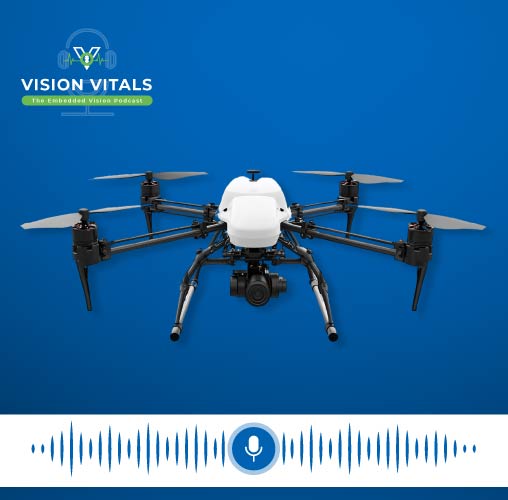
Drones, these days, support agriculture, construction, mining, inspection, delivery, and object detection. Now, what gives them the visual capability to handle such varied tasks?
And how do camera requirements change above crops, around high-rise buildings, or inside dark mining caves?
Our in-house vision Expert is here to explain.
Good to have you here.
Thanks! I'm glad to join you. It's a fascinating subject for sure.
Host:
So my first question would be - do all drones follow the same umm design?
Expert:
Not at all. Drones come in different forms. Based on their operating principle, they can be fixed-wing aircraft or multi-rotor aircraft. Advanced vision supports functions that demand convenience, speed, and accuracy.
Host:
Aha, and where does embedded vision enter the picture?
Expert:
Simply put, cameras give drones the imaging capability needed to observe scenes and support their tasks. However, the imaging requirement then changes with the application.
Host:
Hmm, let's start with robotics. How impactful are drones there?
Expert:
extremely impactful, to say the least! AMRs and AGVs operate on land, while drones operate in the air. The ability of drones to function autonomously and carry out tasks places them within robotics.
Host:
Okay, what are drones doing in smart agriculture? Is “impactful” the right word to use again?
Expert:
Hehe, it certainly is. So agricultural drones can spray pesticides, monitor plant growth, identify when crops are ready for harvesting, and observe livestock across large areas. These activities traditionally require extensive manual work. Since a drone flies above the ground, it can observe plants, trees, and cattle across a wide area.
Host:
Is there a set of features these agriculture drones need?
Expert:
Yep. For example, zoom matters because the drone operates at a distance from the subject. NIR imaging is another requirement. Agricultural drones use near-infrared images to calculate the vegetation index, so the camera needs a strong response in the NIR spectrum.
Host:
What about construction? What features do those drones require?
Expert:
Construction drones can reach areas that are difficult or risky for people, including oil rigs and high-rise building sites. High-resolution imaging and zoom help capture information for detailed inspection.
HDR also becomes important because the camera may face the horizon at several angles.
The sun, glass, and metal can create glare, hotspots, or whitewashed images. A camera with High Dynamic Range can retain more scene detail when a bright light source enters the frame.
Host:
Right. Now, is mining even tougher for drones because visibility can be extremely limited?
Expert:
That is correct. Mining caves may have low oxygen, poisonous gases, and very little lighting, which makes human access dangerous. The camera needs high sensitivity to visible and infrared light so it can capture usable detail with low-power LEDs for IR illumination.
Using high-power LEDs consumes more energy and can reduce flight time. For this reason, an NIR camera with strong low-light performance is recommended for mining drones.
Host:
Let's talk about autonomy itself. How is this achieved across general drone designs?
Expert:
Autonomy reduces human intervention and can reduce crashes caused by human error. One camera or several cameras can supply depth and orientation measurements in real time. Drones can also use simultaneous localization and mapping (SLAM) algorithms to sense their immediate surroundings.
A global shutter multi-camera solution can support surround view while avoiding rolling shutter artifacts. Fast shutter speed support also helps prevent motion blur, which matters when the drone and objects in the scene are in motion.
Host:
Well, that certainly gives us a clear picture of how drones work - and what they need to meet the imaging requirements of modern applications.
Thanks for walking us through it.
Expert:
My pleasure! I enjoyed the conversation and look forward to the next one.
Host:
Likewise!
Also, big thanks to our listeners for joining us.
We hope today's discussion helps you better understand the camera requirements for your drone application.
Visit e-consystems.com to explore camera solutions for your drone applications.
Or if you'd like to start a conversation with an imaging Expert, please write to camerasolutions@e-consystems.com.
We'll see you in the next episode of Vision Vitals!
Close Full Transcript


 Mr. Thomas Yoon
 +82-10-5380-0313




 Employee Login