Welcome to another episode of e-con Systems’ Vision Vitals.
Let me paint a familiar picture that product engineers may know firsthand. Imagine they have designed a system around a 5MP global shutter sensor. And the application demands crisp imaging in motion, reliable performance under challenging lighting, and sufficient speed for real-time analysis.
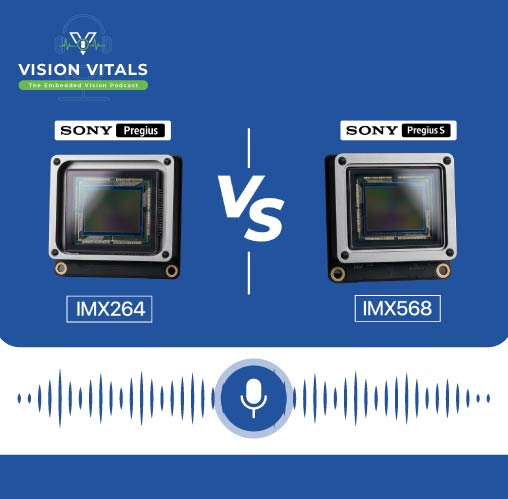
They have two Sony Pregius sensors as their choices.
One is IMX264. The other is IMX568.
The decision appears straightforward at first glance. However, the choice is actually a lot more nuanced. To walk us through that, I’m joined by our in-house vision expert. Good to have you here.
Certainly glad to be here! As we already know, the IMX264 and the IMX568 are part of the same sensor line, but they mark distinct generations of Sony Pregius technology. That advancement alters camera capabilities for motion-intensive and light-sensitive applications.
Host:
Ok, give us the plain starting point. What kind of sensors are these?
Speaker:
Both are Sony Pregius global shutter sensors for high-speed vision tasks. IMX264 uses second-generation Pregius technology and incorporates Sony Exmor. It debuted with 3.45 x 3.45 micrometer pixels and was the industry’s first small-pixel sensor.
The IMX568 belongs to the Sony Pregius S Generation Four. The S refers to the stacked structure. In this sensor, the photodiode is placed on top, and the circuits are placed below. It also uses a smaller pixel size of 2.74 micrometers by 2.74 micrometers.
Host:
So are they close in resolution, but with a different architecture?
Speaker:
Yep. You nailed it. The IMX264 is roughly 5.07MP, while IMX568 is roughly 5.10MP. That difference in pixel count is tiny. The larger change comes from how the sensor receives light, stores charge, reads data, and controls exposure.
Host:
Let’s spend a minute on that, shall we? What happens inside the older front-illuminated structure?
Speaker:
Absolutely. In the second-generation front-illuminated structure used by IMX264, conductive elements are positioned above the light-sensitive element. Some incoming light is intercepted before it reaches the photodiode. That matters more as pixel sizes shrink because every bit of collected light has value.
Host:
And IMX568 changes the physical arrangement?
Speaker:
Right. Pregius S flips that structure. The photodiode layer is placed on top, and the conductive elements move underneath. Light can reach the photodiode more directly. That improves light collection and supports smaller pixels while keeping sensitivity.
Host:
Hmm. So does a smaller pixel in IMX568 mean a weaker camera response by default?
Speaker:
Correct. Architecture compensates for pixel size. IMX568’s smaller pixels are balanced by the stacked back-illuminated design, which optimizes light collection. Comparison must focus beyond pixel size alone.
Host:
Let’s discuss numbers. What should engineers compare first?
Speaker:
The image size is a good place to begin. IMX264 has an 11.1 mm diagonal, Type 2/3 image size. IMX568 has an 8.8 mm diagonal, Type 1/1.8 image size.
Then comes the architecture. IMX264 is front-illuminated. IMX568 is back-illuminated and stacked. For pixel size, IMX264 uses 3.45 micrometers by 3.45 micrometers pixels. IMX568 uses 2.74 micrometer by 2.74 micrometer pixels.
Both use global shutter operation.
Host:
Speed is where the change becomes easier to see, right?
Speaker:
Very much. At 12-bit, IMX264 reaches around 35.7 frames per second. IMX568 reaches around 67 frames per second. At 8-bit, IMX264 reaches around 60 frames per second, while IMX568 reaches around 96 frames per second.
That is a major reason IMX568 becomes attractive for robotic guidance, motion tracking, and high-speed inspection. The faster readout circuitry and SLVS-EC high-speed interface help drive that higher throughput.
Host:
Uhmm, what does that extra throughput actually change in a system?
Speaker:
It gives the vision system more frequent image updates at full resolution. In motion-heavy use cases, this can support better tracking and higher system accuracy. In inspection, it can help the system process more visual events in less time.
Host:
Now, both are global shutter sensors. Many listeners will ask whether a global shutter alone settles the motion distortion question. What changes between the two?
Speaker:
IMX264 already provides true global shutter operation, so it can eliminate motion distortion. IMX568 adds a redesigned charge storage structure that reduces parasitic light sensitivity, or PLS.
PLS matters because stored pixel charges can get contaminated by incoming light during readout. By reducing that effect, IMX568 improves image output in high-contrast or high-illumination inspection conditions.
Host:
So the improvement is less about basic global shutter capture and more about how charge is protected during readout.
Speaker:
Yes, that is a good way to frame it. Both sensors address motion distortion through a global shutter. IMX568 then improves the charge storage behavior inside the pixel, which helps image quality when illumination is intense or contrast is high.
Host:
Let’s talk image quality. The source mentions lower read noise, fixed pattern noise, and dynamic range for Pregius S. How should we understand that in practical terms?
Speaker:
Pregius S sensors offer lower read noise, reduced fixed pattern noise, and better dynamic range. For IMX568, that means better image output in low-light environments and higher signal fidelity as exposure conditions change.
There is also a processing angle. When the raw sensor output has better noise performance, the system can rely less on aggressive ISP noise reduction. That helps preserve fine detail, which matters for machine vision algorithms.
Host:
Right. That is the kind of detail that can affect recognition, measurement, and inspection quality downstream.
Speaker:
Yep. The sensor is only one part of the system, but sensor-level noise and dynamic range influence how much useful data reaches the vision pipeline.
Host:
Power and thermal behavior usually come up after speed. Since IMX568 runs faster, does it demand a heavier thermal setup?
Speaker:
The source points in the other direction on a per-frame basis. IMX568 uses less power per frame despite higher operating speeds. Improved charge transfer and readout structure reduce heat generation. That makes it suitable for compact, fanless, and always-on camera systems.
Host:
Interesting. Let’s bring system integration into this because sensor upgrades can create processor and interface questions.
Speaker:
That is a key part of the decision. IMX264 uses traditional SLVS and LVDS interfaces, so it integrates well with legacy ISPs and FPGA platforms.
IMX568 demands higher data bandwidth. Its readout leverages SLVS-EC, and the specification lists MIPI CSI-2 as an output interface. Teams must verify their processing platform can accommodate this data path.
Host:
Mmm hmm. So a team with an older platform may find IMX264 easier to integrate, while IMX568 asks for a more current processing path.
Speaker:
Correct. The gain is higher throughput and newer imaging features, but the host side has to be ready for that.
Host:
Let’s get into those newer features. IMX568 seems to bring a lot more than a higher frame rate.
Speaker:
It does. One feature is a short-interval shutter. IMX568 can perform short-interval shutters starting at 2 microseconds. That reduces the time between frames through register control and helps cameras capture fast-moving objects in industrial automation.
Host:
And then there is multi-exposure trigger mode, right?
Speaker:
Yes. IMX568 supports multiple exposures within a single trigger sequence. That means the camera can capture several images of the same scene at different exposure times, covering both bright and dark areas of the object. This reduces dependency on complex lighting and strobe tuning. It also helps in challenging lighting conditions in use cases such as sports analytics.
Host:
Ok, multi-frame ROI is probably the feature many embedded vision teams will care about. Walk us through it.
Speaker:
IMX568 supports simultaneous readout of up to 64 user-defined regions from arbitrary positions on the sensor. Instead of reading the entire frame every time, the camera can focus on selected regions.
The source also mentions e-con Systems’ e-CAM56_CUOAGX, an IMX568-based global shutter camera with multi-frame ROI functionality. It supports up to 1164 frames per second with the multi-ROI feature.
Host:
That is a huge leap for applications that only need selected image regions, no?
Speaker:
Multi-ROI helps when the system only needs certain portions of the image, such as vehicle motion in traffic surveillance or the facial region in security surveillance. It reduces the amount of data that has to move through the pipeline and can raise frame rates for the relevant regions.
Host:
What about short exposure mode? It sounds similar to short interval shutter, but the source treats it separately.
Speaker:
Short exposure mode deals with very brief exposure times while keeping image stability and sensitivity. The exposure time can vary by up to plus or minus 500 nanoseconds depending on the sample and environmental conditions, including temperature and voltage levels.
Host:
What about the dual trigger feature?
Speaker:
Dual trigger operation divides the screen into upper and lower areas and gives independent control over image capture timing and readout. That helps synchronize capture with external events, lighting, and strobes in complex inspection setups.
Host:
There are two more features we should cover before we compare the final choices. Gradation compression and dual ADC. Let’s talk about these.
Speaker:
First, gradation compression optimizes how brightness levels are represented in the output image. It helps preserve image details in bright and dark regions while avoiding extra bit depth or extra lighting complexity.
Host:
And the dual ADC feature?
Speaker:
Dual ADC gives faster and more flexible signal conversion. It supports high frame rates while maintaining image quality and helps optimize performance at 8-bit, 10-bit, and 12-bit. It also supports high throughput and low latency in demanding vision systems.
Host:
Okay, let’s bring it all together through application choices. Where does IMX264 still make sense?
Speaker:
IMX264 makes sense when a system already depends on second-generation Pregius behavior, larger Type 2/3 image size, traditional SLVS or LVDS integration, and established ISP or FPGA workflows. It remains a global shutter option for high-speed vision applications that need sensitivity, low noise, and distortion-free imaging.
Host:
Now, what about the IMX568 sensor? What’s the verdict?
Speaker:
IMX568 is the better choice when the application needs newer Pregius S architecture, higher frame rate, improved PLS behavior, lower read noise, reduced fixed pattern noise, better dynamic range, multi-exposure trigger, multi-frame ROI, short interval shutter, dual trigger, gradation compression, and dual ADC.
It is relevant for robotic guidance, motion tracking, high-speed inspection, industrial automation, sports analytics, traffic surveillance, and selected-region surveillance tasks.
Host:
Mmm, I like that split. IMX264 gives teams a known Pregius global shutter path. IMX568 brings the fourth-generation Pregius S path with stacked architecture, faster readout, and more exposure and ROI control.
Speaker:
That is indeed the comparison. Both are Pregius global shutter sensors. The final choice comes down to what the camera has to capture, how fast it has to read out, how difficult the lighting is, and what the processing platform can support.
Host:
Before we close, let’s connect this to e-con Systems’ camera portfolio. What should listeners know?
Speaker:
e-con Systems has been developing and manufacturing cameras since 2003. We offer Sony Pregius sensor-based cameras and support teams evaluating sensors such as IMX264 and IMX568 for embedded vision applications.
Listeners can explore the Sony Pregius sensor-based camera portfolio and use the Camera Selector to review available options.
Host:
That is a good place to end. Sensor selection begins with a simple comparison, but the real decision depends on architecture, throughput, exposure control, noise performance, interface support, and the kind of scene the camera has to capture.
Thanks for walking us through the IMX264 and IMX568 comparison.
Speaker:
Glad to. If there is one takeaway here, it is this. In global shutter sensors, the generation matters as much as the shutter type. IMX568 shows how Pregius S moves the discussion from basic distortion-free capture into faster, more controlled, and lower-bandwidth embedded vision capture.
Host:
And that wraps this episode of e-con Systems’ Vision Vitals.
As mentioned by our guest speaker, to explore e-con Systems’ Sony Pregius sensor-based cameras, visit e-con Systems dot com.
If you’d like to discuss the sort of imaging power your embedded vision application needs with camera experts, please write to camerasolutions@e-consystems.com.
Thanks for listening!
We’ll be back with another exciting and revealing episode of Vision Vitals next week.
Close Full Transcript


 Mr. Thomas Yoon
 +82-10-5380-0313




 Employee Login