Welcome once again to e-con Systems' Vision Vitals - your favorite or soon-to-be-favorite podcast on embedded vision!
Now, anyone working on embedded cameras knows that sensor selection rarely comes down to resolution alone. Two sensors can look close during an early review, and then lead to very different imaging outcomes.
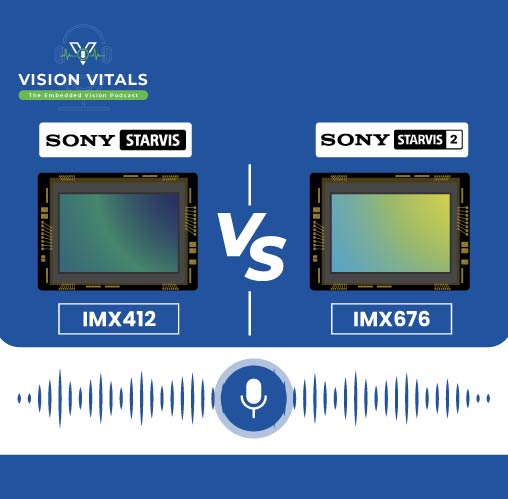
Today, that decision is Sony IMX412 vs. Sony IMX676.
On the surface, both belong to Sony's high-resolution BSI sensor family. But sensor selection rarely stops at resolution. The harder questions usually come from lighting, motion, optics, frame timing, HDR, NIR response, and output format.
That is why this comparison is critical for those working on embedded vision products.
So, today's discussion will trace the differences between these two Sony sensors so that you can better understand which one suits your application the best.
Joining me today is our in-house vision expert.
Thanks. This is a very useful comparison because, as you had mentioned, IMX412 and IMX676 can look close at first. Once you get into the camera architecture, they start pointing toward their own unique embedded vision needs.
Host:
So let's start with the two sensors themselves. What are we comparing here?
Speaker:
The IMX412 is a 12.3MP Type 1/2.3 back-illuminated stacked CMOS image sensor. Umm, it has approximately 12.33 million active pixels, a 4056 by 3040 active pixel array, and 1.55 micrometer pixels. It also uses an R, G, and B primary color mosaic filter and an electronic shutter with variable integration time.
The IMX676 is a 12.63MP Sony back-illuminated CMOS image sensor based on STARVIS 2. It ermm has a 3536 by 3536 active pixel array, a Type 1/1.6 optical format, and 2.0 micrometer pixels. It is available in color and monochrome variants.
Host:
So when teams compare IMX412 and IMX676, which part of the camera architecture should they look at first?
Speaker:
The IMX412 uses a stacked BSI STARVIS architecture. The pixel array and processing circuitry are placed on separate silicon layers. That helps with fast readout and high frame rates.
The IMX676 uses STARVIS 2 BSI architecture with Deep Trench Isolation, or DTI. That structure reduces optical and electrical cross-talk between pixels. It improves photon capture, dynamic range, color accuracy, and near-infrared sensitivity.
Host:
And how actually does the stacked BSI in IMX412 differ from STARVIS 2 with the DTI in IMX676?
Speaker:
The IMX412 is a good match when speed and compact integration carry more weight. The IMX676 is the better match when low-light quality, NIR response, HDR, and monochrome imaging are the preferred features.
Host:
Umm, let's focus on camera hardware for a minute. Does the optical format affect the sensor choice?
Speaker:
It does. The IMX412 uses a Type 1/2.3 optical format with a 7.857 mm diagonal. That format has broad lens compatibility, especially in surveillance-style camera designs.
The IMX676 uses a larger Type 1/1.6 optical format. Its larger sensor area and 2.0 micrometer pixels help gather more light, but the lens has to cover that larger image circle.
Host:
Uh huh. How should teams review the sensor and lens together before locking the camera design?
Speaker:
Sensor size, pixel size, lens image circle, and the mechanical envelope all have to be reviewed together.
If the camera needs a smaller optical path, IMX412 is easier to integrate. If the application needs better image quality under low light or high dynamic range conditions, IMX676 gives the camera more imaging margin.
Host:
Okay, now let's talk speed. Which sensor has the advantage here?
Speaker:
The IMX412 has a frame-rate advantage. It supports full resolution at 60 fps in 10-bit mode and 40 fps in 12-bit mode. It can also reach 240 fps at 1080p with binning.
The IMX676 supports 12-bit 30 fps, 10-bit 60 fps, and 1080p 140 fps.
So for applications that need faster capture, IMX412 has the edge. That includes traffic enforcement, sports analytics, and high-throughput industrial inspection.
Host:
Right. And how does frame rate affect motion capture and high-rate inspection?
Speaker:
The frame rate can determine how much motion detail the camera can capture. It also affects how the camera fits into the system pipeline.
Host:
Now, let me flip that. Where does IMX676 make a better technical case?
Speaker:
IMX676 leads in low-light imaging, NIR response, HDR capability, and monochrome availability.
The larger 2.0 micrometer pixels collect more photons per unit time than the 1.55 micrometer pixels in the IMX412. STARVIS 2 and DTI further improve the sensor response under difficult lighting. That gives IMX676 an advantage in machine vision, robotic imaging, traffic monitoring, and low-light surveillance.
Host:
Mm-hmm. And the monochrome version seems important. Please tell us why.
Speaker:
The monochrome IMX676 removes the Bayer color filter array. That means each pixel can capture luminance across a wider spectrum, from UV through NIR.
This can increase light sensitivity by around 3 to 4 times compared with the color variant. It also supports true NIR imaging because infrared filters are absent.
That is important for OCR, barcode reading, and NIR-based biometric systems.
Host:
Ahh, I see. Does the monochrome variant change the type of image data the camera can capture?
Speaker:
Yes, that is a good way to say it. The IMX412 is color only. The IMX676 gives color and monochrome routes. That makes it useful for a wider set of industrial and machine vision tasks.
Host:
Let us get into HDR, because both sensors support DOL-HDR. Does implementation differ?
Speaker:
Right. Both sensors support Digital Overlap HDR, or DOL-HDR. The IMX412 supports 2-frame DOL-HDR at full resolution, 4056 by 3040, at 30 fps. The IMX676 supports DOL-HDR with 2-frame and 3-frame combinations. It also supports Clear HDR.
Host:
Hmm. Where does that difference show up in actual imaging?
Speaker:
Well, it mostly shows up in scenes with motion and high contrast. DOL-HDR is useful, but sequential multi-exposure HDR can create motion artifacts when objects move through the frame. Clear HDR gives the IMX676 an advantage in dynamic scenes where those artifacts would hurt image usability.
The IMX412's 2-frame DOL-HDR works well for fixed scenes or slow-moving applications.
Host:
So, if the camera has to read a moving scene with high contrast, the IMX676 gives the image pipeline a better HDR path. Is that correct?
Speaker:
Yes. Especially where motion artifacts would hurt the captured frame.
Host:
Since both sensors can operate in synchronized multi-camera setups, what details should be compared?
Speaker:
Both support multi-camera synchronization. The IMX412-AACK provides dual sensor synchronization operation capability. That helps with frame-level timing for strobe-synchronized illumination and event-driven inspection systems.
The IMX676 includes trigger and synchronization options such as master, slave, and external modes. So both can be used in synchronized camera setups. The decision depends on the timing, architecture and the capture workflow.
Host:
Why does synchronization become critical during ermm system integration?
Speaker:
If multiple cameras have to capture the same event, timing becomes part of image quality. If the lighting is strobed or if inspection is event-driven, the trigger path becomes a core camera requirement.
Host:
Okay, what about low power? IMX412 has a dedicated low-power mode, right?
Speaker:
Yes. The IMX412 includes a dedicated low-power mode.
The IMX676 has a different design focus. It prioritizes larger 2.0 micrometer pixels, high dynamic range, and image quality. So the power discussion depends on the system target. If sleep-state power saving is the goal, IMX412 has a direct advantage. If image quality under difficult lighting matters more, IMX676 is better suited.
Host:
Uh huh. Let us make this practical. If an OEM is choosing between these two sensors, what should the first decision be based upon?
Speaker:
I would start with the imaging problem.
If the main need is compact camera design, color imaging, high full-resolution frame rate, and broad Type 1/2.3 lens compatibility, IMX412 is the better option. If the main need is low-light imaging, NIR response, high dynamic range, monochrome output, or STARVIS 2 performance, IMX676 is the better choice.
Host:
So yeah, the answer is aligned with what the camera has to capture.
Speaker:
Exactly. Resolution alone only gets you partway. The application decides which tradeoff is more relevant.
Host:
Give me the application split. Where does IMX412 make sense?
Speaker:
IMX412 is perfect for surveillance camera applications. It is also ideal for traffic enforcement, ermm sports analytics, and high-throughput industrial inspection use cases. Its compact Type 1/2.3 format, stacked BSI architecture, and high-speed output make it a good match for systems that need speed and easier optical integration.
Host:
And what about the IMX676, then?
Speaker:
IMX676 is positioned for demanding industrial, robotic, and machine vision applications. It also supports traffic monitoring, OCR, barcode reading, NIR-based biometric systems, and low-light surveillance. Some of the errr reasons are improved NIR response, Clear HDR, and the monochrome option.
Host:
Hmmm. Interesting. That seems like an efficient decision split. Speed and compact optics on side. Low-light, HDR, NIR, and monochrome on the other side.
Speaker:
Oh yes, totally. That is the practical split.
Host:
Before we wrap, let's talk about e-con Systems' Sony sensor-based cameras, shall we?
Speaker:
With pleasure! Basically, e-con Systems offers Sony sensor-based cameras with HDR, low-light optimization, large and small pixel sizes, pixel binning, and advanced synchronization capabilities.
Our portfolio includes IMX676 and IMX412 camera modules.
e-con Systems also specializes in camera customization, including hardware trigger implementation, multi-camera synchronization, custom form factors, and lens integration. That helps customers go effortlessly from sensor choice to a camera module that meets their application's vision needs.
After all, a good sensor decision has to connect to the complete camera design!
Host:
I suppose the right sensor choice depends on frame rate targets, optical format, lighting conditions, HDR requirements, synchronization needs, and the final application.
Thank you so much for sharing your expert insights and breaking this down with us.
Speaker:
Glad to do it. Just remember - the best sensor choice usually comes from asking what the camera has to capture, what the lighting looks like, and how much speed or image quality the system needs.
Host:
Perfect!
And folks, that brings us to the end of this episode of e-con Systems' Vision Vitals.
To explore e-con Systems' IMX676 and IMX412 camera modules, visit e-con Systems dot com.
If you need help selecting the right Sony sensor-based camera for your application, please reach out to the vision experts at camerasolutions@e-consystems.com.
A special thanks to everyone listening in. We truly appreciate that you take the time out of your busy day to spend time with us. We love sharing these insights as much as we hope you love listening to them!
We will be back with another episode soon.
See you again next week!
Close Full Transcript


 Mr. Thomas Yoon
 +82-10-5380-0313




 Employee Login