Mr. Thomas Yoon
 +82-10-5380-0313


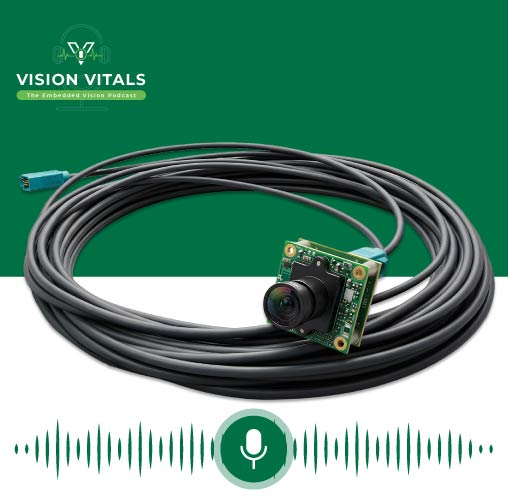
How to Choose the Right GMSL Camera Interface
May 08, 2026


Description :
In the newest episode of Vision Vitals, e-con Systems’ podcast for all things embedded vision, we look at the reasons why teams choose the GMSL interface. It is the perfect choice when high bandwidth, 15-meter transmission, low latency, virtual channels, backward compatibility, and ARM platform fit all enter the picture. GMSL can carry large video streams fast, linking multiple data paths through one channel.
Know how data rates up to 12 Gbps, longer cable runs, and near-instant transfer influence system planning from the start. See GMSL’s impact on auto farming, smart traffic, surveillance, parking, retail checkout, and warehouse automation. Ultimately, understand what makes GMSL attractive when deployment conditions get rough
Transcription :
Host:
So, you’re looking at building a high-performance embedded vision system, and the name GMSL keeps coming up. Of course, it’s a popular choice due to its speed, distance, and reliability, but what does that actually mean for your product?
When should you commit to the GMSL camera interface, and where does it deliver the most value in the real world?
To help us sort through the selection criteria and applications, our resident embedded vision expert once again joins us.
Welcome, welcome!
Speaker:
Oh it’s always great to be back. Thanks for having me here today. So yeah, GMSL is one of those interface technologies that’s become a mainstay of demanding vision systems. Umm, knowing when to choose it and what it enables can really determine the success of your embedded vision system.
Host:
Let’s jump right in. So, what are the top technical reasons someone should select a GMSL camera interface?
Speaker:
Right, so there are a few key factors. First is high bandwidth transmission. GMSL cameras ensure rapid data transfer, reaching up to 12 Gbps. That’s tremendously useful for moving large data volumes, like high-definition video streams.
Then there’s long-distance support. The technology enables data transmission over distances up to 15 meters using coaxial or shielded twisted pair cables. You can place the camera far from the processing unit without a dip in performance.
Another big one is low latency. GMSL cameras excel here by providing near-instantaneous data transmission, which minimizes the delay between data capture and processing.
Host:
What about system flexibility and integration? Does GMSL offer advantages there?
Speaker:
Absolutely. It supports virtual channels, which allows the transmission of several data streams over one physical channel. That enhances the scalability of camera systems, enabling the integration of various data sources without extra wiring.
There’s also backward compatibility. GMSL interfaces can work with earlier versions of the technology, which provides flexibility in upgrading and expanding existing systems without requiring complete overhauls.
And then, compatibility with ARM platforms, like the NVIDIA Jetson series. This drives smooth integration with advanced processing units and leverages their computational power for tasks like image processing, machine learning, and real-time analytics.
Host:
That’s a strong set of technical merits. Now, where does this actually get put to work? What are the major use cases for the GMSL camera interface?
Speaker:
Umm, there are several impactful applications. One is auto farming. GMSL cameras enhance advanced agriculture operations by providing high-resolution imaging in real time. The ability to capture clear images and transmit them quickly enables more accurate and timely decision-making in tasks like plant health analysis, crop monitoring, and machinery guidance.
Host:
What about in urban or infrastructure settings?
Speaker:
Definitely, smart traffic management is a big one. GMSL cameras capture high-definition visuals of traffic flow. The real-time transmission of high-quality imaging data enhances the accuracy of systems used for congestion analysis, license plate recognition, and incident detection.
Then there’s smart surveillance. These cameras provide continuous, high-speed imaging, ensuring every detail is captured to enhance security in monitored environments. The high resolution and rapid data transmission make them perfect for situations that demand immediate monitoring.
Host:
Any applications in commercial or logistics spaces?
Speaker:
Yeah, for sure. Parking lot management is a good example. Cameras can be placed at entry and exit points and over parking spaces for automated license plate recognition and space allocation. The low latency and high data transmission ensure the system receives up-to-the-minute information to guide drivers and improve traffic flow. It also enhances security by detecting unauthorized access.
Another is smart checkout in retail. GMSL cameras enable modern checkout systems to process images quickly and accurately, ensuring correct item identification and pricing. This speeds up the process and improves customer experience while preventing errors.
Warehouse automation is a crucial use case, as well. Here, GMSL cameras can be integrated into automated storage and retrieval systems to monitor stock levels, verify item locations, and track inventory movements in real time. They also provide visual feedback to robots, helping them avoid obstacles and optimize routes.
Host:
Beyond the specs and use cases, what are the overarching advantages of choosing a GMSL camera?
Speaker:
I’d highlight a few. First, enhanced image quality. GMSL cameras maintain good image quality in rugged conditions and support high-definition, high-resolution video streams for clear images.
They can also be cost-effective. The compatibility with existing infrastructure and ability to support multiple data formats can lead to cost savings, since upgrades can often happen without extensive modifications or extra components.
The interface also enables a simplified design by reducing the number of cables needed for data and power transmission. This decreases installation complexity and minimizes potential points of failure.
Finally, more durability. These cameras are built to withstand extreme temperatures, vibrations, and other challenging conditions, ensuring consistent performance in harsh industrial and outdoor settings.
Host:
That’s quite a comprehensive picture: from why to choose it, to where it’s used, to the tangible benefits. Thanks for walking us through it all so clearly.
Speaker:
My pleasure. It’s indeed a versatile technology that solves a lot of real-world problems.
Host:
If you, our faithful listener, are exploring GMSL camera solutions for your embedded vision systems, we can certainly help.
After all, e-con Systems has over 20 years of experience designing and manufacturing OEM cameras, including a portfolio of GMSL, GMSL2, and GMSL3 modules.
Our cameras come with features like HDR, IP66/67-rated enclosures, global or rolling shutters, and LED flicker mitigation, and are compatible with the NVIDIA Jetson platform.
To see our full range or discuss customization, you can visit e-con Systems dot com or contact our team of experts at camerasolutions@e-consystems.com.
And once again, thanks for tuning in.
We’ll see you next time on Vision Vitals.
Related podcasts
GMSL2 vs Ethernet Cameras Explained: Which Interface Should You Choose for Embedded Vision?
May 01, 2026
In this latest episode of e-con Systems' Vision Vitals, we serve up a comparison between GMSL2 and Ethernet, two camera interfaces built for different kinds of distance, bandwidth, and system design.
Know moreGMSL2 vs FPD-Link III Explained: Camera Interface Comparison for ADAS & Robotics
April 24, 2026
n this episode of Vision Vitals, e-con Systems’ embedded vision podcast, we compare GMSL2 and FPD-Link III, two SerDes-based camera interfaces. Both are leveraged to transfer high-bandwidth image data in ADAS, robotics, industrial vision, and surveillance setups.
Know more Employee Login