Alright, folks. We’re back with e-con Systems’ Vision Vitals – your go-to embedded vision podcast.
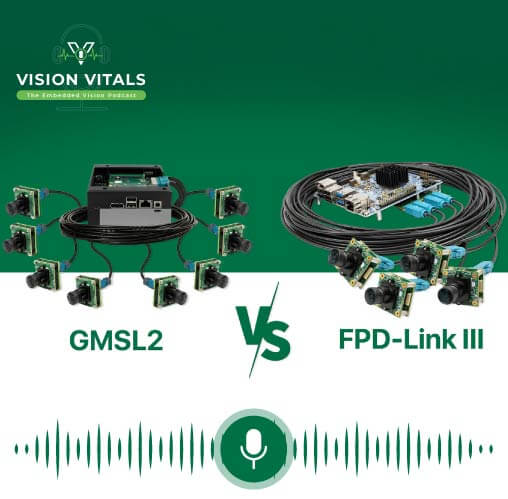
In this brand new episode, we’re comparing two popular heavy-hitters when it comes to long-distance, high-bandwidth camera interfaces: GMSL2 and FPD-Link III.
I mean, if you’re working on automotive ADAS, robotics, or any vision system where you need to move a lot of data over meters, not centimeters, you’ve probably run into these two interfaces.
They’re similar in a lot of ways, right? But the differences matter when you’re designing for performance, cost, and reliability.
Here to help us untangle these technologies is our embedded vision expert.
Welcome back.
Hey, thanks. Yeah, this is a great comparison to do. Umm… both are SerDes-based, both go 15 meters, but you know, the devil’s in the architectural details.
Let’s start with the foundation. These two interfaces are based on SerDes technology. Can you just briefly remind us what that is and why it’s so important for these applications?
Speaker:
Sure. So, SerDes stands for Serializer/Deserializer. I mean, it’s a technique that converts parallel data into a high-speed serial stream for transmission, and then back to parallel at the other end.
The key advantages are long-distance transmission at high speed with very low latency.
And the interfaces and cables are highly resistant to shocks and vibrations, which makes them suitable for harsh industrial and automotive environments. So yeah, it’s the backbone for GMSL2 and FPD-Link III.
Host:
Got it. So, let’s define them individually. What is a GMSL2 camera, in simple terms?
Speaker:
Yeah, so a GMSL2 camera uses the GMSL2 interface to transmit data from the camera to the host.
It’s defined as a high-speed SerDes communication IC that supports the bandwidth and data integrity needs for things like automotive infotainment and ADAS.
It offers a forward channel bandwidth of 6 Gbps and a backward channel of 187 Mbps.
GMSL2 uses coaxial, Shielded Twisted Pair, or Shielded Parallel Pair cable, and it can transmit data up to 15 meters.
It supports MIPI and parallel forward interfaces, and I2C and UART backward interfaces.
Host:
And what about FPD-Link III cameras? How are they positioned?
Speaker:
Right. So FPD-Link III is another long-distance transmission interface, developed by Texas Instruments.
It’s positioned for ADAS, security and surveillance, industrial systems, and medical imaging.
It also offers a max transmission distance of 15 meters.
FPD-Link III’s forward channel bandwidth is 4.16 Gbps, and the backward channel is 50 Mbps.
It uses an automotive-grade single-ended coaxial or STP cable.
It’s a D-PHY v1.2 and CSI-2 v1.3 compliant system and supports up to four data lanes.
Host:
Okay, so we’ve got two interfaces that can handle 15-meter cable support. Let’s break down the key differentiating features one by one. First up: bandwidth. How do they compare?
Speaker:
I mean, GMSL2 has a slight edge here. GMSL2 offers 6 Gbps in the forward channel and 187 Mbps backward.
FPD-Link III offers 4.16 Gbps forward and 50 Mbps backward.
So, both meet the needs of modern camera systems, but if raw bandwidth is the top priority, GMSL2 has the higher numbers.
Host:
What about EMI and EMC performance? That’s huge for automotive and industrial environments.
Speaker:
Yeah, it’s critical. GMSL2 cameras are designed with a spread spectrum capability and a High Immunity Mode (HIM), which provides more reliable reverse channel communication and better EMI performance and EMC tolerance.
For FPD-Link III, it can tolerate a reference clock with spread spectrum clocking to mitigate EMI.
So both interfaces have solid features to handle electromagnetic interference, but the implementation differs.
Host:
What about virtual channel support? That’s important for multi-camera setups too, right?
Speaker:
Yep, you nailed it. Both support virtual channels because they’re SerDes techniques.
A GMSL2 deserializer can decode up to 16 virtual channel IDs for a dual 4-lane MIPI CSI-2 setup.
FPD-Link III supports up to 4 virtual channels.
So, if you’re planning a very complex, multi-sensor system, GMSL2 offers more granular channel separation.
Host:
What about multi-camera support and synchronization?
Speaker:
Both support multi-camera configuration with synchronized streaming.
In FPD-Link III, a serializer paired with a companion deserializer delivers precise multi-camera sensor clock and synchronization.
GMSL2 also has robust aggregation and splitting modes for managing multiple cameras.
Host:
Platform compatibility is always a practical concern. How do they stack up?
Speaker:
They’re compatible with popular processing platforms, especially NVIDIA Jetson modules like AGX Orin, Xavier, TX2, and Nano.
From a platform availability standpoint, they’re on fairly equal footing.
Host:
Are there any other notable differences in features?
Speaker:
A couple. GMSL2 supports 10 GPIOs, while FPD-Link III supports 4.
FPD-Link III also supports audio transmission over the same link, while GMSL2 doesn’t.
Host:
Now, with all these details on the table, how should someone choose between them for a real project?
Speaker:
It comes down to the specific demands.
If you need the highest bandwidth and more virtual channels, choose GMSL2.
If you need integrated audio or are aligned with Texas Instruments ecosystem, FPD-Link III might be better.
Cost and chip availability also matter. It’s always recommended to consult with an imaging expert.
Host:
That’s a really clear, side-by-side breakdown. Thanks for walking us through it.
Speaker:
Yeah, absolutely. Happy to share my insights on these interfaces.
Host:
For our listeners who are evaluating GMSL2 or FPD-Link III cameras, you can explore e-con Systems’ portfolio.
If you need help integrating cameras into your device, reach out to camerasolutions@e-consystems.com.
Thanks for tuning in to Vision Vitals. We’ll see you next time.
Close Full Transcript


 Mr. Thomas Yoon
 +82-10-5380-0313




 Employee Login