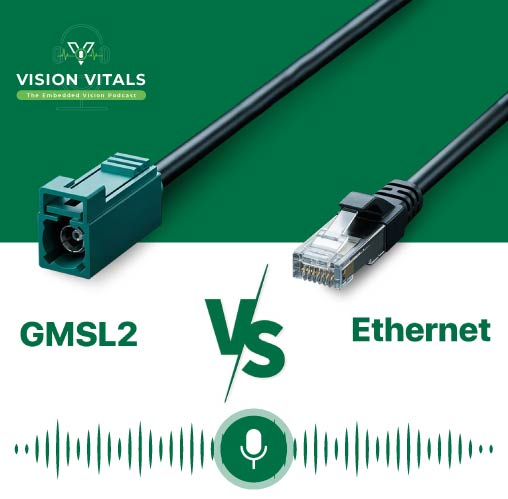
Hello, dear listeners, welcome back to e-con Systems’ Vision Vitals. So, here’s a situation I'm sure some of you may be facing: you're designing an embedded vision system where the camera can't be right next to the processing unit. Maybe it’s on a robot arm, mounted on a vehicle, or installed across a wide factory floor. When that happens, two interface names keep popping up: GMSL2 and Ethernet.
They both promise reliable data transmission over distance, but they come from completely different worlds and solve the problem in fundamentally different ways.
To help us unpack all of that and get to a practical decision framework, we're once again joined by our embedded vision expert. Welcome back.
Thanks, glad to be here. Yeah, you hit the nail on the head. This is one of those comparisons that looks simple on the surface but has a lot of depth. I mean, these two interfaces will move your pixels from point A to point B, but how they do it, what they require, and where they might fail... that's where the real engineering choice happens. Umm, it's definitely worth taking the time to understand.
Host:
Let's build that understanding from the ground up. Starting with the basics: what is a GMSL2 camera, in simple terms?
Speaker:
Right, so GMSL stands for Gigabit Multimedia Serial Link. At its heart, it's a high-speed serial interface built on something called SerDes technology, which stands for Serializer/Deserializer. Umm, practically speaking, the camera connects using a single coaxial cable, or a Shielded Twisted Pair cable.
Inside, a chip called a serializer takes the parallel video data from the sensor and converts it into a tight, high-speed serial stream. That stream travels down the cable, and at the other end, a deserializer chip converts it back into parallel data for the host processor to handle.
The cool part is, this one cable can carry high-speed video, bidirectional control signals, and even power. We're talking about transfer speeds up to 6 gigabits per second, over a distance of up to 15 meters.
Host:
Got it. So it's a streamlined, purpose-built pipeline for high-fidelity video. Now, how about an Ethernet camera? That term gets used everywhere from home security to industrial automation. What defines it in this embedded vision context?
Speaker:
Yeah, that's a good point, the term is broad. In our world, an Ethernet camera is essentially a network device with an image sensor. It captures frames, compresses them using an onboard processing chip to save bandwidth, and then transmits that data over a standard Ethernet cable using common networking protocols.
They're built on open standards like ONVIF to ensure they can talk to network video recorders and other gear. The cable itself is usually a twisted-pair cable, categorized as Cat5e, Cat6, Cat7, and so on, each with different capabilities for speed and distance.
So, while a GMSL link is a dedicated point-to-point video highway, an Ethernet camera plugs into the existing network ecosystem.
Host:
A major advantage we hear about with Ethernet is Power over Ethernet, or PoE. Can you demystify how that works and why it's such a big deal for system design?
Speaker:
Absolutely, it's a huge practicality win. Normally, installing any device requires two connections: power and data. PoE eliminates the power cable. It sends electrical power and data over the same Ethernet cable by using different twisted pairs of wires inside the jacket. There's a whole family of standards.
The basic one, IEEE 802.3af, delivers up to 15.4 watts, enough for a simple fixed camera. The next step up, PoE+, can deliver about 25.5 watts, which can handle a camera with a heater or a fan. And the newer PoE++ standards can push 51, even 71 watts, enough for powerful pan-tilt-zoom assemblies or even a small embedded computer.
Umm, the result is a much simpler, cleaner, and cheaper installation, especially in places where running a separate power line is difficult or expensive.
Host:
So both can handle power and data, but the philosophies are different. Let's move into a detailed, parameter-by-parameter comparison. First and maybe most obvious: transmission distance. What are the realistic limits for each?
Speaker:
This is where they really diverge. GMSL2 is designed for what we call "moderate" distance in the embedded world. It reliably hits 15 meters with its coaxial or STP cable while maintaining its full rated speed and very low latency.
Pushing beyond that isn't what it's made for. Ethernet, on the other hand, is a distance champion in this matchup. Using common Cat5e or Cat6 cable, you get a solid 100 meters. And if that's not enough, you can add a device called a PoE extender, which can push the signal another 100 meters, for a total of 200.
You can even daisy-chain these extenders theoretically out to 500 meters. The trade-off, you know, is that as you add distance with extenders, the maximum data rate can drop, and you introduce more points of potential failure.
Host:
That leads perfectly into the next parameter: data transfer speed and bandwidth. How do they compare when you need every bit as fast as possible?
Speaker:
Yeah, so GMSL2 is built for speed in that 15-meter window. It's designed to move uncompressed or lightly compressed video with very high bandwidth and minimal delay, or latency. That's why you see it in applications like drones, advanced driver assistance systems, or high-speed robotic systems where every millisecond counts.
Ethernet cameras are fast, but there's always compression happening in the camera to make the data fit into a network-friendly stream. Even with high-grade 10 Gigabit Ethernet, the practical, real-world throughput over long distances, especially with those extenders, is going to be lower than what GMSL2 delivers over its shorter, dedicated link.
So if pure, low-latency throughput is your top priority, GMSL2 has a clear edge.
Host:
Next up is a critical factor for industrial and automotive settings: electromagnetic compatibility, or EMC, and interference, EMI. How do these interfaces handle electrically noisy environments?
Speaker:
Umm, this is another area where GMSL2 shows its automotive and industrial roots. It's engineered from the chip level to be robust. The serializer and deserializer chips have features like programmable spread spectrum clocking, which essentially spreads the signal's energy out to avoid creating narrowband interference, and a high-immunity mode specifically to keep the control channel communication stable in the midst of electrical noise.
This lets it meet really stringent automotive EMC standards. Ethernet, particularly with shielded twisted-pair cables, is no slouch and meets the basic EMI/EMC requirements for most factory or commercial settings. But, I mean, it's generally not as hardened as a SerDes link that's meant for a noisy industrial environment.
Host:
And finally, the bottom line for every project: cost. How do the economics of each option shake out?
Speaker:
This is always a multi-part calculation. For the initial installation, Ethernet with PoE tends to have a lower upfront cost. The cable itself, Cat5e/Cat6, is inexpensive and ubiquitous. You're running one cable instead of two, which saves on material and labor. PoE extenders are a relatively cheap way to add more distance. GMSL2 historically needed separate coaxial cable for video and another wire for power, which added cost and complexity.
However, now with Power over Coax, PoC, GMSL2 can also run everything over that single coaxial cable for up to 15 meters, which helps close the gap. But when you look at the component level, the SerDes chips and the specialized coaxial cable for GMSL are typically more expensive than their Ethernet counterparts.
So, for very long runs or where network infrastructure already exists, Ethernet usually wins on cost. For shorter, high-performance, high-reliability runs, the value of GMSL2 justifies its price.
Host:
Are there any new developments on the horizon that could change this calculus in the near future?
Speaker:
There are some interesting innovations, for sure. On the Ethernet side, keep an eye on Single Pair Ethernet, or SPE, and the Advanced Physical Layer, APL. SPE, as the name implies, uses just one twisted pair instead of four, reducing size and weight. It can still deliver data and power, making it great for small sensors and cameras in tight spaces.
APL is an enhancement to SPE that boosts its range and makes it safe for use in hazardous industrial areas. For GMSL, the latest generation is GMSL3. It pushes the data rate up to 12 Gbps, supports 4K video at 90 frames per second, and maintains backward compatibility with GMSL2 gear, which is great for upgrading systems.
Host:
That's a ton of great information. So, to bring it all home, can you give us a simple rule of thumb? When should an engineer definitely choose one over the other?
Speaker:
I'd frame it like this. If your application needs very high bandwidth, the absolute lowest latency, and has to survive in a very electrically noisy environment, all within a 15-meter radius... think automotive ADAS, or high-speed industrial applications... then GMSL2 is your likely choice.
If your priorities are longer distance, easier integration into an existing IT network, lower cabling cost, and you're okay with compressed video, then an Ethernet camera with PoE is probably the way to go. And if your project involves lots of small, distributed sensors, the new SPE technology is worth a deep look.
Host:
Fantastic. That's an incredibly practical framework. Thanks so much for your time and for breaking down such a complex topic.
Speaker:
My pleasure. Always happy to help navigate these kinds of choices.
Host:
For our listeners who are now deep in thought about their own system's design, e-con Systems has hands-on experience designing and integrating GMSL and Ethernet camera solutions. I
If you want to see specific camera models or get a feel for what's possible, our website has a full Camera Selector tool you can browse.
And if you're at the stage where you need to talk specifics about integration for your unique product, our team of experts is just an email away at camerasolutions@e-consystems.com.
Thanks for spending your time with us today on Vision Vitals. Until next time, let’s keep envisioning a brighter future for cameras!
Close Full Transcript


 Mr. Thomas Yoon
 +82-10-5380-0313




 Employee Login