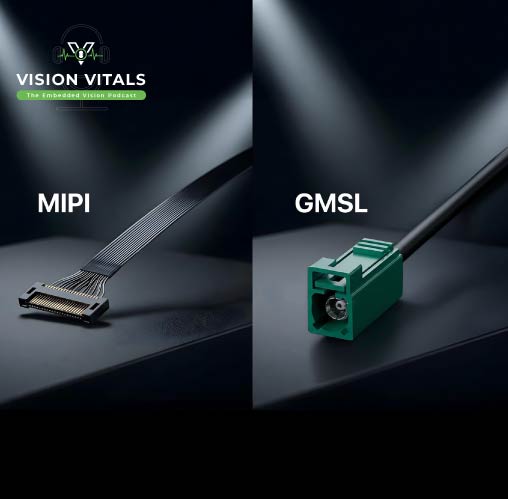
Alright, welcome back to Vision Vitals – THE go-to podcast for getting exclusive insights into embedded vision technologies. So, today we're getting into, honestly, a very critical design decision in embedded vision: GMSL camera interface versus MIPI camera interface.
As you may already know, both are high-speed interfaces. But they're really meant for different worlds. I mean, if you're working on something like a robot, a smart traffic system, or an automotive setup, choosing the wrong one can, well, it can introduce a lot of headaches down the line.
Here to help us sort through the specs and the use cases is our embedded vision expert.
Welcome back.
Hey, thanks. Yeah, this is a good one to dig into. And I'm excited to share my insights about how to make the right choice while selecting a camera interface.
So, GMSL relies on something called SerDes technology, right? Can you explain what that is and why it matters?
Speaker:
Sure, yeah. So SerDes stands for Serializer/Deserializer. Umm… it's a technique that's popular in telecom, datacom, and industrial apps because it offers high data rates and long-distance support. Basically, it takes parallel data and converts it into a high-speed serial stream over a single cable, like a coaxial cable or a shielded twisted pair.
That, you know, cuts down on the number of wires and connectors you need, which simplifies things and really boosts reliability in harsh environments. For GMSL cameras, this SerDes technique is what lets you send video, control data, and even power over one cable for up to, umm… 15 meters without losing performance.
Host:
Got it. Now, what exactly is a MIPI interface in contrast?
Speaker:
Right. So MIPI is a high-speed protocol mainly for transmitting video and image data between a camera and a host processor. It's, you know, really widely used in mobile devices. The MIPI CSI-2 variant offers a max bandwidth of about 6 Gb per second. But, umm, the big catch is cable length.
The maximum for a standard MIPI CSI-2 connection is only about 30 centimeters. So it's great when everything's close together, like in a phone or a compact device, but it's not meant for longer runs.
Host:
So distance is the first major differentiator. Can we go through the other key parameters one by one? Let's start with EMI/EMC performance. Why is that a big deal for GMSL?
Speaker:
Yeah, electromagnetic interference is a serious challenge, especially in automotive or industrial settings. GMSL has built-in features to handle it. For example, umm, programmable spread spectrum capability is built into each GMSL serializer and deserializer chip.
This improves EMI performance without needing an external clock. Some serializers, like the MAX96705, even have a high immunity mode, HIM, for more robust control channel communication in really noisy environments. It's a key feature for safety-critical camera applications.
Host:
What about video handling features? Does GMSL offer anything special there?
Speaker:
It does. GMSL supports video duplication and aggregation modes. Umm, the splitter mode lets you connect one serializer to two deserializers, which is great for display applications. The aggregation mode, or reverse splitter mode, connects two serializers to one deserializer, which targets multi-camera setups. This lets you manage multiple video streams efficiently over a single link.
Host:
And how does GMSL ensure data integrity over longer, noisier cables?
Speaker:
That's where the Automatic Repeat Request, ARQ, feature comes in, especially in GMSL2. It's an error control method. If the transmitter doesn't get an acknowledgment for a data packet from the receiver, it automatically retransmits it.
This, combined with the cyclic redundancy check in GMSL2, ensures really reliable data transmission. It's crucial for maintaining the robustness of critical control functions.
Host:
What about compatibility and support for multiple cameras?
Speaker:
Umm, two things. First, backward compatibility. GMSL1 and GMSL2 interfaces support a backward compatibility mode, so newer components can work with older ones, though some GMSL2 features might not be available in that mode. Second, virtual channel support. GMSL deserializers can decode multiple virtual channel IDs.
This, combined with the MIPI CSI-2 specification, allows for multiple camera capture over the same link, which is essential for systems like vehicle surround-view.
Host:
It's common knowledge among product developers that platform support is always a practical concern. What's the landscape there?
Speaker
For rapid prototyping, GMSL cameras have good off-the-shelf support for platforms like the NVIDIA Jetson development kit and Connect Tech's carrier boards. MIPI CSI interfaces are also widely supported on those same Jetson modules. So both have strong ecosystem support, but the choice often comes back to the physical constraints, like distance.
Host:
And finally, on the comparison side: cost. How do they generally stack up?
Speaker:
GMSL cameras are typically more expensive. They're built for longer distances and harsher environments, which adds cost. Using coax cables instead of STP can help reduce that a bit. MIPI cameras can be cheaper upfront, but if you need a custom driver for your specific platform, that adds development time and cost. So the total cost depends on your project's needs.
Host:
That's a thorough breakdown of the technical parameters. Now, let's talk applications. Where does GMSL become the clear choice? Start with robotics.
Speaker:
Umm, in robotics, especially for autonomous mobile robots, AMRs, you often need cameras placed far from the main compute unit for navigation or inspection. GMSL's 15-meter reach is perfect here. These applications also need fast frame rates and low exposure times, which GMSL supports while maintaining data integrity over that distance.
Host:
What about smart traffic systems?
Speaker:
Yeah, smart traffic systems need to transmit captured video data over long distances, from intersections or poles back to a central unit. GMSL's long cable length and reliability make it a strong fit. It can handle the outdoor environment and the need for multiple cameras over a single reliable link.
Host:
Let's move on to automotive applications- what's the right choice of interface for them?
Speaker:
Well, firstly, Advanced Driver Assistance Systems need high reliability and flexibility for transmitting uncompressed camera feeds for functions like lane keeping or collision avoidance. GMSL's SerDes technology meets those essential needs. Secondly, fleet management and surround-view systems for large vehicles like trucks. You need multiple cameras placed around the vehicle, often far from the host processor, to eliminate blind spots. GMSL's distance capability is critical there.
Host:
What about infotainment systems inside vehicles?
Speaker:
Right, automotive infotainment. These systems might have displays or cameras that are positioned a considerable distance from the host processor. For a reliable, high-quality video feed over that distance within a vehicle's electrically noisy environment, GMSL is preferred over MIPI or USB.
Host:
So, to wrap up the application side, if you need reliable, high-bandwidth video, especially in a challenging environment, GMSL is the tool for the job, right?
Speaker:
Exactly. It's about matching the interface to the physical and performance demands of the application.
Host:
Perfect. Thank you so much for walking us through all of that.
Speaker:
Sure thing. It's always a pleasure to share my insights on Vision Vitals.
Host:
For our listeners looking to explore GMSL or MIPI camera solutions for their embedded vision systems, you can find more details on e-con System dot com. You can browse our full portfolio of cameras, including GMSL and GMSL2 modules with features like HDR, IP-rated enclosures, and NVIDIA Jetson compatibility.
And if you need help with finding the perfect GMSL camera for your application, please get in touch with our team of camera experts at camerasolutions@e-consystems.com.
Thanks for tuning into Vision Vitals.
As always, we'll see you next time with more insights about embedded vision technologies.
Close Full Transcript


 Mr. Thomas Yoon
 +82-10-5380-0313




 Employee Login