Hey everyone, welcome back to Vision Vitals - your friendly-neighborhood podcast for all things related to embedded vision.
You know, sometimes when you're building a vision system, it feels as though you're picking between tools that all look the same on the surface. But the small details, like which version of GMSL you choose, can make or break your entire setup.
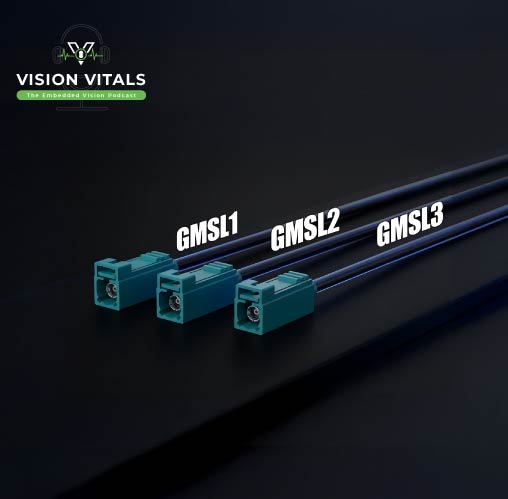
In today's episode, we're digging into GMSL1, GMSL2, and GMSL3. What really changed between them? And more importantly, when should you care?
Here with us again is our embedded vision expert.
Thanks for joining.
Always good to be here. Yeah, this is a topic I get asked about a lot, especially from teams who are upgrading systems and aren't sure where to start.
Okay, first let's talk about GMSL1. When it came out, what kind of problems was it solving that people were struggling with before?
Speaker:
You know, before GMSL1, if you wanted to put a camera more than a meter or two from your processor, you were dealing with signal degradation, noise, and a ton of wiring. GMSL1 came in and said, "Hey, here's a single cable that can do 15 meters, carry power, video, and control data, and give you up to 3 Gbps."
That was, umm, huge for early automotive and industrial setups where you needed a camera on a mast, on a robot arm, or outside the vehicle cabin.
Host:
So it was a “simplicity” play as much as a performance one.
Speaker:
Totally. Less wiring, fewer points of failure, easier to install. But of course, it had its limits. Umm, once you wanted more than 720p, or faster frame rates, or you were in a really electrically noisy environment, you started hitting walls. People were asking for HD, for 4K, for more cameras in one system… and that's where GMSL1 started to feel a bit… tight.
Host:
Tight as in not enough bandwidth?
Speaker:
Bandwidth, yes, but also flexibility. Umm, GMSL1 didn't have built-in error correction as we see now. So if you had a noisy environment, you could get glitches. And if you wanted to run multiple cameras, you were basically running multiple cables back to the host. It worked, but it wasn't elegant.
Host:
Then GMSL2 comes along. What changed? Was it just a speed bump?
Speaker:
Not just speed, no. I mean, speed was a big part. They doubled the data rate to 6 Gbps. So now you're talking 1080p, even 4K in some setups. But the real story was in the reliability and the smarts. GMSL2 added something called the Automatic Repeat Request feature.
Host:
What does it actually do?
Speaker:
It's like a “message received” handshake. If a data packet gets corrupted, the receiver can ask the transmitter to send it again. Automatically. That's huge for safety-critical stuff, especially in cars or medical devices. It also improved noise immunity and, you know, they kept backward compatibility, so you could mix GMSL1 and GMSL2 in the same system if you had to.
Host:
Is it fair to say that GMSL2 was kind of like GMSL1 grew up and became more powerful?
Speaker:
Hahaha, yeah, that's one way to put it. It could handle more data, more reliably, and it played nicer in complex systems. Umm, but then… the demand for data just kept growing. More pixels, more frames, more cameras.
Host:
Enter GMSL3, I presume?
Speaker
Exactly. GMSL3 is… well, it's a beast. We're talking 12 Gbps now. That's enough for an 8K video, or multiple 4K streams at once. But again, it's not just about speed. They've improved the signal integrity so much that you can run these data rates over even longer distances without losing clarity.
Host:
What about in really harsh environments?
Speaker:
It's built for this. The noise immunity is even stronger. It's got better shielding, better encoding. You can run this in an electric vehicle next to huge motors and not worry about interference. Umm, it also supports bidirectional communication more efficiently, so you can send commands to the camera and get data back on the same wire without lag.
Host:
Now, when would someone actually need GMSL3? Is it overkill for most applications?
Speaker:
Umm, not necessarily overkill. It's just matching the need. If you're building an autonomous truck with eight 4K cameras doing real-time object detection, you need GMSL3. If you're doing high-speed industrial inspection with multiple high-res cameras, you need GMSL3. But if you're just putting a backup camera on a forklift, GMSL2 might still be perfect.
Host:
So, it's about matching the tool to the job? Do I have that right?
Speaker:
Yep. And also thinking about future-proofing. If you're designing a platform today that might need to support higher-resolution sensors in a year or two, going with GMSL3 now might save you a redesign later.
Host:
What about cost? I mean, moving from GMSL1 to GMSL3, are we talking a big jump in price?
Speaker:
Yeah, generally. The newer the tech, the more you pay upfront. But it's not just about the chip cost. It's about the total system cost. With GMSL3, you might need fewer cables, less shielding, maybe even fewer processors, because you can aggregate more streams. So in a big system, the ROI can actually make sense.
Host:
And what about compatibility with cameras and sensors? If I pick GMSL3, am I locked into only the latest cameras?
Speaker:
Good question. Actually, GMSL3 is designed with backward compatibility in mind. You can often use older GMSL2 or even GMSL1 cameras with a GMSL3 deserializer, but you'll be limited to the older spec's speed. So it gives you flexibility to upgrade cameras over time without changing your whole backbone.
Host:
What about cable types? Has that changed between the GMSL versions?
Speaker:
Well, the principle is the same, whether coax or shielded twisted pair. But the quality requirements go up. With GMSL3 running at 12 Gbps, cable quality really matters. Even a small impedance mismatch can cause issues. So, you might need better cables, but you're also getting way more data through them.
Host:
Let's talk about real-world mistakes. What do people usually get wrong when choosing between these versions?
Speaker:
Umm, two big ones. First, over-specifying. I've seen teams pick GMSL3 for a simple 1080p monitor camera that never moves. That's just wasted budget. Second, under-specifying. They go with GMSL1 because it's cheap, then try to push 4K through it and wonder why the video is glitchy. You really have to model your data needs, your environment, and your growth plan.
Host:
Any advice for someone sitting down to spec this out for the first time?
Speaker:
Umm, start with your camera requirements. These include resolution, frame rate, exposure time, and how many cameras. Then map that to bandwidth. Add 20% for overhead and future needs. Then look at your environment. Is it noisy? Long cable runs? Harsh conditions? That'll point you to the right GMSL generation. And don't forget to talk to your camera solution provider early because they can help match the interface to the sensor.
Host:
This has been super practical. Thanks for walking us through it all.
Speaker:
Anytime. Glad to be a part of this wonderful podcast!
Host:
And for our listeners, if you're looking to better understand GMSL cameras or need help selecting the right version for your embedded vision system, check out our full portfolio at www.e-consystems.com.
You can also reach out to our camera experts at camerasolutions@e-consystems.com.
Thanks for joining us for another episode of the Vision Vitals podcast.
We can't wait to see you again!
Close Full Transcript


 Mr. Thomas Yoon
 +82-10-5380-0313




 Employee Login