Alright, welcome back to e-con Systems' weekly podcast - Vision Vitals.
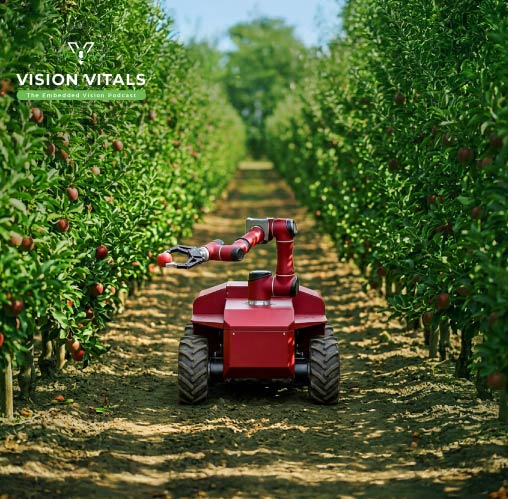
Let me ask you something. Have you ever watched a robot try to navigate a farm? Not a perfectly manicured test field. A real farm. Dirt flying. Sun beating down. Crops growing every which way. It's chaos.
Most vision systems look at that and just... give up. They see noise. They can't tell where the row ends and the soil begins. They definitely can't tell if that apple is six inches away or eight.
So, today we're talking about 3D iToF cameras in smart agriculture.
Big thanks to our resident embedded vision expert who is sitting across from me.
Appreciate you coming on again.
Good to be here. Always like talking about applications where the tech actually has to survive in the wild!
Hehehe as do I! Shall we start with the big picture? I think we should. What makes agricultural systems such complex, hard-to-deliver use cases for vision systems?
Speaker:
Well, you see - smart agriculture puts robots in open fields where visual conditions change hour by hour. Morning light, noon glare, evening shadows. They go through dust, rain, and fog. Meaning that crop rows bend and twist, the soil rises and falls, and plants grow and overlap.
Color-based vision struggles once you throw shadows and dust and dense foliage into the mix. Depth perception becomes the factor that determines whether a machine keeps moving or loses alignment.
Host:
Hmm. So it's not about what the plant looks like. It's about where it actually is in space.
Speaker:
Exactly. Row detection and crop harvesting form the core of agricultural autonomy. A robot first needs depth data to identify row position, spacing, and ground variation. The same depth information then guides harvesting, where fruit location, height, and reach distance drive every picking action.
Small depth deviations at either stage can cascade into missed rows or damaged produce.
Host:
Okay, let's dig into row detection first. How do 3D CW iToF cameras handle that?
Speaker:
Row detection depends on consistent depth data across soil, stems, and foliage that change shape and position through the day. 3D Continuous-Wave iToF measures distance directly through phase calculation of modulated infrared light. It produces Z-axis depth that stays stable when color and texture vary.
Host:
So, it doesn't care if the plant is green and the soil is brown?
Speaker:
Hahaha care is an interesting word. But yeah. It doesn't care at all! After all, it's depth-first. The camera gives the robot a dependable way to read the field structure before any harvesting action begins. That's the foundation.
Host:
Interesting- and what specific features make row detection work out in the field?
Speaker:
First is dense depth for continuous row visibility. High pixel density in a 3D CW iToF sensor captures crop rows as continuous depth structures rather than broken segments.
Host:
What does that look like in practice? Like when the robot's actually moving through a field?
Speaker:
Narrow gaps between plants, thin stems, uneven spacing — errr all of it remains visible in the depth map. The robot doesn't lose the row when crops grow irregularly or start overlapping. It sees a continuous line instead of ermmm scattered points.
Host:
Huh. So the row doesn't disappear when things get messy. What else helps with row detection?
Speaker
Ground profiling and spacing measurements are easy answers. Because the depth map represents ground height, slope, and row spacing all in a single frame. Variations in soil elevation register as gradual depth changes instead of visual noise.
Host:
You mean the robot can tell the ground is sloping even if it looks flat to a regular camera?
Speaker:
Oh yeah. Agricultural robots use that information to maintain alignment between rows while accounting for ridges, furrows, and wheel tracks.
Host:
Fields are huge, though. How does the camera perform when the robot needs to see farther out?
Speaker:
Dual-frequency CW iToF operation improves signal quality across longer distances in open fields. Depth readings up to 3 meters stay consistent across dry soil, moist ground, and leaf surfaces that all reflect light differently.
Host:
Woah. Does this mean that dry dirt and wet leaves don't break the depth reading?
Speaker:
Totally. That stability keeps row detection reliable as robots move across large plots during planting, monitoring, or harvesting passes.
Host:
Alright, so row detection gets the robot to the right place. But what happens when it's actually time to pick something? That feels like a different problem entirely.
Speaker:
Completely different. Crop harvesting changes the depth challenge from wide-area perception to close-range accuracy. Once the robot reaches the crop row, it has to judge fruit position, height, and separation with minimal tolerance for error.
Host:
Uhmm how much error are we talking about here?
Speaker:
Missing by a centimeter can mean damaged produce or a failed pick. 3D Continuous-Wave iToF delivers direct distance measurement at the point of interaction. Harvesting actions stay aligned with real crop geometry rather than visual estimates.
Host:
Let's talk about what that looks like, case by case. Start with fruit height. How does the camera help there?
Speaker:
Accurate fruit height estimation. High-frequency modulation improves Z-axis resolution at close range. Small height differences between fruit, stems, and branches register clearly in the depth map.
Host:
The robot knows exactly how far up the fruit is, not just roughly?
Speaker:
Yeah. That keeps the picking tools aligned during approach and grasp. No guessing.
Host:
What about when you've got different surfaces? Like a shiny apple next to a dull leaf?
Speaker:
Handling mixed surface properties. Crops present varied reflectivity. Matte leaves. Glossy fruit skins. One setting doesn't work for everything.
Host:
How does the camera deal with that without going crazy?
Speaker:
Programmable configuration contexts. The sensor switches settings for different surface responses. Depth data stays usable across mixed materials during harvesting. It doesn't break when you move from a leaf to an apple.
Host:
Ah, I see. What about when fruit is clustered together? Seems like that would confuse things.
Speaker:
Separation of overlapping produce. Closely clustered fruits often overlap in color images. Looks like one big blob.
Host:
But depth can tell them apart?
Speaker:
High-resolution 3D iToF depth reveals separation through small depth discontinuities. The robot can identify individual targets instead of treating clusters as a single object. It knows where one fruit ends and the next begins.
Host:
And during the actual picking motion? The robot's moving, the fruit's maybe moving a little. How does the camera keep up?
Speaker:
Controlled approach during picking actions. Depth updates occur directly at the camera level, keeping motion decisions tied to live distance data. As the gripper moves closer, depth values adjust in real time.
Host:
So it's not relying on a measurement that's even half a second old?
Speaker:
Basically, yeah!. That reduces overreach and missed picks during errr harvesting cycles.
Host:
We spoke about DepthVista Helix quite a bit. What is that camera bringing to the table specifically?
Speaker:
DepthVista Helix is e-con Systems' brand-new 3D CW iToF camera module. Powered by onsemi's AF0130 CMOS ToF sensor, it uhmm delivers high-resolution depth data at 1.2MP at 60 frames per second and VGA at 30 frames per second.
Host:
And it's built to handle outdoor conditions?
Speaker:
Yeah. It comes with on-camera depth computation and a high accuracy depth range from 0.2 meters to 6 meters. It can be customized with multiple VCSEL illumination options, including a 4-VCSEL configuration for outdoor deployments. Plus, DepthVista Helix extends usable depth sensing up to 3 meters in open-field environments and up to 6 meters for indoor use cases.
Host:
I saw something about an RGB option too?
Speaker:
Yep. This camera can be offered with an optional RGB sensor alongside depth output. It enables simultaneous capture of visual information and 3D depth data in the same sensing pipeline.
Host:
Nice. If someone's out there building agricultural robots, what's the main thing they should walk away with from this conversation?
Speaker:
That 3D CW iToF depth solves the core problems such as:
- Dense depth for continuous row visibility
- Ground profiling
- Stable performance across distance and reflectivity
- Accurate fruit height estimation
- Mixed surface handling
- Overlap separation
- And real-time depth updates during picking
Those aren't nice-to-haves. They're what make the difference between a robot that navigates a field successfully and one that loses alignment or damages produce.
Host:
Good stuff. Appreciate you walking through all this.
Speaker:
My pleasure. Always enjoy discussing the vision part of agri-tech.
Host:
That brings the curtains down on today's episode of Vision Vitals.
If you need more information on DepthVista Helix and how it applies to agricultural use cases, everything's available on www.e-consystems.com
If you've got questions about system architecture or how to integrate depth sensing into your specific application, our vision experts can be reached at camerasolutions@e-consystems.com.
Thanks for hanging out with us today. We'll be back with another episode soon.
Until then - keep your eyes on the future of embedded vision!
Close Full Transcript


 Mr. Thomas Yoon
 +82-10-5380-0313




 Employee Login