Welcome back to Vision Vitals, e-con Systems' podcast on embedded vision technologies.
I'm your host, and today, we're talking about a question that comes up early in many iToF design decisions.
Continuous Wave versus Pulsed iToF, and which architecture gives you more reliable depth.
And that choice is umm critical because it can influence outdoor behavior, thermal load, power draw, and range strategy. Sometimes, even the kind of scene data your system gets.
We're joined by our resident vision solution expert, who works closely on 3D vision and depth-sensing technologies.
Glad to be here, as always. And you're absolutely right. That choice is indeed critical.
So, let us start there. What is the real difference between Continuous Wave and Pulsed iToF?
Speaker:
Yeah, so at the highest level, both are indirect Time-of-Flight methods. In both cases, the system emits modulated light and compares the returning signal against the emitted one to estimate distance.
Where they differ, mmm, is in how that distance gets calculated.
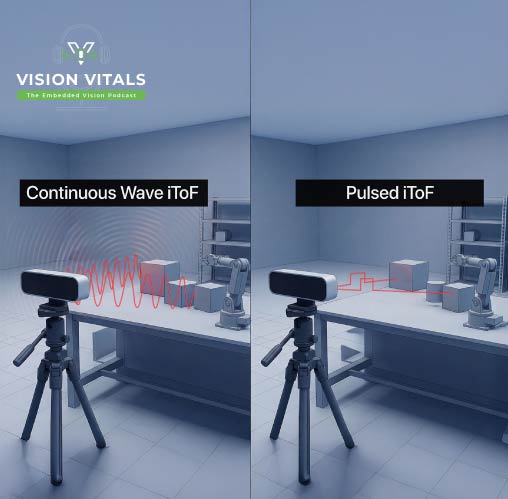
In Continuous Wave, or CW, the emitter projects a sinusoidal or square-wave modulated beam. The reflected signal comes back with a phase delay, and that phase shift maps to distance.
In Pulsed iToF, the emitter sends short bursts of light. Then the system looks at the timing offset and correlation strength of the returning signal.
Host:
Right, right, so the shared goal is depth. Where does CW start to stand out, though?
Speaker:
CW becomes attractive when you want fine depth mapping and richer scene data. Since the system can extract amplitude and phase at the same time, developers get insight into both intensity and distance. But this is the case with the Pulsed approach, as well.
Then, there is the flexibility side. Developers can tune the modulation frequency for shorter or longer working distances. And, you know, CW systems can use relatively compact driver circuits.
So, mmm, CW has real appeal in structured environments where detailed mapping matters. And that's great for conveyor systems and robotic guidance devices.
It is also ideal when lighting conditions are more manageable, similar to Pulsed iToF, since neither relies on external lighting conditions in indoor settings.
Host:
Is there a trade-off at all? I mean, does CW start to feel pressure at some point?
Speaker:
Three places usually come up.
First, the demodulation side gets demanding. If you are using multiple frequency bands to deal with phase ambiguity and extend range, the circuitry has to handle that very accurately.
Second, ambient light can push error into the measurement, especially in outdoor or uncontrolled scenes.
Third, thermal load rises because the emitter runs continuously. So over longer operating periods, heat becomes part of the engineering conversation.
Now, that does not make CW a weak choice. It just means CW shines when the deployment conditions fit its strengths.
Host:
Now, let us flip it. What is the Pulsed approach doing differently?
Speaker:
Pulsed iToF sends discrete light bursts, often at nanosecond-scale pulse widths. Because the source fires in bursts and remains idle between them, average power consumption goes down and thermal stress comes down too.
That is one major advantage.
Another is ambient-light tolerance. Pulsed systems use sharp timing structure, which helps isolate the signal in high-background conditions. That makes Pulsed attractive for sunlight-heavy scenes and other demanding environments.
And then there is range scaling. Teams can extend coverage by adjusting pulse width and repetition rate, instead of relying on growing modulation complexity.
Host:
Mmm. And the cost of that choice?
Speaker:
The hardware has to move faster. Pulsed systems need detectors and correlation circuits that can capture rapid transients. Synchronization between emitter and sensor also has to remain highly stable.
That can raise integration complexity and system cost.
So again, really, this is less about one winner for every case and more about matching the architecture to the operating environment.
Host:
Right, let us make that comparison more practical. If a team asks, “Which architecture delivers reliable depth,” what should they examine first?
Speaker:
I would break it into five questions.
First, what kind of lighting are you dealing with? If the system will live in high-background outdoor scenes, Pulsed usually has an edge because of its resistance to ambient light.
Second, what matters more, richer scene data or depth-first performance? CW can deliver amplitude and phase together, which gives more scene information. Pulsed keeps the focus more on depth, while intensity takes a secondary role.
Third, what are your power and thermal targets? CW carries higher average power draw and higher emitter heating. Pulsed reduces both through burst operation.
Fourth, how are you extending range? CW usually does that through multiple modulation frequencies. Pulsed does it through pulse width and repetition-rate control.
Fifth, what is the actual deployment? For structured automation, robotic guidance, and many controlled indoor environments, CW can be a very good fit. For automotive safety, robotics in sunlight, and outdoor monitoring, Pulsed often makes more sense.
Host:
That's a very useful framework to decide! So, let's look at the big picture, these days. Where exactly does the industry seem to be heading now?
Speaker
One interesting direction is hybrid modulation.
Researchers are exploring dual-mode sensors that can use CW in one set of conditions and Pulsed in another. So you could use CW for fine indoor depth mapping, then switch to Pulsed outdoors when ambient light gets harsher.
That kind of adaptability is compelling because many real deployments move between multiple lighting environments during the same operating cycle.
And, mmm, it also tells you something broader. The debate is moving away from “Which architecture is better in general” toward “Which architecture fits this environment, this workload, and this reliability target.”
Host:
Right, that leads well into product fitment. You mentioned earlier that e-con Systems has a CW-based iToF camera in this space. Tell us about that.
Speaker:
Yes. DepthVista Helix is e-con Systems' latest iToF-based vision solution, and it is based on Continuous Wave Time-of-Flight. It is a rugged 1.2MP 3D ToF camera that processes depth data directly on the sensor. That helps capture fast-moving scenes while reducing processing pressure on the host side.
It also comes with an IP67-rated build and laser safety monitoring, so the camera is positioned for robotics and automation use cases that need reliable real-time spatial awareness in demanding environments.
Host:
And if someone listening is evaluating indirect ToF architecture right now, what is the main takeaway from this episode?
Speaker:
Yeah, here is the takeaway.
If your program lives in structured automation and you want fine mapping plus amplitude-and-phase data, CW deserves serious attention.
If your program has to deal with sunlight, high background noise, or vehicle-style deployment conditions, Pulsed can be the smarter architecture.
And if your use case spans both worlds, hybrid modulation is a direction worth watching.
Host:
That wraps today's episode of Vision Vitals.
We looked at how Continuous Wave and Pulsed iToF differ, where each one fits best, and why reliable depth starts with the right architecture choice.
In case you didn't already know, e-con Systems offers DepthVista Helix, a CW-based iToF camera, as well as the Pulsed-based DepthVista GMSL IRD camera series.
For more details, please visit e-con Systems dot com.
And for a one-on-one discussion on camera selection, system architecture, or specific application needs, please write to camerasolutions@e-consystems.com.
Thank you, folks, for listening - and giving us the pleasure of offering our insights.
We will be back soon with another episode of Vision Vitals.
Have a great week!
Close Full Transcript


 Mr. Thomas Yoon
 +82-10-5380-0313




 Employee Login