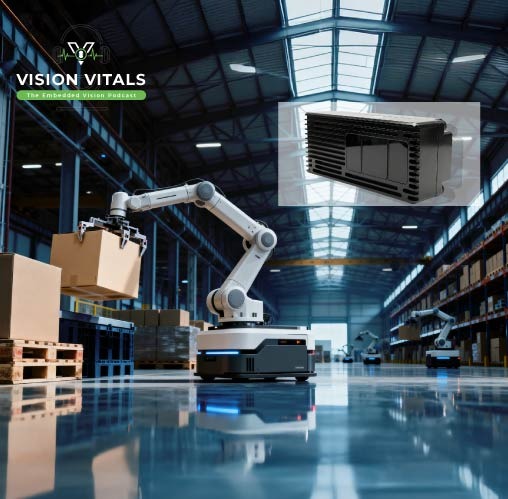
Welcome back to Vision Vitals, e-con Systems' weekly podcast on embedded vision technologies. I'm your host - and today, we'll be discussing how 3D iToF cameras enable reliable perception for AMRs and robotic picking systems.
As always, our embedded vision expert will help us understand what's actually going on!
Let me set the scene first.
So there's an Autonomous Mobile Robot moving through a warehouse. It's supposed to navigate around obstacles. Basically, do its job, not cause problems! But then it misses a thin vertical rack edge and plows right into it. Now there's downtime. There are repairs. All this leads to lost productivity.
If such incidents keep happening, pretty soon the whole operation gets disrupted, right?
Now, guess what the one thing these failures have in common is.
Well, if you're thinking “Unreliable or low-resolution 3D perception” - you have absolutely nailed it! Because the margin for error in automated warehouses and factories right now is tiny. If the robotic system gets the 3D depth wrong even by a few centimeters, the business pays for it!
Now, what is it about warehouse environments that makes them so hard for vision systems to handle?
Speaker:
Yeah, the simple answer is that they're dynamic and cluttered. You've got mixed materials everywhere. You've got reflective floors. Uneven lighting. Thin structures like rack edges and poles are easy to miss.
Standard sensors fail because they don't have the specific tools needed to interpret all that chaos accurately. They collect data but they can't make sense of it in a way that prevents failures.
Host:
How do 3D iToF cameras approach that differently?
Speaker:
So, a 3D iToF camera converts that chaos into reliable data by measuring depth in a specific way. It emits modulated infrared light and, well, calculates the phase difference between what it sends out and what bounces back.
Umm that phase shift tells you exactly how far away things are.
Host:
Aha. And that's more reliable than other methods?
Speaker:
For these applications, definitely yeah. Cameras like e-con Systems' DepthVista Helix capture high-resolution depth, confidence, and IR data simultaneously. And they process depth directly within the camera itself. The robotic system gets real-time, precise output without loading down the host processor.
Host:
Let's get into the specifics. What are the actual iToF features that prevent these operational failures?
Speaker:
There are four that directly counteract the problems people run into. First is high pixel density for detecting thin hazards.
Host:
What does that mean in terms of actual resolution?
Speaker:
DepthVista Helix runs at 1280x960 resolution. That provides significantly higher pixel density than standard VGA depth cameras.
Host:
Walk me through why that matters for something like a rack edge. How does having more pixels stop an AMR from missing it?
Speaker:
Because higher pixel density significantly reduces the angular width of each pixel's field of view. When each pixel covers a smaller slice of the scene, thin objects like poles, bars, or pallet edges are far less likely to fall between pixels and go undetected. But thanks to DepthVista Helix, they actually show up in the depth map, instead of disappearing into gaps. Therefore, the AMR can see them as solid obstacles.
Host:
Ah. So more pixels means smaller gaps between what the camera sees. What's the second feature?
Speaker
Multipath rejection for ignoring false reflections. In environments with reflective floors or shiny surfaces, you get multipath reflections that introduce phase distortion. That creates false depth readings.
Host:
Wait. So, the camera thinks there's an obstacle where there isn't one?
Speaker:
Well, in a sense, yes. But the sensor's processing flags those pixels with low confidence. The system can then filter them out and prevent unnecessary emergency stops or false obstacle detections.
Host:
Wow. Got it. Basically, the robot doesn't slam on its brakes because it thought a reflection was a wall - Now, what's the third?
Speaker:
Hehehe right. Third is dual-frequency operation. This technology, basically, offers better precision and an extended depth range.
Host:
Why can't a standard iToF camera just do that? What's the limitation it's overcoming?
Speaker:
At longer distances, depth measurements tend to get noisy. The signal degrades. Dual-frequency operation keeps that signal clean and stable, which is critical for AMR navigation across large warehouse floors. Without it, your robot's perception falls apart past a certain range.
Host:
Okay, and the fourth feature?
Speaker:
Programmable contexts for mixed-material handling. This one's huge for bin-picking. A single exposure setting fails when you have varied materials in the same bin.
Host:
Give me a concrete example of where that becomes a problem.
Speaker:
Say you've got a bin with dark rubber parts and shiny metal parts mixed together. Dark rubber absorbs light. Shiny metal reflects it. One exposure setting can't accurately gauge depth for both. The sensor stores pre-configured settings optimized for different properties. The robot switches between these modes instantly to ensure all parts get detected accurately.
Host:
I see. Instead of one setting that does a mediocre job on everything, you get settings tuned specifically for each material type.
Speaker:
Totally. And that prevents gripper misalignment or damage from misjudged height.
Host:
Mmm let's talk about where people are actually deploying these cameras. What are the top applications?
Speaker:
First is AMR navigation and safety. In warehouse navigation, you need two things working together. High pixel density makes sure real thin obstacles like rack edges get detected. Multipath rejection makes sure false ones from floor reflections get ignored.
Host:
That combination prevents unnecessary emergency stops?
Speaker:
Yeah, and collisions too. Plus, dual-frequency operation gives you the stable, long-range depth measurements required for confident path planning and obstacle avoidance across large facilities.
Host:
second application?
Speaker:
Precision bin-picking. Programmable configuration contexts solve the problem of mixed materials in a single bin. The system switches instantly between settings optimized for dark rubber and shiny metal, capturing accurate depth for all parts.
Host:
And that directly addresses gripper failure?
Speaker:
Mm-hmm. A 3D iToF camera directly addresses the issue of gripper failure due to misjudged height from material reflectivity variations. The robot knows exactly how far away that shiny part is, even though it's reflecting light everywhere.
Host:
What about the third application?
Speaker:
Palletization and depalletization. In logistics, confidence-based measurement validation is critical. When you're depalletizing, shiny surfaces and box edges can generate false depth signals.
Host:
What does the camera do about those false signals?
Speaker:
The sensor flags those unreliable pixels with low confidence scores. That enables the robot to ignore phantom objects and grasp only real boxes. Prevents errors where the robot attempts to pick up reflections.
Host:
Huh. So it doesn't try to grab something that isn't physically there.
Speaker:
Right. This makes sense for the fourth application, as well, which is outdoor and harsh environment operations. For smart agriculture vehicles and other outdoor AMRs, you need a camera that can survive.
Host:
What makes the difference when you take it outside?
Speaker:
An IP67-rated enclosure ensures reliable performance despite dust, moisture, and variable ambient light. Along with the 940nm wavelength, the robust design enables accurate depth data capture. Speaking generally, this technology can support measurements up to several meters outdoors. However, for our current product to achieve that range, it would require specific customization .
Host:
You've mentioned e-con Systems' DepthVista Helix a bunch of times. Tell me more about that camera specifically.
Speaker:
Yeah, DepthVista Helix is e-con Systems' latest 3D camera based on Continuous Wave Time-of-Flight technology. It uses the onsemi AF0130 sensor.
Host:
What kind of customization options does it offer?
Speaker:
It can be customized with multiple VCSEL illumination options, including a 4-VCSEL configuration for outdoor deployments. That enables extended depth sensing up to 6 meters. It can also be offered with an optional RGB sensor alongside depth output, and you can ensure simultaneous capture of visual and depth data.
Host:
Nice. So if someone's listening and dealing with these exact problems — thin obstacles getting missed, reflections causing false readings, mixed materials in bins, outdoor conditions — what should they take away from this?
Speaker:
The takeaway is that 3D iToF cameras with the right features directly solve these failures. High pixel density. Multipath rejection. Dual-frequency operation. Programmable contexts. Those aren't nice-to-haves. They're what make the difference between a robot that works reliably and one that causes downtime, repairs, and lost productivity.
Host:
Good to know. Appreciate you walking through all this.
Speaker:
Yeah, it's been my pleasure, and I really hope the listeners got something useful out of this episode.
Host:
And that closes today's episode of Vision Vitals.
We saw how 3D iToF cameras enable reliable perception in AMRs and robotic picking systems. If you want more information on DepthVista Helix and its use cases, please visit e-con Systems dot com.
Of course, if you need a one-on-one discussion on system architecture, integration approach, or application fit, please write www.e-consystems.com.
Thanks for listening today.
We'll be back very soon with the next episode of Vision Vitals.
Until then -stay informed and be future-ready!
Close Full Transcript


 Mr. Thomas Yoon
 +82-10-5380-0313




 Employee Login