Welcome back to Vision Vitals - a podcast that offers expert insights into the embedded vision universe without any of the fluff!
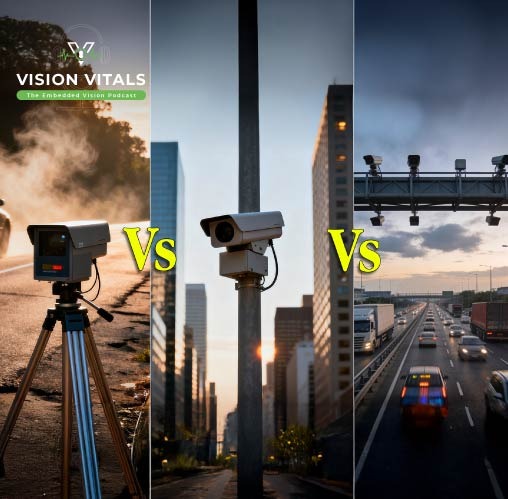
Today were tackling a question that comes up in traffic planning, urban design, and smart city projects: when you're implementing automated speed enforcement, how do you decide between mobile, fixed, and average speed cameras?
Each of these systems serves a distinct purpose, and selecting the right one can mean the difference between effective safety management and costly underperformance.
To help us navigate the specifics, were joined once again by our embedded vision expert. Welcome back.
Thanks, Im glad to be here. Umm, this is an important topic because it really ties technology to real world outcomes. You know, the camera itself is just one part of the equation. Where and how you deploy it… thats what determines its success.
Let's start with the first camera type. What exactly is a mobile speed camera, and what makes it mobile in both form and function?
Speaker:
Yeah, good question. So, a mobile speed camera is basically a portable enforcement unit. It's designed to be mounted on vehicles, tripods, or temporary poles. In terms of function, it typically uses radar, laser, or a vision-based system to detect a vehicle's speed. It captures evidence using a global shutter sensor, which is essential because it freezes the entire frame at once. That eliminates the motion blur you'd get from a rolling shutter with a fast-moving car, you know?
And, umm, many units also have optical zoom to clearly resolve details like license plates from a distance. Crucially, they have onboard processing that handles the speed calculation, image capture, and initial violation packaging right at the edge, in real time. So its fast, and its self-contained.
Host:
So its entire value proposition is portability. Where does that portability deliver the most practical advantage for traffic authorities?
Speaker:
Well, its advantage is highest in dynamic or temporary scenarios, right? The classic examples are temporary highway work zones, school zones during specific high-risk hours, areas with a sudden spike in collisions, and major public events like sports games or parades where traffic patterns are… kind of abnormal.
A mobile unit allows enforcement to be present exactly where and when it's needed, without the months long process of planning and installing a fixed system. So yeah, it's a tool for responsive, tactical safety management.
Host:
That covers flexible response. Now, for constant presence, we have fixed speed cameras. How are they fundamentally different in their design and deployment?
Speaker:
Right. Fixed speed cameras are permanent installations. They're physically embedded into the traffic infrastructure such as on gantries, poles, or overpasses, and theyre intended to operate 24/7 at a specific location. Technologically, they often integrate multiple detection methods, like radar and LIDAR, with high-speed, high-resolution imaging to monitor multiple lanes simultaneously. These systems are networked directly to central traffic management centers, allowing for real-time data transmission.
And, umm, a key component is Automated Number Plate Recognition software. This automatically reads the license plate from the captured image and cross references it with a vehicle registry, creating a seamless, automated chain from violation detection to issuing a notice.
Host:
Given their static, always-on nature, what environments benefit most from a fixed camera installation?
Speaker:
They are optimal for locations with a proven, persistent speeding problem. You know, like expressway segments with a history of serious accidents, urban intersections notorious for red light violations, the entrances and exits of tunnels where speed differentials are dangerous, and toll plaza approaches.
In these spots, the goal is deterrence through certainty. The consistent, unblinking presence of a fixed camera modifies driver behavior over the long term and generates a reliable stream of enforcement data.
Host:
Now, let's discuss the third model: average speed cameras. Their operating principle is unique. Can you explain how they measure speed?
Speaker:
Certainly. Average speed camera systems calculate a vehicle's mean velocity over a predetermined stretch of road rather than at a single point. This method involves installing camera pairs at two or more locations along a route. As vehicles pass each checkpoint, cameras capture license plate images along with timestamps. Backend algorithms then compute the average speed based on time-distance calculations.
This encourages drivers to maintain consistent lawful speeds across extended road sections rather than merely slowing down at isolated enforcement points. Average speed systems thus promote smoother traffic flow and uniform compliance with speed regulations.
Host:
What is the tangible safety outcome of this corridor enforcement approach compared to a fixed camera?
Speaker:
The primary outcome is smoother, more stable traffic flow and a reduction in accident risk over the entire enforced zone. It reduces the occurrence of aggressive braking near isolated camera points and encourages steadier driving behaviors.
This ends up lowering accident rates on long stretches prone to speeding violations. It also reduces speed variance between vehicles, which is a key factor in traffic safety. For long, high-risk stretches like tunnels or bridges, this method actively helps create a safer driving pattern for everyone passing through.
Host:
Where are average speed camera systems most effectively deployed?
Speaker
They best serve enforcement needs in areas demanding sustained speed regulation. Suitable scenarios include long tunnel passages where sudden braking poses safety risks, bridge crossings, and rural highways. Anywhere the safety goal is to manage driver behavior over a significant distance, not just at a specific black spot.
Host:
We've covered three distinct systems. But they must all rely on a common foundation of imaging technology. What are the non-negotiable camera features that apply whether it's mobile, fixed, or average speed?
Speaker:
You're right, the core imaging specs are universal for reliable enforcement. First, high-resolution sensors are mandatory for evidentiary-quality images, especially for automated plate recognition. Second, rugged environmental sealing, typically an IP67 rating or higher, is essential to withstand rain, dust, heat, and cold. Third, superior low-light performance is critical.
This is supported by inbuilt infrared illuminators to guarantee clear captures at night. Fourth, onboard Image Signal Processing, or ISP, is vital. The camera must handle exposure control, noise reduction, and wide dynamic range processing in real time to deliver a usable image in any lighting condition.
Finally, enough processing power at the edge to run detection and OCR algorithms without latency… thats what makes the system real-time.
Host:
Let's crystallize the decision. If you had to state the primary strategic strength of each type, what would it be? Start with mobile speed cameras.
Speaker:
Umm, the primary strength of mobile speed cameras is operational flexibility and rapid deployment. They are the enforcement equivalent of a rapid response team.
Host:
What about fixed cameras?
Speaker:
The strength of fixed speed cameras is persistent, automated deterrence and continuous data collection. They are a permanent sentinel for high-risk locations.
Host:
And average speed cameras?
Speaker:
The strength of average speed cameras is corridor-wide performance modification. They are engineered to calm traffic and enforce compliance over an extended area, improving safety across a zone, not just at a point.
Host:
Is it fair to say that defining the safety objective makes it possible for the correct camera type to become clear?
Speaker:
Exactly. The technology is a tool. You must start with the problem on the road. The system design follows from that.
Host:
That's an exceptionally clear framework. Thank you for the detailed breakdown.
Speaker:
My pleasure. It's all about applying vision to save lives - and thats one of the major reasons why e-con Systems is here.
Host:
Alright, so weve broken down the big three: mobile for when you need to move fast, fixed for those high-risk spots that never sleep, and average speed for keeping things steady over the long haul. The bottom line? Match the camera to the challenge.
If you'd like to explore camera options for your own traffic enforcement projects, you can find more details at e-con Systems website.
And if you need help selecting the right camera, our team has deep expertise in building vision systems for smart traffic management. Just reach out to www.e-consystems.com for a consultation.
Thanks for tuning in to Vision Vitals.
Well see you next time!
Close Full Transcript


 Mr. Thomas Yoon
 +82-10-5380-0313




 Employee Login