Hey everyone, welcome back to e-con Systems' Vision Vitals. Really glad you're here.
Pull up a chair, get your headphones out, and get comfortable. In this episode, we are talking about the technology that makes robots see the world the way they need to.
In fact, we've been getting questions from clients nonstop about 3D depth cameras. Not the theoretical stuff. The practical stuff. Like, which one do I actually put in my robot? Which one won't go cuckoo when it hits a patch of sunlight or has to figure out the difference between a reflective floor and an actual obstacle?
So, today we're getting insights into how 3D iToF cameras enable reliable perception in AMRs and robotic picking systems. The features that actually matter. The applications where they make or break a deployment.
I have our embedded vision expert sitting across from me again.
Thanks for coming back.
Yeah, happy to be here. There's a lot of noise, err the good kind, in the 3D depth space right now. A lot of cameras claim a lot of things. This is a great chance to cut through some of that.
Alright, let me ask you something. What even is a 3D iToF camera?
Speaker:
Fair enough. So a traditional 2D camera captures only X and Y image data. Width and height. You get a flat picture. A 3D iToF camera provides Z-axis depth information. It enables direct measurement of the distance between the camera and objects in the scene. So it's ideal for applications where understanding spatial geometry is more critical than visual texture.
Host:
Okay, but how does it actually measure that distance? What's the mechanism?
Speaker:
Uhmm a 3D indirect Time-of-Flight camera measures distance by emitting modulated, continuous-wave infrared light and calculating the phase difference between the transmitted and received signals. So, you're basically sending out light, watching it come back, and measuring how much it changed. That tells you how far things are.
Host:
Huh. And that's different from other depth-sensing approaches?
Speaker:
Well, yes. The advantage of iToF technology lies in its ability to capture high-resolution depth data in real time, largely independent of ambient lighting. Since it processes the phase shift of the reflected light, the camera can generate a dense point cloud or depth map.
That's why it's become so valuable for robotics, automation systems, and other embedded vision devices that require precise, real-time 3D perception of an environment.
Host:
Give me some real-world examples. Where are people using these?
Speaker:
Some of the popular use cases are obstacle avoidance for autonomous mobile robots, box dimensioning, and precise bin-picking in manufacturing.
And anything else that needs to understand space in real time.
Host:
Got it. So let's get into the five features. What's the first thing someone should be looking for when they're evaluating these cameras?
Speaker:
First is high accuracy across a broad depth range. You want a camera that offers high precision across both short and long distances. An ideal solution should provide impressive less than 1 percent depth accuracy up to 6 meters.
Host:
Why does that specific range matter? Like, why 6 meters?
Speaker:
Because it ensures that measurements are trustworthy, whether you're detecting a near-edge on a pallet or an obstacle several meters away for an AMR. That level of accuracy minimizes errors in judgment. If the accuracy falls off after 3 meters, your robot is basically blind past a certain point.
Host:
Fair. What's the second feature?
Speaker
Flexible multi-mode capability. Versatility is a must-have, especially in dynamic environments. A top-tier 3D iToF camera should offer programmable modes to adapt to different scenarios.
Host:
What kinds of modes are we talking about here? Give me specifics.
Speaker:
It includes a high-resolution mode for detailed close-range work and a long-range VGA mode that uses dual-frequency technology to extend the unambiguous range and improve signal stability at a distance. This multi-mode capability makes the camera perfect for navigation and large-scale scene analysis. You can switch depending on what the robot needs to do at that moment.
Host:
Ah, I see. So it's like having multiple cameras in one.
Speaker:
Absolutely. Feature three is superior low-light and ambient light performance. The camera must perform reliably in controlled lighting, but also in unpredictable real-world conditions.
Host:
How do you actually engineer for that? Like, what goes into making a camera work in both complete darkness and bright sunlight?
Speaker:
The design incorporates powerful infrared VCSELs to illuminate the scene, ensuring the camera can capture accurate depth data even in complete darkness. Advanced sensors then work in tandem to mitigate issues from bright sunlight or dark shadows, ensuring stable depth measurements where other technologies might fail.
Host:
And that matters for both indoor and outdoor applications?
Speaker:
Yeah, this is critical for indoor use cases like warehouse automation and outdoor use cases like smart agriculture. You need that reliability regardless of where the robot is deployed.
Host:
Give me a concrete example of where that becomes a problem.
Speaker:
Okay, feature four. What's next?
Host:
Integrated safety monitoring. Safety-related compliance should never be an afterthought, which is why features like integrated laser eye safety monitoring are the need of the hour.
Host:
What does that do? Like, how does it work?
Speaker:
Laser safety monitoring is implemented to ensure laser emission levels remain within defined safety limits. The system is designed to ensure that, across all operating modes and under any single fault condition, the illumination optical power remains within the limits specified by applicable laser safety standards.
Host:
Mm-hmm. So if something fails, the system doesn't become dangerous, right?
Speaker:
Right. It's particularly useful in collaborative robotics, public spaces, and any application where humans may be present in the camera's field of view. You can't just assume it'll be fine.
Host:
And feature five? Here comes the last one!
Speaker:
Ruggedized, real-world design. A camera is only as good as its ability to survive its operating environment.
Host:
What does that look like in practice? What should someone be looking for?
Speaker:
An IP67-rated enclosure provides complete protection against dust ingress and can withstand temporary water immersion in harsh factory environments, agricultural applications, outdoor deployments, and more.
This rating, along with extended cable support up to 15 meters, ensures your investment remains operational even in the most demanding conditions while simplifying installation in complex facilities.
Host:
Fifteen meters is significant. That gives you a lot of flexibility in how you lay out a system.
Speaker:
Uh-huh yep. You're not constrained by short cable runs.
Host:
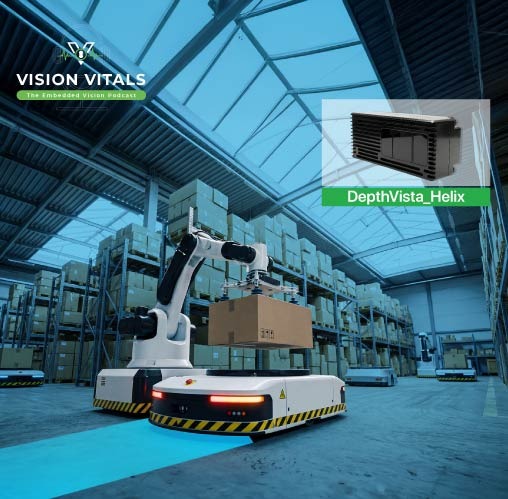
Okay, so those are the five features. Now, you've been describing these in a way that feels very specific to a particular camera. Tell me about DepthVista Helix.
Speaker:
Yeah, DepthVista Helix is e-con Systems' latest 1.2MP 3D Depth iToF USB camera, built on the onsemi Hyperlux ID AF0130 sensor. It illuminates a scene with 940nm wavelength infrared light, captures the reflected signal through a specialized CMOS sensor, and processes depth directly on-board.
Host:
On-board processing. Why does that matter?
Speaker:
It reduces host processor load, increases frame rates, and delivers precise, ready-to-use depth data. That makes it a perfect match for seamless integration with powerful embedded platforms like the NVIDIA Jetson AGX Orin.
Host:
And how does it stack up against those five features you just laid out?
Speaker:
On accuracy — it delivers exceptional on-camera depth processing with less than 1 percent deviation. The AF0130 sensor includes pre-configured settings optimized for different material properties.
Host:
So it handles different surfaces without you having to fiddle with settings constantly?
Speaker:
Yes. On multi-mode — it provides 1280x960 resolution in high-resolution mode, delivering 2x more pixels than VGA. That makes it far less likely that thin hazards will fall between pixels and go undetected. Using dual-frequency modulation, it improves multipath suppression and flags pixels with low confidence.
Host:
What does that mean for someone dealing with reflective surfaces or tricky lighting?
Speaker:
The sensor flags problematic measurements with low confidence scores. So robotic systems can easily ignore these false targets, leading to accurate 3D information. That's the confidence-based validation.
Host:
Interesting. Anything else you'd like to mention?
Speaker:
Of course. DepthVista Helix is built for depth capture across low-light and bright ambient conditions using that 940nm illumination. It also uses multipath rejection and confidence scoring so systems can filter low-confidence pixels caused by reflections and indirect returns.
Moreover, integrated laser eye safety monitoring is built in. And on the ruggedized front — IP67-rated enclosure, extended cable runs up to 15 meters.
What this means is that it's absolutely designed for real-world deployment.
Host:
You mentioned customization earlier. What options are there?
Speaker:
DepthVista Helix can be customized with multiple VCSEL illumination options. These include a 4-VCSEL configuration for outdoor deployments, which comes with extended depth sensing up to 6 meters. It can also be used with an optional RGB sensor alongside depth output, enabling simultaneous capture of visual and depth data.
Host:
Huh. So you can get color and depth from the same unit.
Yep. And unlike competitor solutions limited to MIPI or Ethernet, DepthVista Helix supports GMSL interface and is optimized for NVIDIA Jetson AGX Orin. So integration is smoother.
Host:
Nice. Thanks for sharing all your insights about this!
Speaker:
Uh-huh. It's been a real pleasure, as always.
Host:
Well, that closes today's episode of Vision Vitals.
We covered a lot: the five key features that actually matter in a 3D iToF camera, why each one matters, and how DepthVista Helix delivers on all of them.
So, if you're looking for a best-fit depth camera for robotics, automation, or any application that needs real-time 3D perception, those features are worth keeping in mind.
If you want more information on DepthVista Helix and its use cases, detailed information is available on www.e-consystems.com.
Write to camerasolutions@e-consystems.com if want to better understand why DepthVista Helix could be exactly what you've been looking for.
And thanks for listening. Your continued presence keeps inspiring us to cover more interesting topics!
We'll be back soon with the next episode of Vision Vitals.
Until then, stay sharp. And stay perceptive!
Close Full Transcript


 Mr. Thomas Yoon
 +82-10-5380-0313




 Employee Login