



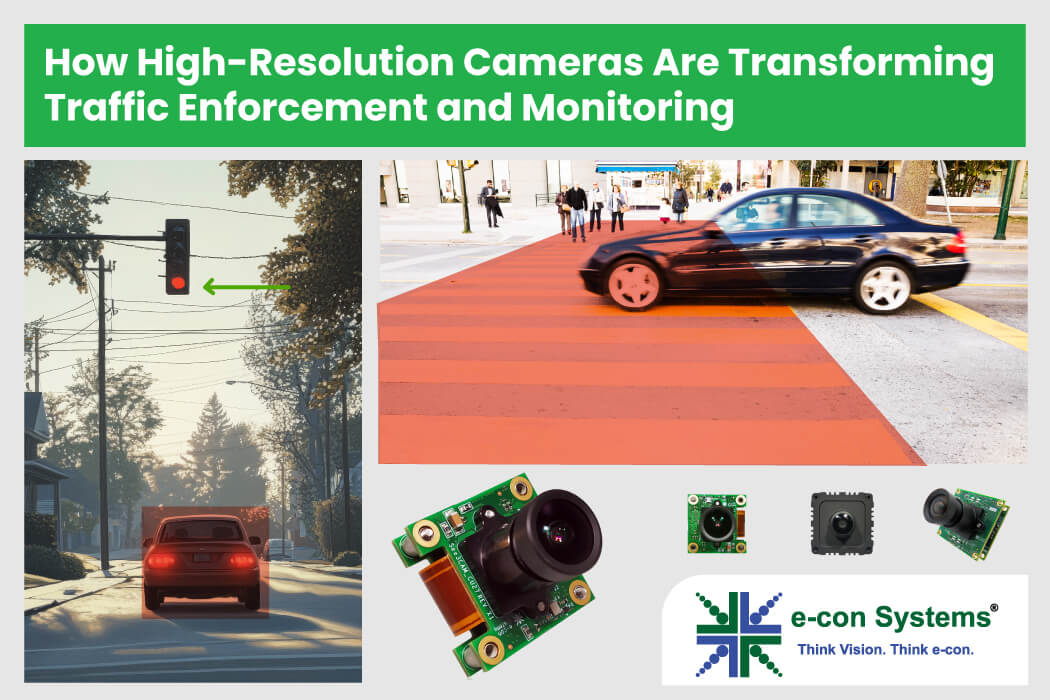
Modern urban traffic networks are shifting toward smart infrastructure powered by real-time data and automated systems. Smart traffic systems go a long way to help manage roadways and improve the commuter experience. These systems rely on embedded camera solutions that provide high-resolution imaging output.
Therefore, with the right camera, it becomes easy to deliver frame-by-frame insights that feed into systems tasked with adjusting traffic signal timing, recording violations, and detecting traffic anomalies.
In this blog, you’ll learn about how high-resolution cameras are transforming traffic enforcement and monitoring, their key applications, and other features that make them sought after by product developers.
High-Resolution Cameras in Traffic Enforcement and Monitoring
Traffic enforcement involves automated observation and documentation of violations, such as red-light running, overspeeding, and lane misuse. Cameras in these setups have to maintain visual accuracy across wide intersections, fast-moving vehicles, and crowded urban corridors.
A wide Field of View (FOV) plays an important role in monitoring complex intersections or multi-lane highways. Cameras must observe without sacrificing detail, ensuring that objects at the edges of the frame remain sharp and distinguishable.
High-resolution cameras, especially 4K cameras with 3840×2160p output, provide dense pixel grids that make this coverage possible. Every frame contains enough spatial data to isolate vehicles, capture license plates, and monitor lane movement from varying angles.
For applications focused on narrower areas, such as single-lane enforcement zones or pedestrian crossings, 1080p Full HD cameras offer sufficient image coverage while maintaining visual fidelity. These cameras help monitor lane-specific activity, entry and exit points, or intersections with limited span.
Another factor is sensor size. A large-format sensor paired with a high-resolution output helps avoid data loss, especially in outdoor environments where lighting conditions fluctuate. So, cameras that combine large sensors with 4K or 1080p output consistently capture sharper images, even under motion or partial occlusion.
Smart Traffic Management Use Cases of High-Resolution Cameras
Traffic enforcement
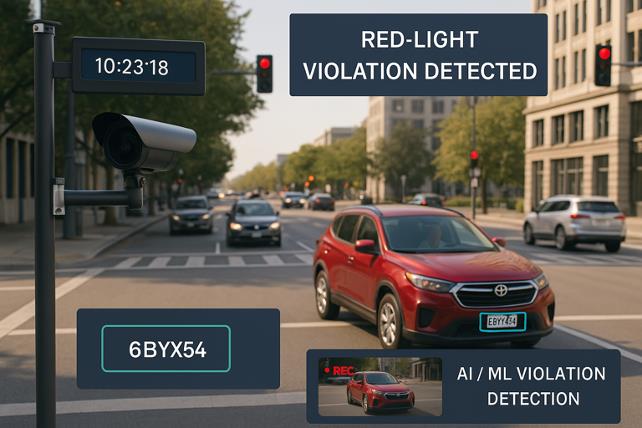
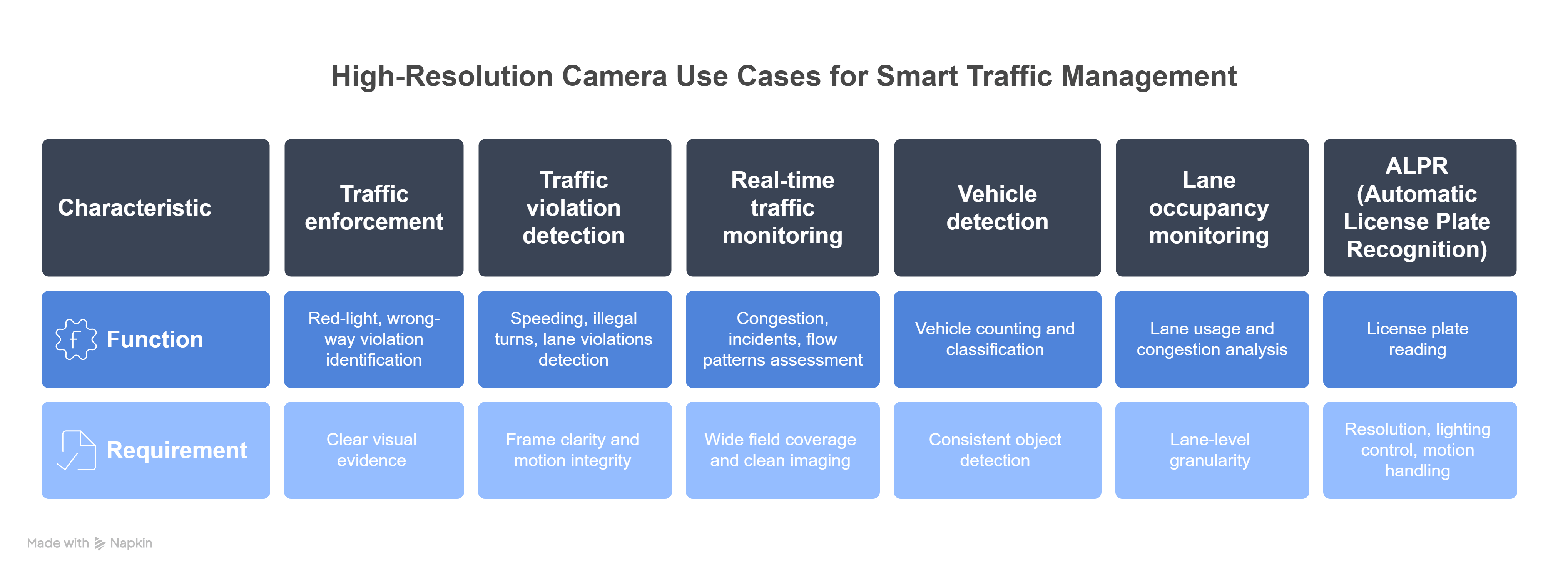
Cameras deployed at intersections and road corridors support the identification of red-light violations, wrong-way driving, and other rule breaches. High-resolution imagery enables automated documentation with clear visual evidence, reducing the need for manual intervention.
 Traffic violation detection
Systems configured to detect behavior such as speeding, illegal turns, and lane violations require accurate imaging at various angles and speeds. Frame clarity and motion integrity are critical for building reliable event records.
Real-time traffic monitoring
Urban traffic control centers depend on continuous visual feedback from key points across the city. Cameras with wide field coverage and clean imaging help operators assess congestion, incidents, and flow patterns with accuracy.
Vehicle detection
Accurate vehicle counting and classification rely on consistent object detection across multiple lanes and entry/exit points. Resolution and sensor quality ensure that even small or partially obstructed vehicles are recognized within crowded traffic scenes.
Lane occupancy monitoring
Understanding which lanes are underused or congested in real time helps optimize signal timing and lane usage. High-resolution cameras provide lane-level granularity, enabling better analytics and decision-making.
ALPR (Automatic License Plate Recognition)
License plate clarity depends on resolution, lighting control, and motion handling. High-resolution cameras improve the success rate of plate reading systems, even when vehicles move quickly or lighting conditions vary.
Other Must-Have Features of High-Resolution Cameras
High-resolution imaging alone does not determine camera performance in traffic systems. Other features are critical to delivering clean, usable data in real-world conditions. These features include:
High Dynamic Range (HDR)
Urban roads frequently present complex lighting combinations like glare from vehicle windshields, shadows from overpasses, or flashing signage. HDR imaging enables cameras to handle these inconsistencies within the same frame. High-resolution cameras equipped with HDR combine multiple exposures to balance bright and dark zones, making key visual elements like license plates, vehicle outlines, and markings easier to capture.
| Note: For a deeper understanding of HDR technology and its application in embedded vision systems, read our blog – What is High Dynamic Range (HDR)? How do HDR cameras work? |
Global shutter
In areas with high-speed traffic or during enforcement of violations like overspeeding or aggressive lane switching, traditional rolling shutter cameras can introduce motion artifacts or frame distortions. A global shutter sensor eliminates these issues by capturing the entire frame at once. This is especially useful for capturing license plates or clear images of moving vehicles without streaks or blur.
| Note: Want to understand the difference between global shutter and rolling shutter in more detail? Read our blog: What are Global Shutter and Rolling Shutter Cameras? How to choose the one that fits the application? |
Low light sensitivity
Traffic violations and monitoring cannot be limited to daylight hours. During nighttime, low-light capability becomes critical. High-resolution cameras with high sensitivity in low illumination conditions provide usable images even under minimal artificial lighting or complete darkness. This supports continuous monitoring in poorly lit zones, ensuring system consistency around the clock.
e-con Systems Offers High-Resolution Cameras for Smart Traffic Management Applications
Since 2003, e-con Systems has been designing, developing, and manufacturing OEM cameras. We have proven expertise in helping clients deploy cameras that meet the requirements of their smart traffic management applications.
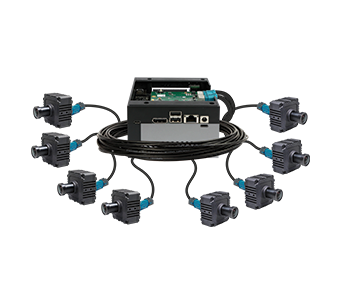
As part of our ongoing efforts to enhance traffic vision, e-con Systems is soon launching STURDeCAM88 – a rugged 4K HDR forward facing camera built for mobility and traffic monitoring applications. Powered by e-con Systems’ industry-leading ISP tuning expertise and equipped with an 8.3 MP OmniVision® sensor with 140 dB HDR and LED Flicker Mitigation (LFM), it delivers excellent 4K imaging performance even in difficult outdoor lighting. Its IP67-rated enclosure and support for multi-camera setups make it ideal for next-gen smart traffic and mobility systems.
We have also built a wide portfolio of proven solutions tailored for smart traffic management applications, including:
- See3CAM_CU81 – AR0821 4K HDR USB Camera with 1/1.7″ Sensor
- See3CAM_CU27 – Full HD Ultra Low-Light USB 3.1 Gen 1 Camera
- See3CAM_CU135 – 4K USB Camera with iHDR Support
- See3CAM_CU22 – Full HD AR0233 HDR USB Camera with LFM
- STURDeCAM20 – IP67 Full HD GMSL2™ HDR Camera
- NileCAM21 – AR0233AT HDR GMSL™ Camera Module
Know more about our traffic management cameras
View our Camera Selector Page to explore our complete portfolio.
If you’re looking to integrate the best-fit cameras into your smart traffic management application, please write to camerasolutions@e-consystems.com.

Dilip Kumar is a computer vision solutions architect having more than 8 years of experience in camera solutions development & edge computing. He has spearheaded research & development of computer vision & AI products for the currently nascent edge AI industry. He has been at the forefront of building multiple vision based products using embedded SoCs for industrial use cases such as Autonomous Mobile Robots, AI based video analytics systems, Drone based inspection & surveillance systems.