



Key Takeaways
- What is the role of rugged USB cameras in indoor and outdoor delivery robots?
- What imaging capabilities are required for navigation, cargo monitoring, obstacle detection, and remote supervision
- Role of features like low-light sensitivity and wide dynamic range in producing usable frames
- How enclosure rating and compact sizing affect delivery robot vision
Autonomous delivery robots are already operating in university campuses, hospital corridors, airports, and city sidewalks. This has led to the growing demand for extending their deployments into more tough environments. Camera selection is, therefore, a moment of truth for the success of the deployment. They need to work in the rain, handle direct sunlight followed by a dark corridor, and see clearly in every direction at once.
That’s why USB cameras with rugged enclosures, wide dynamic range sensors, and UVC-compliant interfaces are built for exactly these conditions.
However, the challenge is matching the right camera specification to each role for which the robot needs vision. Understandably, navigation, cargo monitoring, obstacle detection, and remote supervision all place different demands on the imaging system.
In this blog, you’ll learn about what makes a rugged USB camera ideal for delivery robot applications, which use cases depend the most on them, and how e-con Systems’ rugged USB cameras can help.
How Rugged USB Cameras Work In Delivery Robots
A delivery robot operates in places that a standard camera isn’t rated for. Outdoor sidewalk robots face dust, rain, direct sun, and temperature swings across a single shift. Indoor hospital or warehouse robots encounter harsh fluorescent lighting, narrow corridors, and a constant threat of collision.
In both cases, the camera needs to keep producing usable images regardless of the condition.
Rugged USB cameras can address this with:
- A back-illuminated sensor handles low-light and high-contrast scenes far better than a standard CMOS.
- UVC compliance for driver-free integration on Windows and Linux embedded platforms
- IP-rated enclosure to withstand dust, moisture, and physical impact in outdoor and industrial settings
- Wide dynamic range sensors for simultaneous detail in bright and shadowed areas of the same scene
- Extended operating temperature range covering cold storage, outdoor, and industrial thermal conditions
- Compact, lightweight form factor that fits into space-constrained robotic designs
Delivery Robot Use Cases That Demand Rugged USB Cameras
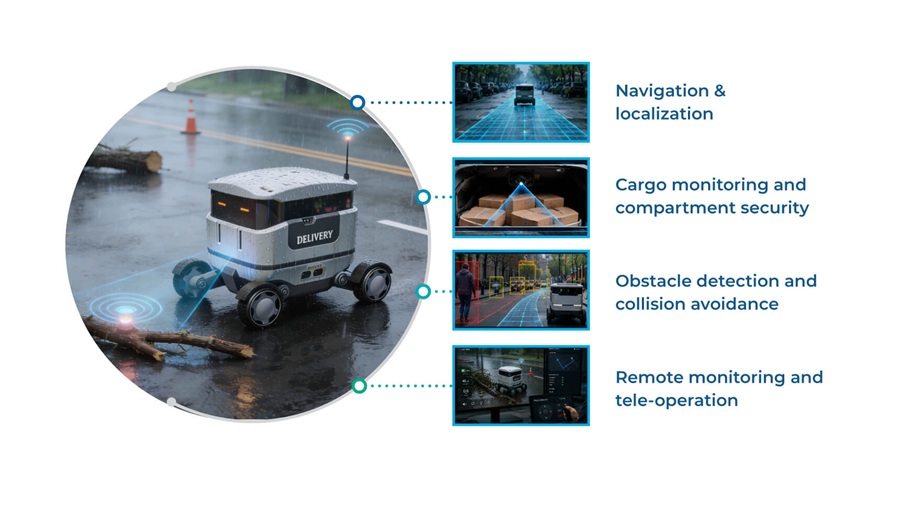
Navigation and localization
Autonomous navigation is the most fundamental camera use case in any delivery robot. The camera feeds visual data into the robot’s localization and mapping stack, helping it construct a representation of its area and track its position within it. Wide field of view coverage is essential here.
After all, the more of the surrounding space the camera can observe from a single mounting position, the less the navigation system depends on mechanical panning or multiple camera feeds to stay oriented.
Sensors with strong low-light sensitivity ensure visual features are detectable even in dim or transitional lighting, reducing the frequency of localization failures when the robot moves between environments. High dynamic range is equally important for outdoor robots navigating public spaces, where a scene with direct sunlight and deep shadow.
Cargo monitoring and compartment security
Knowing what is in the cargo compartment, whether it has been accessed, and whether the contents have shifted during transit are all operational requirements for a delivery robot running at scale. A camera inside the cargo bay provides visual confirmation of contents at pickup and delivery, supports tamper detection, and gives operators visibility into compartment status throughout a run.
The cargo compartment of a delivery robot is typically small, unlit, and high-contrast when the door opens to ambient light. A sensor with strong low-light performance and on-board image processing that handles the exposure transition automatically delivers far more usable frames in this scenario than one relying on host-side software to correct the image after capture.
Obstacle detection and collision avoidance
Delivery robots share space with pedestrians, cyclists, other vehicles, and unpredictable obstacles ranging from a puddle on a sidewalk to a child running into the robot’s path. Camera-based obstacle detection gives the safety system the visual input it needs to identify hazards at close range and trigger avoidance or stop responses before contact occurs.
This is a safety-critical function, and the camera supporting it needs to perform consistently in whatever conditions the robot encounters in the field.
A rugged enclosure is a practical advantage here. A camera at bumper height on a sidewalk robot takes impacts, which means an enclosure rated for ingress and mechanical stress can be crucial. Near-infrared sensitivity extends camera usefulness into night operations and low-ambient-light environments where visible light alone is insufficient for hazard detection.
Remote monitoring and tele-operation
A blocked path, an ambiguous handoff, or a situation the autonomous system wasn’t trained to handle may all need a human operator to take a look and make a call. Remote monitoring gives operators a live view of the robot’s location, and tele-operation extends that to direct control when autonomous behavior isn’t sufficient.
Also, a camera with H.264 or H.265 output makes sure that bandwidth consumption is low enough for smooth remote monitoring over standard wireless connections. Uncompressed or MJPEG feeds can saturate the link and introduce the latency that makes tele-operation impractical. Consistent color accuracy and good performance in variable lighting also contribute directly to operator effectiveness.
e-con Systems’ Rugged USB Cameras for Delivery Robots
Since 2003, e-con Systems has been designing, developing, and manufacturing OEM and ODM camera solutions. We offer compact USB cameras that address the demands of delivery robot deployments. Our portfolio includes:
- e-CAM16_USB: 1.2MP USB 2.0 Camera Module
- e-CAM26_USB: 2.0MP USB 2.0 Camera Module
- e-CAM212_USB: 2MP Sony IMX662 Low-Light USB 2.0 Camera Module
All three cameras are UVC compliant, bus-powered over USB 2.0, and validated on Windows and Linux with sample applications available for each platform. They share a plug-and-play integration model that keeps driver maintenance out of the deployment equation, and all are RoHS compliant, with hardware and firmware customization available for production programs with custom needs.
Use our Camera Selector tool to filter your search by sensor, resolution, enclosure rating, and more.
Want to discuss how our cameras can fuel your delivery robot’s success or the extent of our customization services? Please write to camerasolutions@e-consystems.com, and our team will help identify the right camera for your application.

Suresh Madhu is the product marketing manager with 16+ years of experience in embedded product design, technical architecture, SOM product design, camera solutions, and product development. He has played an integral part in helping many customers build their products by integrating the right vision technology into them.