



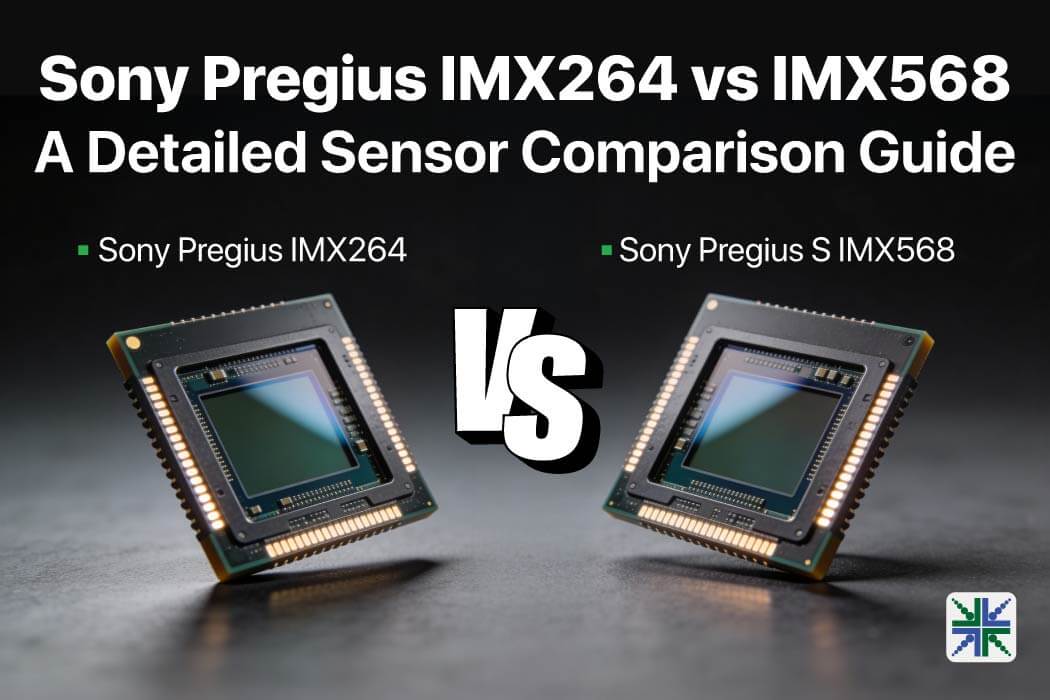
The image sensor is an important component in defining the camera’s image quality. Many real-world applications pushed for smaller pixel sizes to increase resolution in compact form factors. To address this demand, Sony has been improving its image sensor technology across generations. Over the years, this evolution has been focused on key aspects such as pixel size optimization, saturation capacity, pixel-level noise reduction, and light arrangement.
The advancements in Sony’s sensors have spanned four generations. Of these, Pregius S is the latest technology. It provides a stacked sensor architecture, optimal front illumination, and increased speed, sensitivity, and improved exposure control functionality relative to earlier generations.
In this blog, we will discuss:
- What are the IMX264 and IMX568 sensors?
- The architectural differences between the second-generation Pregius and the fourth-generation Pregius S sensors
- Key technologies of IMX568 over IMX264 in embedded cameras
What Are the IMX264 and IMX568 Sensors?
The IMX264 sensor was the first small-pixel sensor in the industry, with a pixel size of 3.45 µm x 3.45 µm when it was introduced. Based on Sony’s “Pregius” Generation two, this sensor takes advantage of Sony’s Exmor technology.
The IMX568 sensor is a Sony Pregius S Generation Four sensor. The ‘S’ in Pregius S refers to stacked, indicating that the sensor has a stacked design, with the photodiode on top and the circuits on the bottom. This sensor is designed with an even smaller pixel size of 2.74 µm x 2.74 µm.
Comparison of key specifications:
| Parameters | IMX264 | IMX568 |
| Effective Resolution | ~5.07 MP | ~5.10 MP |
| Image size | Diagonal 11.1 mm (Type 2/3) | Diagonal 8.8 mm (Type 1/1.8) |
| Architecture | Front-Illuminated | Back-Illuminated (Stacked) |
| Pixel Size | 3.45 µm × 3.45 µm | 2.74 µm × 2.74 µm |
| Sensitivity | 915mV (Monochrome) 1146mV (color) |
8620 Digit/lx/s |
| Shutter Type | Global | Global |
| Max Frame Rate (12-bit) | ~35.7 fps | ~67 fps |
| Max Frame Rate (8-bit) | ~60 fps | ~96 fps |
| Exposure Control | Standard trigger | Short interval + multi-exposure |
| Output Interface | Industrial camera interfaces | MIPI CSI-2 |
Architectural Description: Second vs. Fourth Generation Sensors
Second-generation front-illuminated design (IMX264)
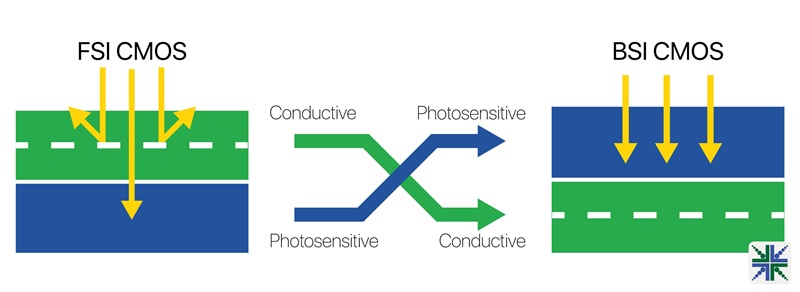
The second-generation Sony sensor uses front-illuminated technology. In front-illumination technology, the conductive elements intercept light before it reaches the light-sensitive element. As a result, some of the light might not reach the light-sensitive element. This affects the performance of the camera with small pixels.
Fourth-generation back-illuminated design (IMX568)
The Pregius S architecture revolutionizes this design by flipping the structure. The photodiode layer is positioned on top with the conductive elements beneath it. This inverted configuration allows light to reach the photodiode directly, without obstruction. It dramatically improves light-collection efficiency and enables smaller pixel sizes without sacrificing sensitivity.
The image below provides a clearer view of the difference between front- and back-illuminated technologies.
 IMX264 vs. IMX568: A Detailed Comparison
Global shutter performance
IMX264 already delivers true global shutter operation, eliminating motion distortion. However, IMX568 introduces a redesigned charge storage structure that dramatically reduces parasitic light sensitivity (PLS). This ensures that stored pixel charges are not contaminated by incoming light during readout.
It results in a clear image, especially under high‑contrast or high-illumination conditions in the high-inspection system.
Frame rate and throughput
The IMX568 has a frame rate that is nearly double that of the IMX264 at full resolution. The reasons for this are faster readout circuitry and SLVS‑EC high‑speed interface. For applications such as robotic guidance, motion tracking, and high‑speed inspection, this increased throughput directly translates into higher system accuracy and productivity.
Noise performance and image quality
Pregius S sensors offer lower read noise, reduced fixed pattern noise, and better dynamic range. IMX568 produces clear images in low‑light environments and maintains higher signal fidelity across varying exposure conditions.
Such an improvement reduces reliance on aggressive ISP noise reduction, preserving fine image details critical for machine vision algorithms.
Power consumption and thermal behavior
Despite higher operating speeds, IMX568 is more power‑efficient on a per‑frame basis. Improved charge transfer efficiency and readout design result in lower heat generation, making it ideal for compact, fanless, and always‑on camera systems.
System integration considerations
IMX264 uses traditional SLVS/LVDS interfaces and integrates well with legacy ISPs and FPGA platforms. IMX568 requires support for SLVS‑EC and higher data bandwidth. While this demands a modern processing platform, it also future‑proofs the system for higher-performance vision pipelines.
What Are the Advanced Imaging Features of the IMX568 Sensor?
Short interval shutter
IMX568 can perform short-interval shutters starting at 2 μs, which helps reduce the time between frames by controlling registers. This allows the cameras to capture images of fast-moving objects for industrial automation.
Multi-exposure trigger mode
The IMX568 allows multiple exposures within a single trigger sequence. This feature allows obtaining several images of the same scene at differing exposure times, both in illuminated and dark areas of the object. This reduces dependency on complex lighting and strobe tuning.
It enables IMX568-based cameras to handle challenging lighting conditions more effectively than single-exposure sensors in vision applications such as sports analytics.
Multi-frame ROI mode
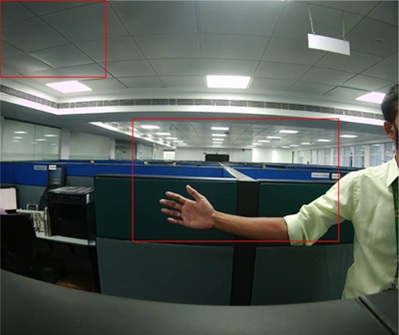
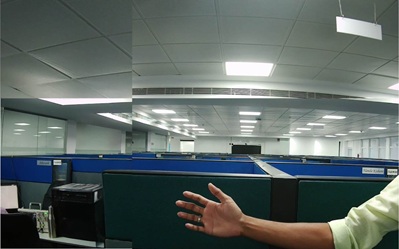
This multi-ROI sensor enables simultaneous readout of up to 64 user-defined regions from arbitrary positions on the sensor.
In the image below, you can see how data from two ROIs have been read from within a single frame. The marked areas represent the ROIs.
 Full Frame Full Frame |
 Selected Two ROIs Selected Two ROIs |
 Cropped ROIs |
e-con Systems’ recently-launched e-CAM56_CUOAGX is an IMX568-based global shutter camera capable of multi-frame Region of Interest (ROI) functionality. It supports a rate of up to 1164 fps with the multi-ROI feature.
This can be very useful in real-time embedded vision use cases, where it is necessary to focus only on a specific region of the image. e-CAM56_CUOAGX can be deployed in traffic surveillance applications where the focus should only be on car motion, facial recognition applications. That way, only the facial region of the subject can be zoomed to achieve superior security surveillance.
Short exposure mode
The IMX568 supports exposure times that can be very short while ensuring image stability and sensitivity at the same time. Exposure times for this mode may vary by up to ±500 ns depending on the sample and environmental conditions, as well as other factors such as temperature and voltage levels.
Dual trigger
The IMX568 enables dual trigger operation, allowing independent control of image capture timing and readout by dividing the screen into upper and lower areas. This enables precise synchronization with external events, lighting, and strobes, and allows flexible capture workflows in complex inspection setups.
Read the article: Trigger Modes available in See3CAMs (USB 3.0 Cameras) – e-con Systems, to know about the trigger function in USB cameras
Gradation compression
IMX568 features gradation compression to optimize the representation of brightness levels within the output image. This preserves important image details in both bright and dark regions. With this feature, the camera can deliver more usable image data without increasing bit depth or lighting complexity.
Dual ADC
The dual-ADC architecture provides faster, more flexible signal conversion. This supports high frame rates without compromising image quality and optimizes performance across the different bit depths: 8-bit / 10-bit / 12-bit. The dual ADC operation also helps IMX568-based cameras maintain high throughput and low latency in demanding vision systems.
IMX568 Sensor-Based Cameras by e-con Systems
Since 2003, e-con Systems has been designing, developing, and manufacturing cameras. e-con Systems’ embedded cameras continue to evolve with advances in sensors to meet the growing demand for embedded vision applications.
Explore our Sony Pregius Sensor-Based Cameras.
Use our Camera Selector to check out our full portfolio.
Need help selecting the right embedded camera for your application? Talk to our experts at camerasolutions@e-consystems.com.
FAQS
- What is Multi-ROI in image sensors?
Multi-ROI (Multiple Regions of Interest) allows an image sensor to crop and read out multiple, user-defined areas from different locations on the sensor within a single frame, instead of reading the full frame.
- Can multiple ROIs be read simultaneously in the same frame?
Yes. Multiple ROIs can be read out simultaneously within the same frame, allowing spatially separated regions to be captured without increasing frame latency.
- How many ROI regions can be configured on this sensor?
The multi ROI image sensor supports up to 64 independent ROI areas, enabling flexible selection of multiple spatial regions based on application requirements.
- What are the benefits of using Multi-ROI instead of full-frame readout?
Multi-ROI reduces data bandwidth and processing load, increases effective frame rates, and enables efficient monitoring of multiple areas of interest.
- Are all ROIs captured at the same time?
Yes. All selected ROIs are captured within the same frame, ensuring consistent timing.

Prabu is the Chief Technology Officer and Head of Camera Products at e-con Systems, and comes with a rich experience of more than 15 years in the embedded vision space. He brings to the table a deep knowledge in USB cameras, embedded vision cameras, vision algorithms and FPGAs. He has built 50+ camera solutions spanning various domains such as medical, industrial, agriculture, retail, biometrics, and more. He also comes with expertise in device driver development and BSP development. Currently, Prabu’s focus is to build smart camera solutions that power new age AI based applications.