



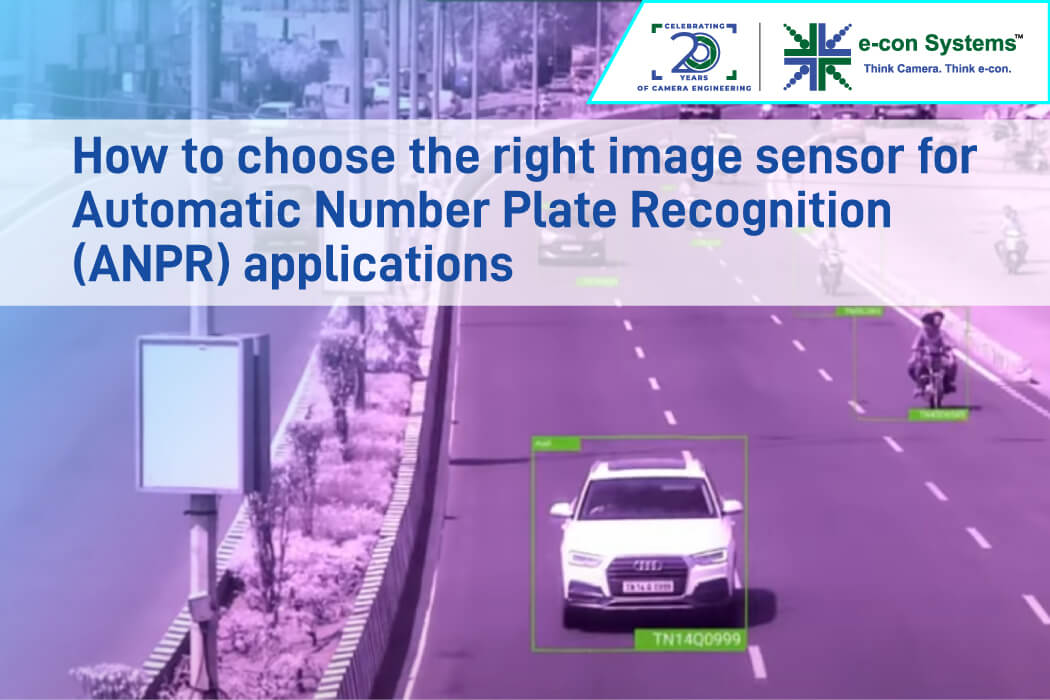
Automated Number Plate Recognition (ANPR) is a big part of smart city management as it ensures more citizen security and streamlines transport. Know its key use cases and uncover the three top factors to be considered while choosing a sensor for ANPR.
ANPR systems have transformed the efficiency of ‘on the road’ monitoring and security solutions. The US Department of Justice reports that “93% of police departments in cities with populations of 1 million or more use their own ANPR systems, some of which can scan nearly 2,000 license plates per minute.”
This statistic highlights ANPR’s critical role in citizen security and real-time traffic flow management.
This blog explores how ANPR systems, work, their key use cases, and the critical factors in choosing the right camera.
What Does Automatic Number Plate Recognition (ANPR) Mean?
ANPR technology uses advanced cameras to capture vehicle registration plates, from identifying letters and numbers to symbols, and collect real-time data such as vehicle identity, location, and travel patterns. It harnesses the power of Optical Character Recognition (OCR) to convert images into digitally processed data. This makes ANPR crucial for traffic management, security, toll collection, and law enforcement.
ANPR systems basically integrate specialized cameras with computer vision algorithms to identify and process number plates, even in challenging lighting or weather conditions. Leveraging advanced image processing techniques, they can rapidly identify plates from moving or stationary vehicles.
These systems can be easily embedded into existing security infrastructure or deployed as standalone systems.
Key Features of Automatic Number Plate Recognition (ANPR)
- Real-time processing: Embedded processors enable immediate recognition and data conversion for real-time vehicle tracking and identification.
- Accuracy: Advanced computer vision algorithms deliver high accuracy in varying conditions, such as different lighting or extreme weather.
- Data-rich: Embedded vision enables the collection and analysis of data from ANPR systems for actionable insights into traffic patterns, security trends, or operational efficiencies.
- Flexibility: ANPR adapts to toll collection, parking management, and security surveillance.
Is ANPR the Same as ALPR?
For practical purposes, ANPR (Automatic Number Plate Recognition) and ALPR (Automatic License Plate Recognition) are the same technology. The terms are used interchangeably based on regional preferences. ANPR is more commonly used in the UK and Europe, whereas ALPR is used in the United States and some other regions.
Both refer to systems that use computer vision and OCR to read and analyze vehicle license plates automatically.
Read: ANPR with e-con Systems’ global shutter camera and Raspberry Pi 4
Top 3 Factors for Choosing the Right Camera for ANPR Systems
ANPR systems operate without human intervention, capturing images of vehicles ranging from high-speed violators to slow-moving parking entrants. Selecting the right image sensor is therefore critical.
Motion blur and rolling shutter effects are two major challenges in ANPR. Without addressing them, capturing readable plate characters from moving vehicles becomes nearly impossible. Other challenges include varying lighting conditions, headlight glare, and harsh environmental conditions.
To overcome these challenges, consider these three critical factors when selecting an ANPR camera.
Shutter Artifacts
There’s no debating that the cameras used in ANPR must capture images without any distortion or skew. If you use a rolling shutter sensor, that will produce artifacts in the output image, making the characters in the number plate virtually unrecognizable. However, with a global shutter, the camera exposes the sensor simultaneously, enabling it to capture a fast-moving image in its entirety, without any artifacts.
It means that you will be able to produce images of moving vehicles without any distortion.

Exposure Time
As you may already know, camera exposure sets the parameters for how sharp or blurry a captured image can be. When it comes to ANPR systems, the exposure time should be dictated by how much light tends to illuminate the vehicle’s number plate and its speed. A well-lit number plate can be captured with a low exposure time.
It also helps to ensure that a frame is captured fast enough to reduce any motion blur that could potentially occur due to the vehicle’s speed. Also, given that the environment in which these cameras are installed is subject to unpredictable lighting conditions, the sensors should be equipped to adapt to varying exposure conditions.
Dynamic range
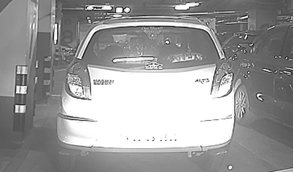
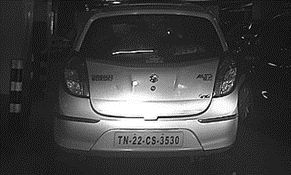
Another critical factor in effectively capturing number plate information is to ensure that a heavy headlight does not bleach the image. It would hinder Optical Character Recognition (OCR) – making the vehicle’s number plate a lot less recognizable.
A sensor with a good dynamic range can go a long way to capture the information on the plate without overexposure due to the surrounding headlight.
Take a look at this comparison to understand the difference between the image output of a normal camera and an HDR camera.
Read: What is an IR-cut filter – and why do ANPR systems need it?
Real-World Challenges in ANPR Deployments (Beyond the Sensor)
While sensors are critical, real-world ANPR deployments introduce challenges beyond shutter type, exposure, and dynamic range.
In live roadside environments, ANPR cameras must perform reliably across changing speeds, vehicle types, angles, and lighting conditions, without human intervention. Factors such as multi-lane coverage, night-time glare, vibration, weather exposure, and long-term stability significantly influence capture accuracy.
A successful ANPR deployment depends on a system-level approach where camera, illumination, triggering, processing, and enclosure work together under real operating conditions.
Fixed vs. Mobile ANPR: Different Use Cases, Different Camera Needs
ANPR systems are deployed in fixed and mobile configurations, each with distinct technical requirements.
Fixed ANPR deployments (highways, toll plazas, intersections) typically require:
- Long capture distances and multi-lane coverage
- Precise synchronization with external triggers (radar, lidar, loop detectors)
- Stable performance across day/night cycles
- Support for continuous 24×7 operation in outdoor conditions
Mobile ANPR deployments (patrol vehicles, trailers, temporary enforcement) introduce additional challenges, such as:
- Vehicle vibration and motion
- Rapid changes in scene geometry
- Power and thermal constraints
- Compact, ruggedized camera form factors
Selecting the right ANPR camera depends heavily on whether the system is designed for fixed infrastructure, mobile enforcement or both.
Role of IR Illumination and External Triggers in ANPR Accuracy
License plates are optimized to reflect infrared (IR) light, making IR illumination a key component of reliable ANPR systems, especially at night.
In real deployments:
- Continuous IR illumination is often insufficient at highway speeds
- Strobe-assisted IR helps “freeze” fast-moving vehicles
- External triggers (radar, lidar or loop-based) ensure frames are captured at the optimal moment
ANPR cameras must support tight synchronization with external illumination and triggers to maintain high capture rates while minimizing motion blur and false reads.
Edge AI vs. Centralized Processing in ANPR Camera Systems
Modern ANPR increasingly relies on edge processing, where recognition and analytics happen on or near the camera. This approach is preferred for evidence-grade enforcement.
Edge-based ANPR offers:
- Lower latency for real-time enforcement
- Reduced bandwidth and backend infrastructure costs
- Improved privacy by processing data locally
- Higher reliability in remote or low-connectivity environments
Centralized architectures may struggle with latency, bandwidth, and scalability—especially in multi-lane or high-speed scenarios.
Hence, choosing the right camera today means evaluating not just imaging performance, but also processing architecture and system integration.
Environmental Reliability and Long-Term Operations of ANPR Cameras
ANPR cameras are often installed in harsh roadside environments where reliability is non-negotiable.
Key considerations include:
- Temperature variation and thermal management
- Protection against dust, rain, and vibration
- Stable imaging performance over years of operation
- Long-term component availability and support
Cameras designed specifically for ANPR applications are engineered to deliver consistent performance across these conditions, reducing maintenance effort and total cost of ownership.
Popular Applications that Use ANPR Technology
Law enforcement and security
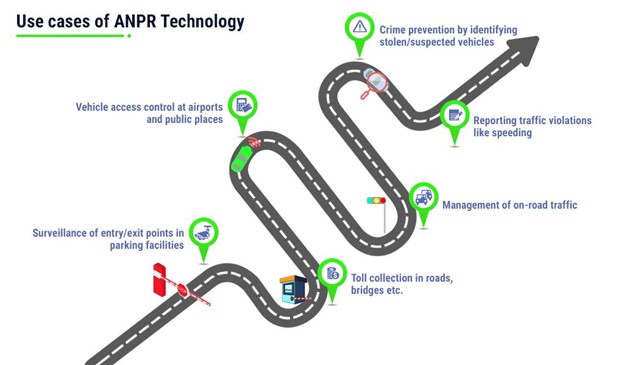
Police departments utilize ANPR systems to automatically identify stolen vehicles, track wanted criminals, and enforce traffic laws. Security agencies also employ it for monitoring vehicles accessing restricted or secure areas.
Toll collection
Automated toll systems use ANPR to recognize vehicles and apply charges without stopping traffic.
Parking management
Parking facilities use ANPR to automate entry, exit, and fee calculation based on duration. This automates operations and reduces human error in enforcement.
Traffic management
ANPR systems empower traffic authorities to collect data on vehicle flow and analyze patterns. It results in informed traffic management decisions while providing authorities with actionable data for enforcement.
Fleet management
Logistics companies use ANPR to monitor their fleets, enabling them to track driver behavior and ensure compliance with company policies. It optimizes routes, reduces operational costs, and boosts operational speed and reliability.
| Note: If you’re particularly interested in how ANPR is transforming toll collection and improving traffic flow, don’t miss our blog: Role of AI-Powered ALPR Cameras in Automated Toll Collection and Traffic Flow Management – where we explore camera challenges and solutions in dynamic highway environments. |
e-con Systems: Your Go-To Complete ANPR Camera Solution Provider
Since 2003, e-con Systems has been designing, developing, and manufacturing OEM camera solutions. These include end-to-end ANPR camera solutions for traffic enforcement, tolling, parking, and smart city deployments. We can work as an ODM partner to ANPR and ITS solution providers, supporting the full journey from concept to deployment.
Our capabilities go beyond image sensors to deliver deployment-ready ANPR camera systems, including:
- Custom camera form factors for fixed and mobile enforcement
- Optimized optics and zoom configurations for multi-lane and long-range capture
- Global shutter, rolling shutter, monochrome, RGB-IR, Low-light and HDR sensor options
- Support for IR illumination, external triggers (radar, LiDAR, inductive loops), and strobe synchronization
- Ruggedized enclosures and thermal design for long-term outdoor operation
- GigE, USB, and MIPI interfaces with Linux and edge-AI–ready software stacks
These building blocks enable customers to create complete ANPR / ALPR camera products, tailored to regional regulations, installation constraints, and performance targets.
For ODM engagement, customization, or system-level integration support, please write camerasolutions@e-consystems.com.
You can also use our Camera Selector to explore our full portfolio.

Dilip Kumar is a computer vision solutions architect having more than 8 years of experience in camera solutions development & edge computing. He has spearheaded research & development of computer vision & AI products for the currently nascent edge AI industry. He has been at the forefront of building multiple vision based products using embedded SoCs for industrial use cases such as Autonomous Mobile Robots, AI based video analytics systems, Drone based inspection & surveillance systems.