



Key Takeaways
- How the idea of near-miss incidents shapes proactive traffic safety programs
- Where near-miss detection strengthens future-ready intersections and highways
- How AI vision tracks movement, classifies conflict, and ranks severity
- Why imaging features such as frame rate, shutter type, HDR, edge modules, and sync matter
- How near-miss intelligence supports long-term planning, redesign, and enforcement
Cities across the world face a new reality. Traffic volumes rise, intersections grow complex, and human error continues to drive accident rates upward. Traditional safety methods rely on recorded collisions, witness statements, and delayed analytics that often surface long after the damage is done.
Modern infrastructure demands a sharper layer of perception, capable of capturing events as they unfold, interpreting them, and sending alerts before impact occurs.
Camera-based AI systems now bridge that gap. Mounted across intersections, pedestrian crossings, and expressway merges, these intelligent imaging units track vehicles, pedestrians, and cyclists in real time. Every frame becomes a data point describing speed, angle, lane deviation, and braking response.
In this blog, you’ll explore how near-miss detection through AI vision transforms safety management across intersections and highways, turning raw imagery into actionable intelligence.
What Is a Near-Miss Incident?
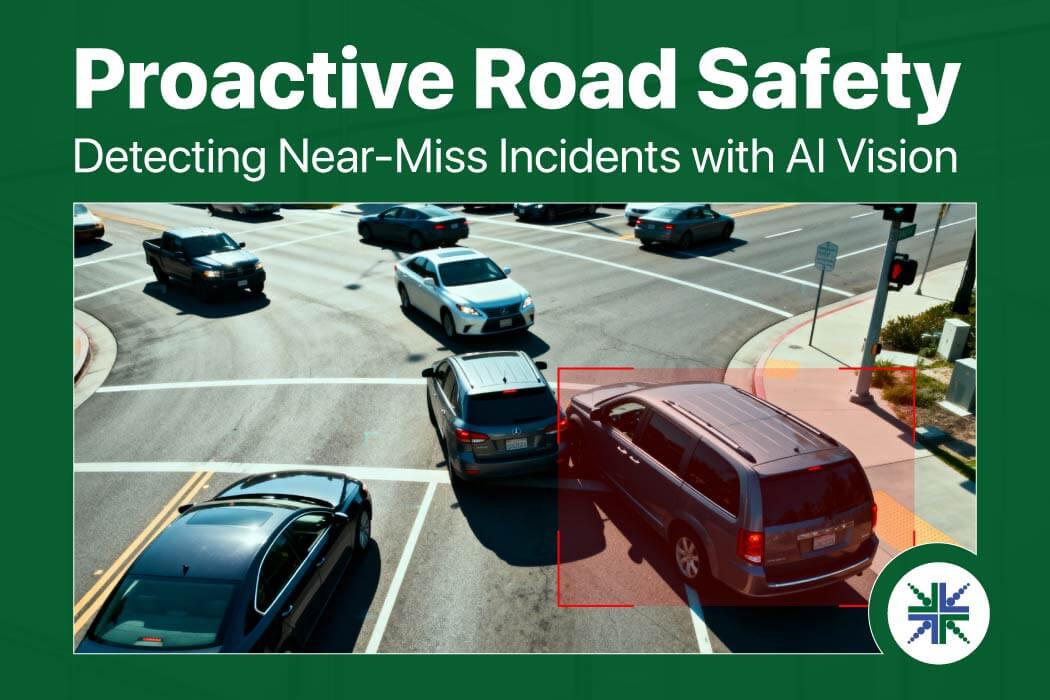
A near-miss incident occurs when two road users (vehicles, pedestrians, cyclists) come dangerously close to colliding but avoid impact by a narrow margin. AI systems quantify near-misses using metrics such as:
- Time-to-Collision (TTC) – estimated time before impact based on speed + distance
- Post-Encroachment Time (PET) – time gap between two users occupying the same conflict point
- Deceleration profiles – abrupt braking or evasive action
- Lateral clearance distance – minimum physical gap between interacting objects
- Trajectory overlap zones – predicted path intersections
These indicators help categorize severity levels even when no physical crash occurs.
Why Near-Miss Detection Defines the Future of Safer Roads
A near miss carries more value than an accident report because it shows where danger brews repeatedly. Thousands of close calls unfold daily without ever reaching formal records. AI vision converts such invisible events into quantifiable risk data.
- Cameras monitor micro-movements that indicate unsafe proximity between vehicles and pedestrians.
- Algorithms classify turning behavior, red-light violations, and lane invasions.
- Pattern recognition highlights zones where risky interactions cluster during specific hours.
- Authorities can map those events to traffic-light timing, signage visibility, or road geometry.
Through this data loop, roads evolve into feedback-driven systems that learn from their own operation. Insights drawn from visual intelligence empower planners to redesign junctions, optimize signaling cycles, and improve flow without waiting for disaster statistics.
How AI Vision Detects Near Misses
AI vision depends on camera networks capable of observing and reasoning simultaneously. Every sensor captures video at high frame rates while edge processors analyze sequences locally before forwarding critical events to central dashboards.
- Object detection models identify vehicles, two-wheelers, and pedestrians within each frame.
- Time-to-Collision (TTC) and distance estimation determine how soon two objects would collide if they continue their current path. Low TTC values automatically flag critical near-miss events.
- Trajectory analysis compares predicted paths against actual motion to detect deviation or sudden avoidance.
- Temporal analysis distinguishes random traffic flow from genuine conflict sequences.
- Edge computing units run deep neural networks that score the severity of near-miss probability.
The system then classifies events according to conflict type, whether vehicle-to-vehicle, vehicle-to-pedestrian, or cyclist interaction, and tags them with time, speed, and location. These metrics form the foundation for near-miss analytics across large city grids.
Top Imaging Features Powering Near-Miss Detection Cameras
High frame rate
High frame rate sensors capture motion detail at every instant, maintaining visual continuity even in fast urban scenarios. When vehicles accelerate, swerve, or brake abruptly, these sensors record every frame clearly, giving AI models uninterrupted temporal data. This precision in frame sequencing helps systems measure distance gaps and reaction time with accuracy across diverse traffic densities.
Global shutter
Global shutter technology eliminates the rolling distortion that can misrepresent objects in motion. Vehicles, pedestrians, and cyclists appear geometrically correct even at high speeds. This integrity in spatial data helps analytical models calculate movement vectors, identify relative velocity, and maintain reliable trajectory reconstruction without guesswork.
High Dynamic Range
High Dynamic Range (HDR) ensures visibility remains balanced during extreme contrast. Streetlights, headlights, reflections, and shaded corners often distort exposure, but HDR maintains detail in both bright and dim zones. As a result, AI algorithms interpret motion consistently through night and day, rain or glare, sustaining dependable input quality across all conditions.
Edge AI modules
Edge AI modules process incoming frames directly at the source instead of waiting for cloud computation. This distributed processing structure shortens detection time and ensures alerts reach control centers within milliseconds. It also minimizes bandwidth usage and data congestion, making the system agile for real-time interventions in high-traffic intersections.
Multi-camera synchronization
Networked synchronization aligns multiple cameras to act as one cohesive analytical grid. Intersections, highways, and crossings benefit from synchronized timestamps, enabling unified tracking of objects moving between views. Such coordination creates an uninterrupted visual chain across lanes and angles, enhancing event reconstruction and reducing blind zones.
Benefits of Vision-Based Safety Intelligence
- Continuous conflict detection helps prioritize maintenance and redesign schedules.
- Near-miss statistics reveal infrastructure weak points invisible to human patrols.
- Emergency services gain faster awareness through automated alerts.
- Traffic authorities can validate improvements with quantifiable reductions in high-risk interactions.
- Long-term data archives enable machine learning models to refine future predictions.
- Consistent imaging supports Vision Zero, black spot analysis, and regulatory mandates.
Ace Near-Miss Incident Detection with e-con Systems’ Cameras
e-con Systems has been designing, developing, and manufacturing OEM cameras since 2003, including high-performance smart traffic cameras.
Learn more about our traffic management imaging capabilities.
Visit our Camera Selector Page to view our full portfolio.
If you want to connect with an expert to select the best camera solution for your traffic management system, please write to camerasolutions@e-consystems.com.
Frequently Asked Questions
- What is near-miss detection in road safety?
Near-miss detection identifies incidents where vehicles, cyclists, or pedestrians come dangerously close to colliding but avoid impact. AI-driven cameras track movement, speed, and distance in real time, using that data to predict where future crashes are most likely to occur.
- How do AI vision cameras recognize near-miss events?
Cameras capture continuous video streams that are processed through deep learning models. These models map object trajectories, detect unusual braking or turning patterns, and classify them as potential conflicts. The output becomes a data feed highlighting risk zones within the road network.
- Why are near-miss analytics more valuable than traditional crash data?
Crash data reflects events that have already caused harm, while near-miss analytics reveal danger patterns before they escalate. This proactive insight gives city planners and traffic engineers the evidence to redesign intersections, adjust signal cycles, and prevent accidents before they happen.
- What kind of camera features improve near-miss detection accuracy?
High frame rate sensors, global shutter imaging, HDR capability, and edge AI processors enable consistent monitoring across varying light and motion conditions. Each component contributes to reliable object recognition, reduced latency, and seamless operation in crowded traffic environments.
- How do cities use data from near-miss detection systems?
Authorities integrate near-miss insights into centralized dashboards that visualize risk concentration and behavior trends. The data supports infrastructure upgrades, dynamic traffic control, and safety compliance audits, turning camera feeds into measurable intelligence for urban mobility planning.
- Can near-miss detection run on the edge, or does it require cloud?
Near-miss analytics can run fully on the edge through embedded processors that handle real-time inference locally. The setup reduces latency, keeps video streams private, and supports instant alerts at busy junctions. Cloud pipelines still play a role during large-scale analysis where long-term storage, citywide trend mapping, and model retraining benefit from centralized compute.

Dilip Kumar is a computer vision solutions architect having more than 8 years of experience in camera solutions development & edge computing. He has spearheaded research & development of computer vision & AI products for the currently nascent edge AI industry. He has been at the forefront of building multiple vision based products using embedded SoCs for industrial use cases such as Autonomous Mobile Robots, AI based video analytics systems, Drone based inspection & surveillance systems.