



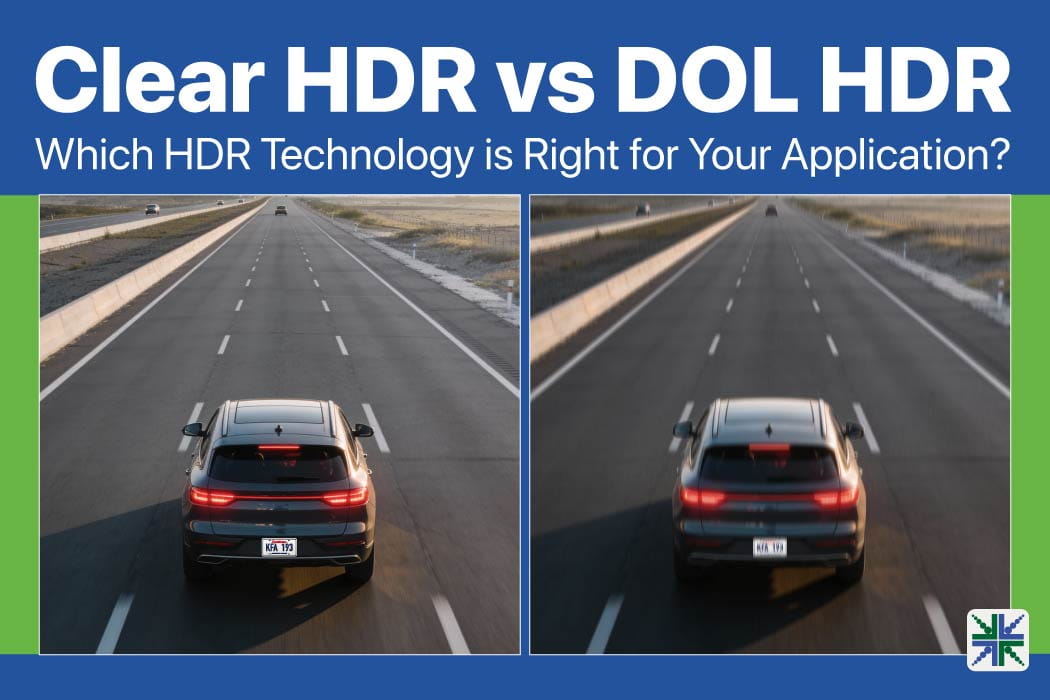
In this blog, we explore
- What clear HDR and DOL HDR are and how they differ
- The key strengths and limitations of each approach
- When to use clear HDR or DOL HDR for optimal imaging performance
High Dynamic Range (HDR) imaging plays a critical role in modern embedded vision systems, particularly in automotive and industrial environments, where lighting conditions can change abruptly—from bright sunlight to deep shadows. Standard sensors are limited to a single set of exposure settings per frame. This limitation results in underexposed and overexposed images.
In contrast, clear HDR and DOL HDR technologies overcome this limitation by adopting different approaches to image capture. In the latest lineup of Sony STARVIS 2 sensors, models such as the IMX675, IMX676, and IMX678 feature HDR and DOL HDR technologies to extend dynamic range under challenging lighting conditions. These technologies maintain accurate mid-tone details, preserve visibility in the darkest regions, and effectively control the brightest light sources across the scene. Additionally, each HDR technique is optimized for specific imaging scenarios and performance requirements.
In this blog, we’ll explore more about clear HDR and DOL HDR technologies, understand their differences, and find out which is the right choice for your embedded vision system.
About Sony STARVIS 2
Sony® STARVIS 2™ image sensors are back-illuminated pixel technology. The back-illuminated pixel technology uses photodiodes arranged in front of the metal wiring, which obstructs light reaching the photodiodes, improving sensor performance, especially in low-light conditions.
There are two advanced HDR functions in the Sony STARVIS 2 sensors. Let’s see what they are in the following sections.
What is DOL HDR?
DOL HDR (Digital Overlap High Dynamic Range) is supported by Sony’s earlier version of STARVIS Image Sensor and newer STARVIS2 Image Sensor.
The DOL HDR function uses 2 or 3 frames per frame time and enables DOL HDR in STARVIS2 Image Sensor-Based cameras, causing the sensor to shoot two separate images by defining a long exposure for the darker section and a short exposure for the brighter section of the scene.
The DOL HDR is suitable for static applications and bright light regions. If your camera is for parking lot management at night or a landscape with minimal movement, the multi-exposure approach will yield the cleanest shadow details.
What is Clear HDR?
Clear HDR, also known as Single Exposure Dual Gain, captures two images simultaneously by setting High Conversion Gain (HCG) for the dark region and Low Conversion Gain (LCG) for the bright region. The output images at different gains are synthesized to achieve a wider dynamic range than a single-exposure image. This technique is suitable for detecting fast-moving objects and for low-light conditions.
Read article: 4 major factors that determine the low light performance of a camera – e-con Systems.
Motion Artifacts and Low-Light Detail: Comparing DOL HDR and Clear HDR
Since DOL HDR captures two frames at different timestamps with different exposure times, motion artifacts can occur when there’s movement in the scene between the two exposures. In contrast, clear HDR captures two pictures at once, and there will be no motion artifacts.
In the image below, motion artifacts are clearly visible in the moving objects (pendulum and car), caused by the time gap between the multiple exposures used in DOL HDR. No artifacts in clear HDR.
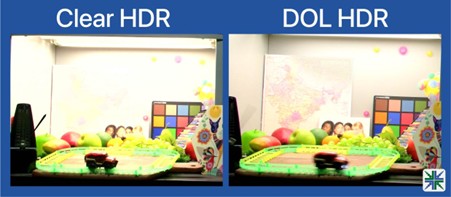 Figure 1: Motion Artifacts in Pendulum and Car
However, in clear HDR, increasing exposure helps reduce noise and improve clarity in dark regions, but it can lead to overexposure in bright areas, as shown in the figure 1.
The details in the dark region are clearly visible in clear HDR and not visible in DOL HDR in the image below.
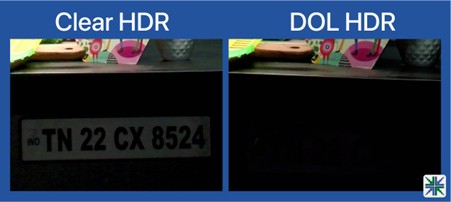 Figure 2: Low-Light Detail between Clear HDR vs DOL HDR
However, clear HDR can sometimes introduce more noise in extremely low-light conditions than DOL HDR. This is because it is amplifying a single short exposure rather than physically keeping the shutter open longer (as DOL HDR does with its Long Frame).
How to Choose Between DOL HDR and Clear HDR
Key advantages of DOL HDR
- DOL HDR provides excellent dynamic range extension by physically gathering more light in the shadows through long exposure.
- The Exposure Ratio Flexibility in the DOL HDR allows adjustment of a very short exposure time to capture very bright areas in a scene without clipping. This significantly enhances the performance of HDR cameras.
Key advantages of clear HDR
- LCG and HCG data are derived from the exact same exposure window; there is absolutely no temporal offset. This ensures zero ghosting on moving objects, making it mathematically impossible for the layers to be misaligned. It can capture very dark scenes by boosting gain.
- The DOL HDR provides a clear image in low-light conditions
The video below compares clear HDR and DOL HDR using the e-con Systems embedded camera.
As mentioned in the demonstration, the camera, which leverages SONY’s updated STARVIS 2™ technology, supports both clear HDR and DOL HDR modes and delivers superior low-light sensitivity, High Dynamic Range, and exceptional image clarity in challenging lighting environments.
Popular Use Cases of Clear HDR
AMRs and AGVs
Warehouse robots operate in mixed-light scenes. So, a low-light camera with clear HDR avoids ghosting during motion and supports real-time analytics.
Traffic, ITS and Smart City Systems
Vehicles tend to move fast with drastic lighting changes. Clear HDR captures both reflective license plates and dark vehicle bodies. Examples include number plate recognition, parking guidance, intersection monitoring, and more.
AR/VR and Gesture Tracking Systems
Human motion varies quickly under uneven lighting. Clear HDR handles bright screens and dark surroundings with single-frame HDR for pose estimation and SLAM, resulting in zero motion artifacts and accurate capture of hand movements.
e-con Systems’ Low-Light and HDR Cameras
e-con systems has over 20+ years of experience in designing, developing, and manufacturing cameras. We are offering HDR, low-light, global-shutter, monochrome, LFM, and low-noise cameras.
Our technology is coming out along with all other advancing technologies, such as sensor technology, interface technology, ISP technology, and various others, to achieve optimal results for visual applications.
For information on the latest STARVIS 2 image sensor cameras, check 4K Sony STARVIS 2 IMX678 Low-Light Camera Module
Visit our Camera Selector Page to explore our full portfolio.
If you need help, finding the right HDR camera for your embedded vision system, please write to camerasolutions@e-consystems.com.
FAQs
1: What is the main difference between clear HDR and DOL HDR?
Clear HDR uses a single exposure with dual gain to capture bright and dark regions simultaneously, eliminating motion artifacts. DOL HDR, on the other hand, combines multiple sequential exposures to extend dynamic range, which can introduce motion artifacts in moving scenes.
2: Which HDR mode is better for fast-moving scenes?
Clear HDR is better suited for fast-moving scenes because it captures all image data within a single exposure window, ensuring there is no temporal misalignment or ghosting.
3: When should DOL HDR be preferred over clear HDR?
DOL HDR is ideal for static or slow-moving scenes that require maximum dynamic range, such as parking surveillance, landscape imaging, or industrial inspection with minimal motion.
4: Does clear HDR perform well in low-light conditions?
Clear HDR delivers excellent low-light performance but may introduce slightly higher noise in extremely dark scenes compared to DOL HDR, as it amplifies a single exposure rather than using a longer exposure to gather more light.

Prabu is the Chief Technology Officer and Head of Camera Products at e-con Systems, and comes with a rich experience of more than 15 years in the embedded vision space. He brings to the table a deep knowledge in USB cameras, embedded vision cameras, vision algorithms and FPGAs. He has built 50+ camera solutions spanning various domains such as medical, industrial, agriculture, retail, biometrics, and more. He also comes with expertise in device driver development and BSP development. Currently, Prabu’s focus is to build smart camera solutions that power new age AI based applications.