



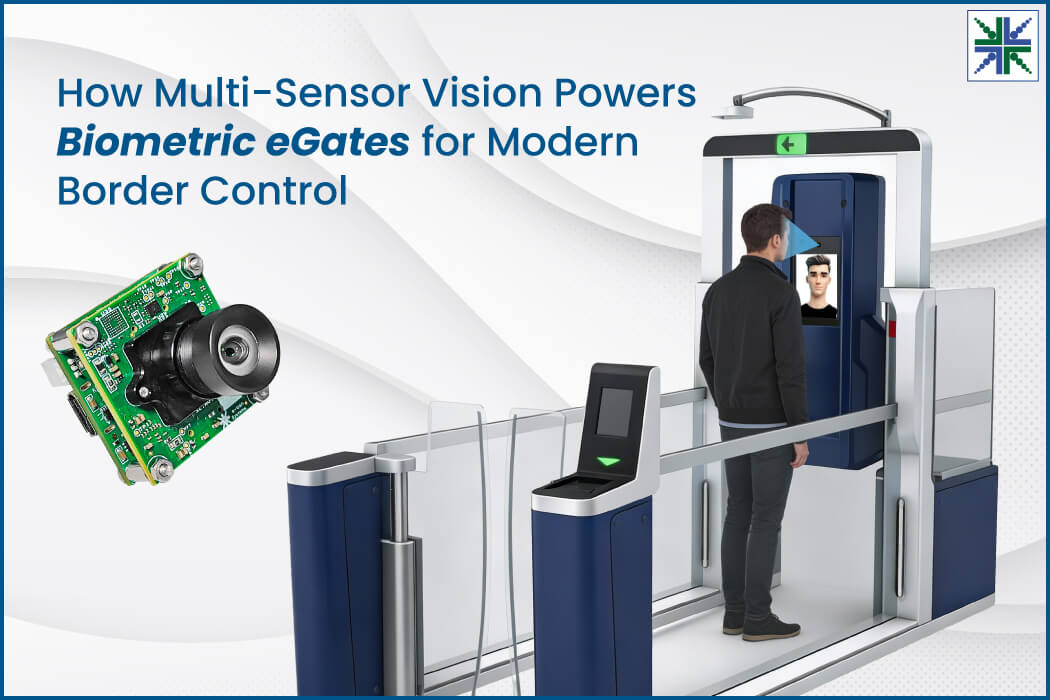
Biometric eGates form a key part of the automated border and transit infrastructure. Airports, seaports, and high-traffic land crossings use these systems to process rising passenger volumes while meeting identity verification and operational targets.
Every eGate uses multiple vision inputs that operate together within a tightly timed interaction. Facial cameras handle biometric matching, while depth sensors handle liveness checks. Overview cameras track user movement through the lane, and document scanners examine passports and identity cards using optical and multi-spectral capture.
This multi-sensor approach turns an eGate into a coordinated vision system. Camera placement, capture timing, and sensor performance directly affect throughput and inspection outcomes.
In the first of our two-part blog series, you’ll get expert insights into the reasons behind the current adoption of access gates and learn about their key vision components.
Why Access Gates Are Widely Adopted
Passenger traffic continues to rise at airports and border checkpoints, while inspection time per traveler keeps shrinking. Manual lanes struggle during peak hours due to staffing limits and uneven processing speed. Biometric access gates address this pressure by shifting routine identity checks into an automated flow with defined steps and machine-led verification.
Automated gates bring consistency to border operations. Vision systems and backend identity platforms follow the same sequence for every traveler, reducing variation across lanes and locations. Authorities gain better capacity planning, surge handling, and predictable processing times.
Access gates also enable oversight by creating traceable records for audits and operational review. This data aids compliance checks and ongoing system adjustments based on real usage patterns.
Additional adoption drivers include:
- Lower dependency on staffing levels during peak travel windows
- Improved lane utilization through uniform processing steps
- Separation between routine clearance and exception handling
- Easier rollout across terminals and border points using the same gate model
Key Vision Components in Biometric Access Gates
Biometric access gates use multiple vision devices, with each assigned a narrow responsibility within the inspection flow. These components operate during a short interaction window and feed different stages of identity verification, movement control, and document checks.
Facial recognition camera
The facial recognition camera captures a frontal facial image during the identity verification step. This image is used for biometric comparison against enrolled or database records. Capture occurs when the traveler pauses or aligns with the gate, forming the primary biometric input in the clearance decision.
Depth camera
The depth camera captures three-dimensional facial structure during the same interaction window. Its role centers on confirming physical presence during biometric capture and reducing misuse attempts that rely on flat images or video replay.
Overview camera
The overview camera observes the gate lane rather than the face. It records user presence, entry timing, posture, and movement through the passage. This input connects biometric events with physical progression through the gate and helps manage tailgating, hesitation, or reverse movement.
Document scanners
Document scanners capture passport and ID data during credential verification. They read visual and encoded information from travel documents and pass extracted data to backend systems for validation. This step links biometric capture with verified identity credentials.
Stay tuned for part two in this biometric eGate vision series, in which you’ll discover the critical imaging features required by these different cameras for biometric eGates.
e-con Systems’ Vision Solutions for Biometric eGates
Since 2003, e-con Systems has been designing, developing, and manufacturing advanced vision solutions for several industries, including smart retail. We empower biometric systems with vision solutions so that they have long-term reliability. Our ISP tuning and optics support help capture high-quality images for accurate recognition across varied environments. With rugged camera designs, we keep biometric devices running around the clock, even in harsh conditions.
Our portfolio includes cameras with driver support for quick integration with leading compute platforms such as NVIDIA, Qualcomm, NXP, Ambarella, and x86 systems.
Know more about e-con Systems’ biometric vision expertise.
Explore our retail vision solutions.
You can also use our Camera Selector to browse our full portfolio.
If you need expert guidance to select the right camera for your biometric system, please write to camerasolutions@e-consystems.com.
FAQs
- What is a biometric eGate, and why are airports and borders investing in them?
Biometric eGates are automated lanes that use facial recognition, depth sensing, and document scanning to verify identity during border or transit checks. They help authorities handle rising passenger volumes, keep processing steps consistent, and generate audit-ready records for compliance and operational review.
- Which vision components usually work together inside a biometric eGate?
A typical eGate combines a facial recognition camera for biometric matching, a depth camera for liveness and 3D structure, an overview camera to track movement through the lane, and document scanners to capture passport or ID data for backend validation.
- What does the facial recognition camera capture during identity verification?
The facial recognition camera captures a frontal facial image when the traveler pauses or aligns with the gate. This image feeds a biometric comparison against enrolled or database records. It serves as the primary biometric input in the clearance decision.
- How does the depth camera contribute during biometric capture?
The depth camera captures three-dimensional facial structure during the same interaction window as facial imaging. Its role focuses on confirming physical presence at the gate. This step addresses misuse attempts based on flat images or replayed video.
- What does the overview camera monitor inside the eGate lane?
The overview camera observes the gate lane rather than the face. It records user presence, entry timing, posture, and movement through the passage. This information connects biometric events with physical progression through the gate.
- What information is captured by document scanners in an eGate?
Document scanners capture passport and identity card data during credential verification. They read both visual and encoded information from travel documents. The extracted data is passed to backend systems for identity validation.

Ranjith is a camera solution architect with over 16 years of experience in embedded product development, electronics design, and product solutioning. In e-con Systems, he has been responsible for building 100+ vision solutions for customers spanning multiple areas within retail including self service kiosks, access control systems, smart checkouts and carts, retail monitoring systems, and much more.