



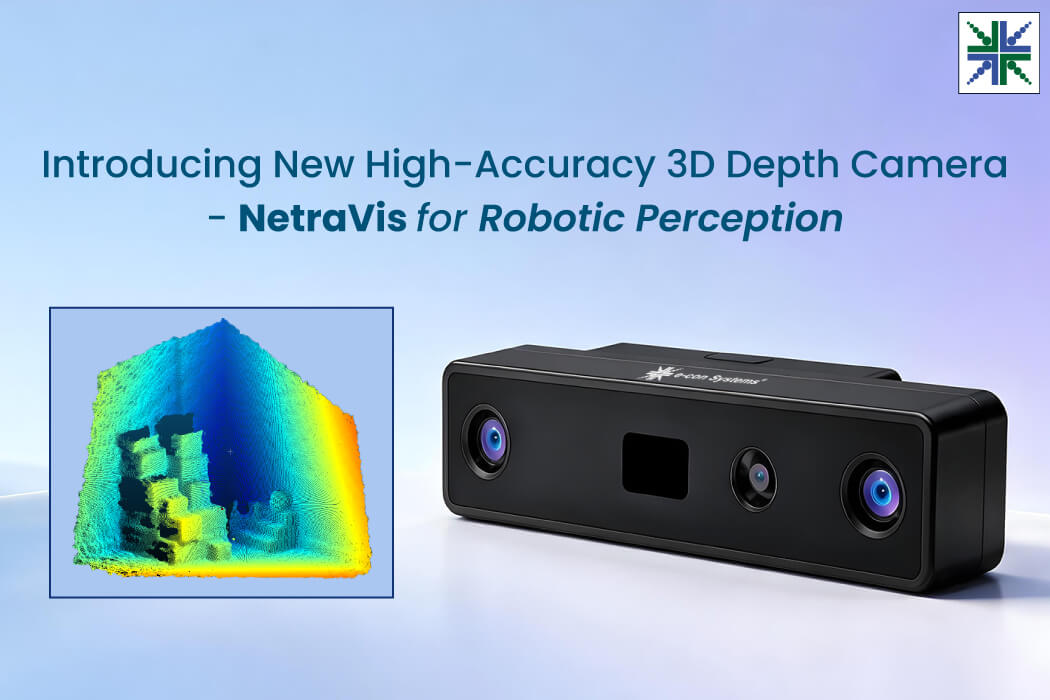
e-con Systems’ soon-to-be-launched NetraVis is a 1MP active stereo depth camera for indoor robotics and automation applications. NetraVis measures the space around a moving platform and calculates depth inside the camera. Powered by e-con Systems’ proprietary depth-processing algorithm, it is designed to deliver accurate and consistent depth data for robotic perception. Its control software uses the resulting distance data for navigation, spatial mapping and obstacle detection.
With two 1MP monochrome global-shutter sensors forming the active stereo pair, the images pass to an on-board ASIC, which calculates depth before data reaches the Linux host. The host receives a computed depth stream, removing the first stage of stereo processing from the host software.
In this blog, you’ll find out how NetraVis captures and processes depth for robotic perception. You’ll also learn how RGB output, motion data and on-camera AI work with the depth stream, along with the software resources available for its target applications.
What NetraVis Brings to 3D Robotic Perception
NetraVis offers stereo depth that begins with two views of the same scene. The depth engine compares their image data to calculate distance, which makes capture quality central to the result. Clear capture is crucial because the depth calculation depends on matching corresponding details between the left and right images.
NetraVis integrates the stereo pair with an on-board depth processor, so the Linux host receives depth data directly from the camera.
Proprietary Depth Processing for Consistent 3D Data
NetraVis combines active stereo sensing with e-con Systems’ proprietary depth-processing algorithm to improve the quality and consistency of the resulting depth data. The processing pipeline is designed to handle challenging surfaces while maintaining accurate depth and excellent frame-to-frame consistency.
The algorithm also enhances texture reconstruction, helping generate dense point clouds with more spatial detail for robotic 3D perception.
Active Stereo Depth with Global-Shutter Sensing
Two 1MP monochrome sensors form the active stereo pair on a 100 mm baseline, with an 850 nm IR filter in the optical path. Both sensors use a global shutter to avoid motion blur when the robot or objects in its view are moving.
Thanks to the global-shutter capture, this preserves the stereo image pair during motion and prevents the frame distortion associated with rolling capture. Preserving the left-right image relationship supports the comparison used to calculate depth.
An on-board ASIC receives the stereo data and computes depth inside the camera. With depth computation handled by the ASIC, application code on the Linux host accesses the resulting output through the SDK.
Depth Performance for Robotic Perception
The 0.2 m to 6 m range covers nearby obstacles and objects located farther from the camera in an indoor scene. At 2 m, depth deviation remains within 1%.
Frame rate determines how often the application receives a new spatial reading as the platform moves, whereas the field of view controls how much of the route enters each frame. The millimeter-based Z-depth map presents distance in a directly usable form.
The working range sets the distance coverage, and the deviation figure defines measurement tolerance at 2 m.
Reliable 3D Data in Difficult Scenes
Reflective materials and dark or black surfaces can make indoor depth sensing difficult. NetraVis produces accurate depth on both surface types with high repeatability. Stable readings under unchanged scene conditions help the application distinguish real movement from sensor variation. The SDK can express the computed measurements as a dense point cloud for 3D reconstruction.
The computed depth is available through the SDK in three additional formats:
- Disparity data derived from the stereo image pair
- Point-cloud output for 3D reconstruction
- Colorized depth output for visual inspection of distance changes
How NetraVis Brings Together Depth, RGB, Motion Data and AI
Depth establishes where surfaces lie in the scene. Depth-to-Color registration maps each measurement to its RGB image location, creating a common reference for visual data and distance. AI models run on the camera, and the 6-axis IMU records camera movement through a separate stream. The Linux host accesses each output through the camera SDK.
RGB and Depth Output
A dedicated 1MP global-shutter RGB sensor produces 1280 × 720 BGRa output at 30 fps over a 97° × 67° field of view. The RGB image records scene appearance, while the stereo pair measures distance. Depth-to-Color registration maps depth positions to matching locations in the RGB image.
Registration removes a separate alignment step from the application pipeline. Hence, the software can retrieve the distance associated with a selected RGB region or view a depth result within its color context. Moreover, depth, IR, RGB and registered outputs remain available through the module and SDK.
On-Camera AI
The 3.2 TOPS NPU runs AI models on the camera independently of the host processor. Model support includes:
- Object detection and segmentation
- YOLO26 model support
- Classification and face detection under development
The ASIC computes depth from the stereo images, and the NPU runs supported models independently of the host processor. Once processing is complete, the camera SDK passes depth and inference results to the Linux application. The host remains available for the rest of the robotics application.
Why NetraVis Is Ideal for Robotics Use Cases
NetraVis connects to Linux systems through USB 3.0 Type-C. A GMSL2 variant will be launched soon for embedded vision platforms, including NVIDIA Jetson. The accompanying software covers initial setup, stream access, visualization, AI inference and robotics integration.
- Python wrapper with sample code for depth, IMU, RGB and point clouds
- C++ applications covering camera outputs and on-camera AI inference
- OpenCV demonstrations for working with image streams
- Full ROS 2 packages for robotics integration
- README files with setup instructions and API documentation
NetraVis is aimed at robotic systems that use 3D perception for movement or physical interaction, including:
- Autonomous mobile robots and AGVs
- Automated Storage and Retrieval Systems (ASRS)
- Humanoid robots
- Robotic arms
Measure Depth Accurately With e-con Systems’ NetraVis
Since 2003, e-con Systems has been designing, developing, and manufacturing embedded vision solutions, from custom OEM cameras to complete ODM platforms. As mentioned earlier, e-con Systems is set to launch NetraVis_USB, its new 1MP active-stereo USB depth camera for indoor robotics and automation at VISION 2026.
Visit our Camera Selector Page to view our full portfolio of camera solutions.
Want to connect with our vision experts to discuss your imaging needs? Please write to camerasolutions@e-consystems.com.
FAQs
1. How does NetraVis calculate depth for robotic perception?
NetraVis uses two 1MP monochrome global-shutter sensors on a 100 mm baseline to capture stereo image pairs. Its proprietary depth-processing algorithm processes the stereo data to calculate depth, with an on-board ASIC handling the depth computation before the resulting depth stream is sent to the Linux host.
2. What depth range does NetraVis support?
NetraVis provides a working depth range of 0.2 m to 6 m for indoor robotic applications. At a distance of 2 m, its depth deviation remains within 1%, while the SDK provides millimeter-based Z-depth data for distance measurements.
3. How does NetraVis handle reflective and dark surfaces?
NetraVis produces depth measurements on reflective materials as well as dark or black surfaces, with high repeatability under unchanged scene conditions. Its SDK can also present depth information as disparity data, point clouds, or colorized depth output.
4. How do RGB, IMU data, and on-camera AI work with the depth stream?
A dedicated 1MP RGB sensor captures 1280 × 720 BGRA output at 30 fps, while Depth-to-Color registration maps depth measurements to corresponding RGB image locations. A 6-axis IMU provides motion data, and the integrated 3.2 TOPS NPU supports on-camera AI tasks such as object detection and segmentation.
5. Which robotics applications and software environments does NetraVis support?
NetraVis is designed for autonomous mobile robots, AGVs, Automated Storage and Retrieval Systems, humanoid robots, and robotic arms. It connects through USB 3.0 Type-C and provides Python sample code, C++ applications, OpenCV demonstrations, ROS 2 packages, setup instructions, and API documentation.

Prabu is the Chief Technology Officer and Head of Camera Products at e-con Systems, and comes with a rich experience of more than 15 years in the embedded vision space. He brings to the table a deep knowledge in USB cameras, embedded vision cameras, vision algorithms and FPGAs. He has built 50+ camera solutions spanning various domains such as medical, industrial, agriculture, retail, biometrics, and more. He also comes with expertise in device driver development and BSP development. Currently, Prabu’s focus is to build smart camera solutions that power new age AI based applications.