



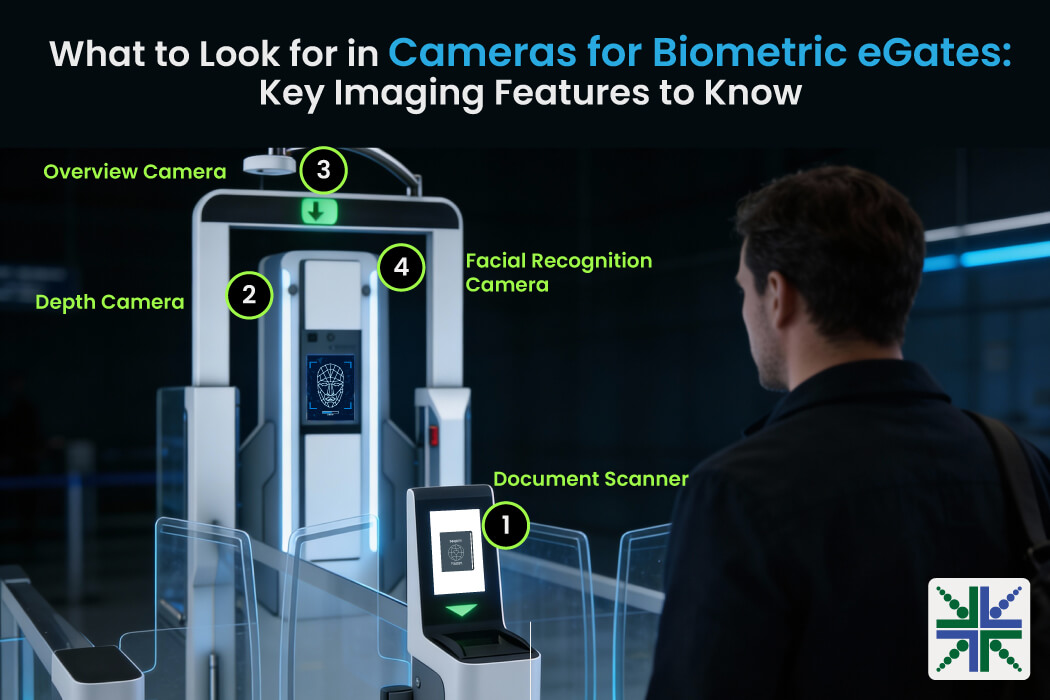
A biometric eGate has very little room for error when it comes to embedded vision performance. A traveler pauses briefly, looks ahead, and moves on. During that short interaction, cameras must capture a face, assess depth, monitor behavior, and scan documents, all while lighting shifts and foot traffic keeps flowing.
This is why camera imaging features are extremely critical for biometric eGates, as they influence accuracy, consistency, and day-to-day reliability.
Part one of this two-part blog series dove deep into the popularity of biometric eGates and the different camera types to consider. In part two, you’ll get expert insights into what imaging features you must look for while selecting the right camera for your biometric eGate system.
Imaging Features of Different Camera Types in Biometric eGates
Facial recognition camera
- High resolution: The sensor must capture extremely fine details such as individual skin pores and eyelid contours. This level of detail is necessary for the biometric algorithm to perform a highly accurate match against the stored template. Hence, even if a traveler is slightly off-center or moving, the high resolution ensures no critical identifying feature is lost.
- HDR support: Airports create challenging lighting with bright windows and deep interior shadows. HDR technology combines multiple exposures into a single, balanced image that retains detail in the brightest and darkest areas.
- NIR sensitivity: These cameras see in the near-infrared spectrum, which is invisible to the human eye. By operating at 850–940 nm, they completely avoid issues caused by unpredictable or harsh visible light in the environment.
- On-board ISP: An integrated Image Signal Processor handles critical tasks directly on the camera module. It performs initial face detection, adjusts focus, and optimizes exposure in real-time.
- Autofocus or fixed focus optics: The choice depends entirely on the physical design of the eGate lane. A walk-through system requires a responsive autofocus to track the user’s face as they move. In contrast, a fixed-position kiosk can use a simpler, more reliable fixed-focus lens set to a specific distance.
- IR-optimized optics and filters: Standard lenses are not efficient for infrared light, which is why specialized optics must be used. These components are coated and designed to maximize transmission of the specific IR wavelengths used for illumination.
- Integrated IR LEDs with diffusers: The camera projects its own infrared light to illuminate the subject’s face. Diffusers are placed over the LEDs to scatter the light and eliminate harsh, directional beams.
- Designed for continuous operation: These devices must function reliably 24 hours a day in high-traffic environments. Their internal components are selected and arranged to manage heat dissipation effectively during constant use.
Depth camera
- Depth accuracy within 1–2 meters: Precise measurement of physical distance is the core function of this sensor. An accuracy of 2–3 percent error at this range is sufficient to map the unique contours of a human face.
- Depth resolution in the range of 640 × 480: This resolution provides a sufficient number of data points across the facial area. Each point represents a precise distance measurement, collectively forming a detailed depth map.
- Active IR-based operation: The camera works by projecting a pattern of infrared dots onto the subject. It then calculates depth by analyzing how this pattern deforms across the contours of the face.
- Time-synchronized capture (with the facial recognition camera): The moment of capture for the 2D image and the 3D depth map must be perfectly aligned. This synchronization is managed down to the millisecond by the gate’s controller.
- Operating range (between 0.5 and 3 meters): The sensor is calibrated to work optimally within the physical confines of the eGate booth. Such a range accommodates a user stepping forward, pausing for verification, and then proceeding.
Overview camera
- Wide field of view: This camera’s primary role is surveillance. It means that a wide-angle lens allows it to monitor the entire approach zone and the interior of the gate.
- Low-light performance: Terminal lighting can dim significantly during nighttime operational periods. The camera must maintain a clear, low-noise video feed even in these low-light conditions.
- Stable frame rate: A smooth, consistent video stream is necessary for accurate behavioral analytics. It equips the system to precisely time how long a user remains in the verification zone.
Document scanner
- High resolution: This is critical for reading extremely fine details in security documents. High-resolution cameras help capture fine details: MRZ, barcodes, and small ID text for accurate OCR and verification.
- Multi-spectral imaging: Visible light imaging provides a clear, color-accurate photograph of the primary document page for visual inspection. UV imaging highlights hidden features like UV-sensitive inks and holograms that confirm authenticity. Finally, IR imaging reveals elements that appear only under infrared light, helping to identify tampering or forged documents.
- Optics and filters: High-quality optics and dedicated filters are used to optimize image clarity. This ensures that each spectral mode captures only the intended features without distortion or interference.
- LEDs with diffuser: Integrated LEDs provide integrated illumination in visible, UV, and IR modes. A diffuser spreads the light evenly across the entire document, reducing glare and shadows for uniform image capture.
- Interface flexibility: Support for standard interfaces like USB3 and MIPI CSI drives straightforward integration into various hardware platforms, from handheld readers to self-service kiosks.
- Compact form factor: The camera module is built into a space-efficient form factor, helping fit the design without space challenges.
What e-con Systems Offers for Biometric eGates
With over 20 years of expertise in embedded vision, e-con Systems designs, develops, and manufactures OEM and ODM vision platforms. We offer best-fit cameras that come equipped with must-have imaging features for modern applications such as biometric eGates. These include:
Interested in knowing more about how we develop vision solutions for biometric eGates? See it all here.
Want to discover the length and breadth of our retail vision expertise? Explore this page.
If you’d rather browse our cameras based on the features that you need, please visit our Camera Selector Page.
You can also write to camerasolutions@e-consystems.com and get connected to our camera experts who can help you find the perfect vision solution.
FAQs
- Why does facial recognition in eGates require very high-resolution cameras?
Facial matching algorithms depend on micro-level details such as eyelid contours and skin texture. Higher resolution preserves these details even when a traveler stands slightly off-center or moves during capture, supporting consistent biometric matching outcomes.
- How does HDR support improve biometric capture in airport environments?
Airports combine bright daylight from glass facades with darker interiors. HDR imaging merges multiple exposure levels into a single frame, retaining facial detail across both highlights and shadows during capture.
- What role does near-infrared sensitivity play in biometric eGates?
NIR-sensitive cameras operate in the 850–940 nm range using controlled infrared illumination. This approach reduces dependence on visible lighting conditions and delivers consistent facial imagery across lanes and terminals.
- Why is time synchronization between facial and depth cameras critical?
Depth maps and 2D facial images must represent the same instant in time. Millisecond-level synchronization ensures the depth data aligns with the facial frame, strengthening liveness detection and anti-spoofing checks.
- What imaging capabilities matter most in document scanners inside eGates?
Document scanners rely on high resolution and multi-spectral imaging. Visible, UV, and IR capture modes reveal text, holograms, and hidden security features, supporting accurate OCR and document authenticity checks.

Ranjith is a camera solution architect with over 16 years of experience in embedded product development, electronics design, and product solutioning. In e-con Systems, he has been responsible for building 100+ vision solutions for customers spanning multiple areas within retail including self service kiosks, access control systems, smart checkouts and carts, retail monitoring systems, and much more.