



Key Takeaways
- How urban lighting and motion define robotaxi imaging needs
- Which camera features support reliable perception during day and night operation
- Why unified AI vision boxes reduce latency and coordination gaps
- How integrated vision platforms support scalable robotaxi fleets
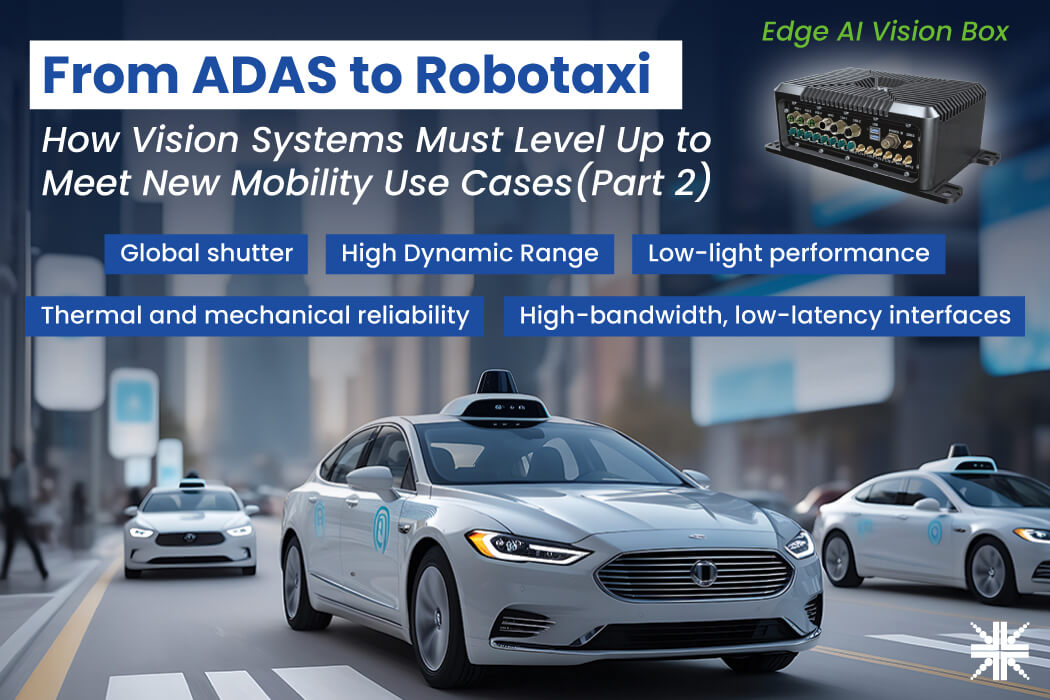
Robotaxis use cameras to understand what is happening around them in busy city streets. However, every robotaxi trip means dealing with direct sunlight, deep building shadows, headlight glare, tunnels, rain on lenses, and constant motion from vehicles, cyclists, and pedestrians. Hence, camera performance influences how well the vehicle interprets scenes, serves passengers, and meets regulatory expectations.
Robotaxis also need camera solutions that can handle low-light settings, fast motion, long duty cycles, and more. AI vision boxes such as e-con Systems’ Darsi Pro are a perfect match for these modern mobility systems since they bring key components into a unified platform.
In part 1 of this blog series, we explored modern mobility vision demands, their challenges, and how advanced vision solutions can overcome them. In part 2, we’ll see which camera features matter most for robotaxis, why unified AI vision boxes are critical, and the unique advantages they offer.
5 Key Imaging Features of Robotaxi Cameras
1. High Dynamic Range (HDR):
In dense city driving, the cameras must handle rapid transitions between direct sunlight, deep building shadows, tunnels, and reflective surfaces that appear within the same route. High dynamic range keeps lane markings, signals, and vulnerable road users visible during these abrupt exposure changes.
2. Low-light performance:
Night operations place different demands on the cameras, with uneven illumination from headlights, street lamps, and storefront lighting. Reliable low-light capture preserves object edges and surface detail when ambient light drops.
3. Global shutter:
Urban intersections introduce fast, multi-directional movement from vehicles, cyclists, and pedestrians. Cameras with global shutter preserve object shape and position during motion, reducing distortion that interferes with tracking.
4. Thermal and mechanical reliability:
Commercial robotaxi deployments keep camera hardware active for long duty cycles rather than short feature-triggered use. Resistance to heat buildup, vibration, and environmental exposure helps maintain stable image output over time.
5. High-bandwidth, low-latency interfaces:
High-bandwidth, low-latency interfaces such as GMSL and FPD Link III carry continuous camera and sensor data at high resolution. Predictable data delivery through these interfaces keeps perception aligned with live movement instead of delayed frames.
Why Robotaxis Need Fully Integrated, Unified AI Vision Boxes
Mobility systems operate in environments filled with movement, glare, outdoor exposure, and unpredictable surroundings. When camera modules, sensors, and AI processors sit on separate units, mobility platforms experience unnecessary pauses while each part responds at its own pace. These gaps become harder to manage as workloads grow and systems run for long-duty operation.
Bringing everything under one vision roof helps avoid those gaps and gives mobility systems a steadier path from camera intake to AI-driven tasks. A unified setup reduces integration steps, simplifies field deployment, and gives developers a unified reference point to work with.
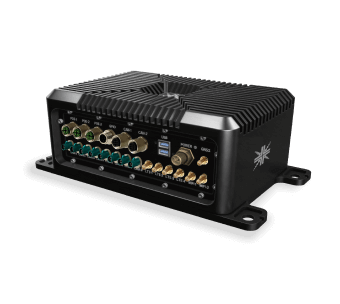
e-con Systems’ Darsi Pro follows this approach by combining camera connectivity, AI processing, sensor support, and interfaces into one Edge AI Vision Box built for mobility use cases.
 Scalable multi-camera synchronization
Mobility platforms rely on several viewpoints to understand movement in warehouses, factory lanes, and outdoor routes. Darsi Pro supports up to 8 GMSL or GMSL2 cameras through FAKRA connectors, helping mobility systems maintain consistent intake from multiple views even when lighting shifts or movement accelerates.
Advanced AI processing
Detection, tracking, and classification place heavy pressure on mobility workloads, especially during long-running operations. Darsi Pro delivers up to 100 TOPS of AI performance and can operate in Super Mode for higher workloads, helping mobility units maintain smooth imaging output during continuous video intake.
Multi-sensor fusion
Mobility platforms depend on inputs from cameras, LiDAR, radar, and IMUs to interpret movement clearly. Darsi Pro works with these sensors using Precision Time Protocol so that mobility systems receive the right inputs and navigation responds more predictably when timing stays aligned.
Rugged performance and interface support
Mobility robots face dust, vibration, and temperature variation during extended operation cycles. Darsi Pro uses a rugged enclosure, fanless build, and wide operating temperature range, along with interfaces such as Dual GbE with PoE, USB 3.2, HDMI, CAN, and wireless support. It helps mobility systems handle long-duty operation and deployment in real environments using one unified unit.
e-con Systems’ Latest Unified AI Vision Box for Robotaxis
Since 2003, e-con Systems® has been designing, developing, and manufacturing OEM cameras. Recently, we launched Darsi Pro – our latest unified AI vision box that equips robotaxis with cutting-edge vision power.
Better understand e-con Systems’ mobility camera expertise.
Looking for something else? Please visit our Camera Selector Page to see our end-to-end portfolio.
Need help integrating the best-fit unified camera solution into your mobility system? Write to camerasolutions@e-consystems.com.
FAQs
- Why do robotaxis rely on unified AI vision boxes instead of separate components?If the robotaxi relies on unified vision systems, components like cameras, synchronization, and AI processing are tightly aligned. This minimizes latency, timing drift, and failure points during continuous operation. When delivered as a pre-integrated package, including the camera, it further reduces bring-up effort, improves fleet-wide consistency, and accelerates deployment.
- How do multi-camera inputs fit into a robotaxi IoT vision setup?Robotaxis use forward, rear, and surround coverage for 360° perception. An IoT vision setup must ingest multiple camera streams together so full-scene perception stays coherent during dense interactions. A unified system helps keep those feeds coordinated during continuous operation.
- Why does time synchronization matter for robotaxi IoT data streams?When multiple cameras and sensors feed perception, timing alignment governs whether the system interprets the same moment across inputs. Tight synchronization also eliminates mismatches between streams during motion. This helps perception stay stable as routes shift from bright streets to shadowed corridors and back.
- Which imaging features map directly to robotaxi city driving conditions?Robotaxis face harsh sunlight, deep shadows between buildings, headlight glare at night, and rain streaks on lenses. HDR and low-light performance support usable imagery across these transitions. Global shutter helps during fast motion and dense scenes, where rolling artifacts can distort objects.
- Which unified-box capabilities help robotaxi IoT deployments scale across fleets?Fleet deployment benefits from repeatable behavior, vehicle to vehicle, day to day. A unified box centralizes capture, synchronization, and processing so performance stays consistent across many units. It also reduces integration steps when the same package gets deployed across locations and climates.

Suresh Madhu is the product marketing manager with 16+ years of experience in embedded product design, technical architecture, SOM product design, camera solutions, and product development. He has played an integral part in helping many customers build their products by integrating the right vision technology into them.