



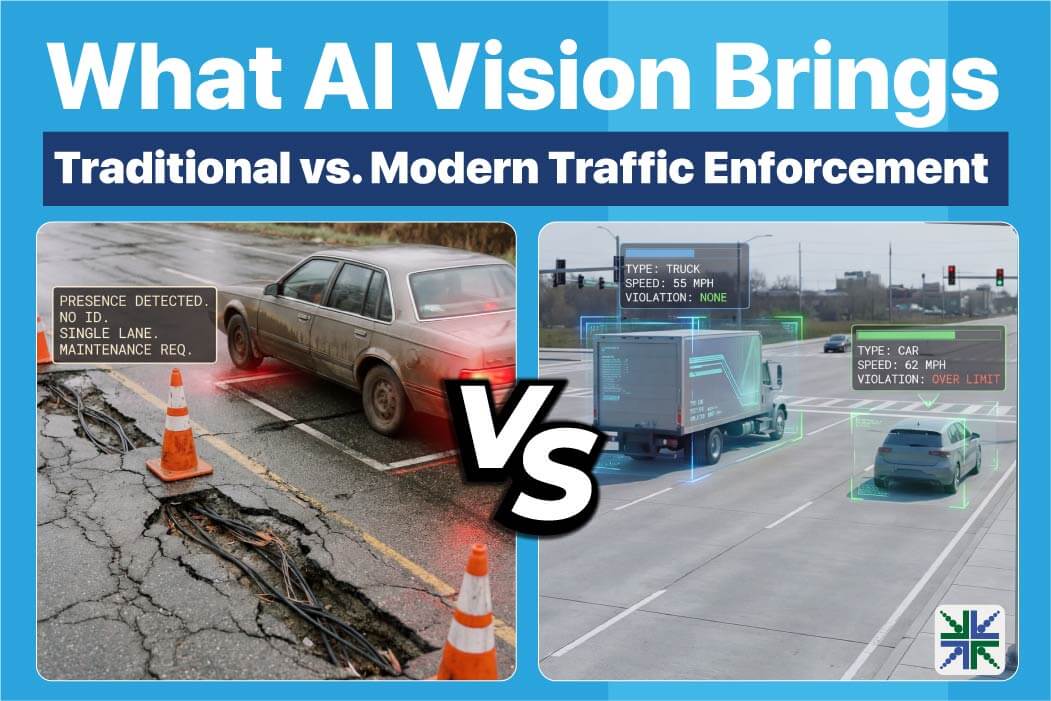
Traffic enforcement has entered a new phase where cameras are the proverbial eyes of intelligent systems that interpret road behavior. The move from mechanical sensors to AI vision has changed how cities manage traffic enforcement and intersection monitoring.
Urban planners used to rely on inductive loops buried under asphalt to detect vehicles. That approach worked for counting traffic volume or triggering lights. However, it could never reveal driver intent, predict collision risk, or support proactive traffic enforcement. Modern roads demand far richer awareness. AI vision systems analyze moving scenes in real time, identifying vehicles and behavior patterns that create violations or near misses.
This blog will help understand why inductive loops are becoming obsolete, how AI-driven imaging enhances detection accuracy, and what this shift means for urban mobility.
Traffic Enforcement Challenges Faced By Inductive Loops
Inductive loops are based on a basic electromagnetic principle. When a vehicle passes over a buried wire coil, the metallic body disturbs the magnetic field, triggering a signal that confirms its presence. For decades, it has been the standard detection method at intersections all over the world.
But the physical nature of these installations has made them increasingly impractical for modern traffic enforcement. They face challenges such as:
- Installation requires trenching into paved surfaces, disrupting traffic and degrading road integrity.
- Environmental wear, repaving, and heavy loads shorten operational life to roughly three to seven years.
- Loops count vehicles but fail to distinguish between passenger cars, trucks, and two-wheelers.
- They cannot track motion, identify direction, or analyze speed variations.
- Repairs involve excavation, calibration, and system downtime, raising the total cost of ownership.
Read: What is a Red Light Camera? A Quick Guide to Traffic Violation Detection
The Rise of AI Vision in Smart Traffic Enforcement Systems
AI-powered traffic cameras are capable of helping interpret visual data in real time. The systems detect and classify vehicles, track trajectories, and identify rule violations without requiring manual supervision. Their raw video is turned into indexed intelligence for sensing nodes and analytical agents within connected intersections.
ML and DL models for imaging in action
Machine Learning and Deep Learning frameworks equip AI vision systems to recognize objects and patterns within milliseconds. Trained on diverse datasets from highways, urban centers, and pedestrian zones, the models differentiate between vehicle types, read license plates, and infer speed using frame-by-frame positional shifts.
The derived insights empower enforcement bodies to capture violations with evidentiary accuracy while maintaining continuous monitoring across multiple lanes or junctions.
Rise of next-gen vision-based enforcement
Unlike legacy systems that respond only to presence signals, AI camera-based traffic systems interpret movement sequences to detect red-light violations, tailgating, or aggressive lane shifts. They operate under variable lighting, glare, and rain through optimized imaging pipelines. Real-time event tagging synchronizes with back-end databases, driving automatic citation generation and incident logging within seconds of detection.
Read: What Are the Top PTZ Camera Features for Traffic Enforcement?
Camera-based networks are also inherently modular. So, expanding coverage demands software calibration rather than physical re-engineering. Edge devices run inference locally to minimize bandwidth use, while central servers aggregate insights for regional analysis.
The architecture supports scalable deployment across metropolitan grids without major civil work, aligning with smart city modernization strategies.
How e-con Systems deployed a complete vision solution for next-gen multi-lane free-flow tolling
Real-World Impact of AI Vision on Traffic Enforcement
- Continuous visibility: HDR traffic cameras sustain monitoring through low light, heavy rain, or glare conditions, ensuring uninterrupted situational awareness.
- Automated violation tracking: Frame-level analytics record events like signal jumps, over-speeding, and lane deviation with time-stamped evidence.
- Accident reconstruction: Video archives assist investigations by mapping trajectories, acceleration patterns, and driver responses leading up to collisions.
- Data-driven traffic planning: Aggregated feeds help engineers optimize signal cycles, lane distribution, and route design using empirical visual data rather than estimates.
- Predictive safety analytics: Algorithms trained on historical footage detect early signs of risky driver behavior – authorities can quickly issue pre-emptive alerts.
- Urban integration: Camera networks connect with centralized mobility dashboards, combining enforcement data with congestion metrics, environmental indicators, and emergency response systems.
- Reduced infrastructure fatigue: Transitioning from buried sensors to above-ground units cuts repair cycles, minimizes physical wear, and provides remote diagnostics.
- Scalable modernization: Adding new lanes, intersections, or capabilities becomes software-driven without requiring any civil work, empowering cities to expand enforcement at minimal cost.
Read: Top 7 Imaging Features of Speed Cameras
e-con Systems’ Cameras for Superior Traffic Enforcement Vision
e-con Systems has been designing, developing, and manufacturing OEM cameras since 2003. We develop AI-based traffic cameras that strengthen vision-based traffic management. Our imaging modules have features like global shutter, High Dynamic Range, and ISP tuning to deliver accurate visuals in high-speed and variable-light conditions. They also come with multi-camera synchronization for offering panoramic coverage across intersections, highways, and tolling points with consistent frame alignment.
Our connectivity options, including GigE and GMSL, integrate directly with roadside controllers and embedded AI vision processors for event detection and analytics. e-con Systems’ ITS cameras also use IP-rated enclosures to handle vibration, dust, and thermal stress. They can be quickly integrated with NVIDIA Jetson platforms, powering real-time enforcement, vehicle classification, and automated tolling.
Check out e-on Systems’ Camera Selector Page to see the full portfolio.
If you’re on the lookout for the best-fit camera module for any smart traffic system, please write to camerasolutions@e-consystems.com.
Frequently Asked Questions
- How is AI vision transforming traditional traffic enforcement?
AI vision enables continuous visual analytics instead of point-based detection. It identifies vehicles, interprets trajectories, and detects violations in real time, offering a comprehensive view of road activity rather than isolated triggers.
- What are the key drawbacks of inductive loops in modern traffic systems?
Inductive loops require road excavation for installation and frequent maintenance. They cannot differentiate vehicle types or capture behavioral data such as speed or direction, making them less adaptable to growing enforcement needs.
- Why are camera-based systems preferred for next-generation intersections?
Camera-based systems deliver scalable, software-driven imaging. They capture multi-angle visuals, integrate easily with AI processors, and provide 24/7 visibility for both enforcement and planning without major infrastructure changes.
- How do AI vision platforms improve road safety analytics?
They generate detailed datasets that track movement patterns, classify vehicles, and identify potential conflict points. This helps city authorities predict and prevent collisions while improving signal coordination and traffic flow.
- How do e-con Systems’ ITS cameras come with AI vision?
e-con Systems offers ITS-grade, AI-powered cameras built for real-world conditions. Our GigE and GMSL connectivity, synchronized imaging, and NVIDIA Jetson compatibility create high-performance vision nodes for enforcement, tolling, and urban mobility analytics.

Dilip Kumar is a computer vision solutions architect having more than 8 years of experience in camera solutions development & edge computing. He has spearheaded research & development of computer vision & AI products for the currently nascent edge AI industry. He has been at the forefront of building multiple vision based products using embedded SoCs for industrial use cases such as Autonomous Mobile Robots, AI based video analytics systems, Drone based inspection & surveillance systems.