



Key Takeaways
- Why wrong-way incidents pose extreme risks on high-speed corridors
- Role of AI vision cameras in detecting reverse movement in real time
- Where AI vision outperforms other camera-based approaches
- What ITS teams gain from on-device analytics and visual evidence
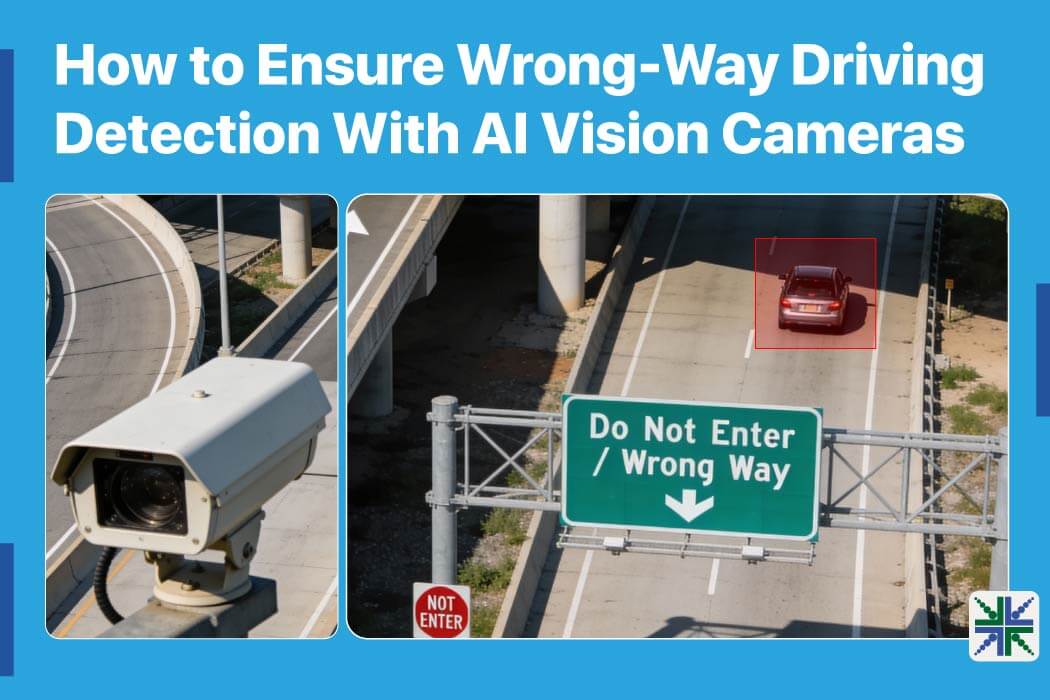
Wrong-way driving refers to a vehicle entering a roadway, expressway, tollway, or ramp in the opposite direction of traffic flow. These moments tend to occur on high-speed corridors where drivers have very little time to react. Conditions such as low visibility at night, impaired driving, ramp confusion, and weak signage contribute to many incidents. Data from recent years shows how often situations lead to severe outcomes on divided highways.
Highway operators and traffic agencies continue to flag wrong-way entries as a major safety risk because they often lead to head-on crashes with very high impact forces. Ramps used for expressways and toll networks face the most exposure since entry mistakes happen more frequently in those segments.
In this blog, you will see how AI vision cameras support wrong-way driving detection, why they strengthen modern ITS programs, and where they provide the most value in real deployments.
Why Wrong-Way Driving Detection Matters for ITS Operators
Wrong-way entries create some of the most severe roadway events due to closing speeds on divided highways. According to FHWA, 2,855 fatalities have occurred between 2018 and 2022, averaging 570 deaths per year all over the US. Alcohol impairment plays a large role as well, with studies indicating involvement in roughly 60% of wrong-way crashes.
This makes such incidents harder to predict and counter through manual monitoring.
Control rooms manage wide territories with limited personnel, especially during night hours when visibility drops and impaired driving increases. ITS Operators may overlook early cues while juggling multiple feeds, which can influence response time during the initial moments of an entry.
Current Industry-Proven Imaging Solutions for Wrong-Way Detection
1) Thermal cameras with direction analytics
Thermal units read heat signatures in fog, dust, and low-light scenes. Moreover, direction analysis highlights movement going against the traffic flow.
Benefits:
- Improves visibility during hazy conditions
- Enhances night coverage (ramp zones)
- Enables monitoring in environments with shifting illumination
Challenge: High cost and absence of plate evidence restrict investigative review.
2) Inductive loop detectors using sequence logic
Loops embedded in pavement register vehicle movement and output a sequence aligned with the correct travel direction. A reversed sequence flags a wrong-way entry.
Benefits:
- Reduces reliance on above-ground hardware
- Maintains consistent performance for single-lane ramps
- Supports straightforward processing inside control rooms
Challenge: Loops cannot classify vehicles and cannot provide images for verification.
3) Radar-based detection
Radar monitors movement and direction across extended distances, helping supervise fast highway sections where entries appear suddenly.
Benefits:
- Covers broad zones (multiple lanes)
- Captures movement patterns along high-speed stretches
- Provides early notifications for field teams
Challenge: Radar offers no visual evidence and reacts to clutter near roadside structures.
4) LiDAR-based detection
LiDAR creates dense spatial readings and reinforces directional tracking in areas with complex ramp geometry.
Benefits:
- Produces detailed spatial information
- Strengthens tracking in irregular layouts
- Understands objects in busy environments
Challenge: High cost, installation complexity, and limited suitability for many ramp deployments influence adoption.
5) ANPR and AI vision cameras
AI vision cameras detect objects, read plates, interpret direction patterns, and classify cars, motorcycles, trucks, and pedestrians. The units support automated workflows inside traffic management centers.
Benefits:
- Provides evidence for traffic teams
- Processes direction logic on-device
- Supports varied vehicle types across lanes
- Integrates with ITS camera networks
- Strengthens TMC automation through real-time event routing
How e-con Systems delivered a full camera solution for next-gen MLFF tolling
Why AI Vision Cameras Are Becoming the Preferred Solution
Automation plays a huge role in wrong-way detection, and state programs continue to validate its impact. For instance, Florida reported a reduction of over 95% of potential wrong-way crashes through real-time alerts and strong field deterrents. AI vision cameras support similar goals by merging direction analytics, object understanding, and evidence capture into a single system for traffic teams.
Automatic evidence capture
AI vision cameras deliver high-resolution frames and plate visibility the moment a wrong-way entry begins. Traffic teams gain visual confirmation at the source, creating stronger support for control-room decisions, incident documentation, and coordination with field units.
Real-time direction detection on the edge
Direction tracking runs inside the camera, sending alerts with minimal delay to traffic management centers and roadside message boards. Edge processing removes reliance on external servers, helping operators act quickly during early movement.
Multi-object detection
AI models identify cars, motorcycles, trucks, and pedestrians. This helps supervise ramps and high-speed corridors where mixed traffic enters at different angles and speeds. Outputs from object detection feed directly into traffic center workflows and strengthen TMC automation.
Night-time and low-light performance
Ramps often function under weak illumination, especially during late hours. NIR and IR support help cameras retain plate visibility and object tracking through challenging lighting, enabling consistent awareness despite changing conditions.
Lower costs
AI vision cameras reduce overall system cost by offering visual evidence and direction analytics through one device. Thermal and LiDAR setups usually rely on multiple sensing units, raising project cost through added hardware, while a single AI camera keeps deployment cost far lower.
How AI-Based Wrong-Way Detection Works
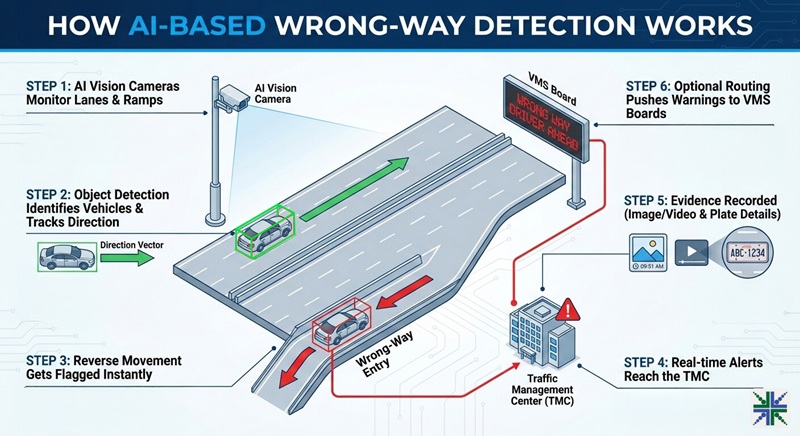
Step 1: AI vision cameras monitor lanes and ramps continuously
The unit keeps a persistent view of the roadway, giving uninterrupted coverage in the monitored zone.
Step 2: Object detection identifies vehicles and tracks the direction vector
AI models highlight vehicles and trace their movement. The direction vector helps determine how each vehicle progresses through the scene.
Step 3: Reverse movement gets flagged instantly
Once movement shifts against the intended flow, the camera classifies the event as a wrong-way entry.
Step 4: Real-time alerts reach the TMC
The camera routes the alert to the traffic management center without delay, helping operators react during the earliest moments of entry.
Step 5: Evidence gets recorded through an image/video with plate details
The camera captures evidence immediately. So, traffic teams get plate visibility and a visual record that supports field coordination.
Step 6: Optional routing pushes warnings to VMS boards
Integration with VMS displays helps guide drivers away from danger by issuing instant roadside messages.
e-con Systems’ AI Vision Cameras for Wrong-Way Driving Detection
Since 2003, e-con Systems has been designing, developing, and manufacturing OEM cameras, including deployment-ready traffic monitoring cameras for wrong-way detection. It includes PTZ cameras, bullet cameras, and other camera modules with features such as high-resolution, HDR, global shutter, and GigE connectivity.
e-con Systems also offers an AI vision box series for real-time edge analytics, leveraging multi-camera inputs and on-board neural processing.
Know more about our traffic monitoring cameras.
Please use our Camera Selector to check out our complete portfolio.
Need a best-fit customization AI vision camera for your wrong-way detection system? Reach out to us by writing to camerasolutions@e-consystems.com.
Frequently Asked Questions
- How do AI vision cameras detect wrong-way movement?
AI vision cameras monitor lanes and ramps continuously and track vehicles through object detection and a direction vector. When movement shifts against the intended flow, the camera flags the event and sends an alert to the TMC. The process supports early operator action.
- Why are AI vision cameras preferred over other imaging solutions?
AI vision cameras merge direction analytics, evidence capture, and object understanding within one device. ITS agencies gain plate visibility, multi-vehicle recognition, and strong low-light coverage through NIR and IR. Lower system cost strengthens adoption across wider networks.
- Can AI vision cameras record plate information for wrong-way events?
AI vision cameras capture an image or video the moment a reverse entry begins. Plate details become available instantly for TMC review and field coordination. Incident teams gain stronger visual records for follow-up.
- How quickly do alerts reach traffic management centers?
Direction tracking runs inside the camera, sending alerts to the TMC with minimal delay. Edge processing removes dependence on external servers. Faster routing supports quicker decisions during early movement.
- Do AI vision cameras support VMS-based driver guidance?
AI vision systems can push warnings to VMS boards as soon as a wrong-way entry begins. Drivers receive a prompt roadside message that helps redirect movement. That way, ITS agencies gain another layer of field deterrence.

Dilip Kumar is a computer vision solutions architect having more than 8 years of experience in camera solutions development & edge computing. He has spearheaded research & development of computer vision & AI products for the currently nascent edge AI industry. He has been at the forefront of building multiple vision based products using embedded SoCs for industrial use cases such as Autonomous Mobile Robots, AI based video analytics systems, Drone based inspection & surveillance systems.