



Industrial drones now handle inspection, monitoring, and audit tasks across plants, refineries, energy assets, yards, mining sites, construction zones, and utility corridors. Their value depends on the quality of the visual evidence they return, which means the camera must see enough detail for a human reviewer or an AI model to act on.
Camera selection is a top priority for industrial drones because this decides the quality of the visual data. If the image lacks usable detail, contains motion artifacts, misses contrast, or loses depth indicators, the rest of the system must compensate through rechecks, manual review, and lower automation trust.
In this blog, you’ll understand the impact of high-quality imaging on industrial drones, the low-light conditions that the cameras must operate in, and how to manage the camera selection process.
Vision Quality and Its Impact on Inspection Drone Accuracy
Inspection accuracy begins with sensor resolution, pixel size, shutter type, lens selection, dynamic range, and other key imaging features. Each choice affects how much usable information the drone carries back from the field.
The practical question is whether the camera can capture the defect, object, label, surface, corrosion pattern, structural edge, or obstacle with enough dependability across repeated flights. A vision system that performs well during a controlled demo can struggle when dust, vibration, sun angle, propeller movement, and changing altitude enter the picture.
Camera selection influences three connected layers of drone accuracy:
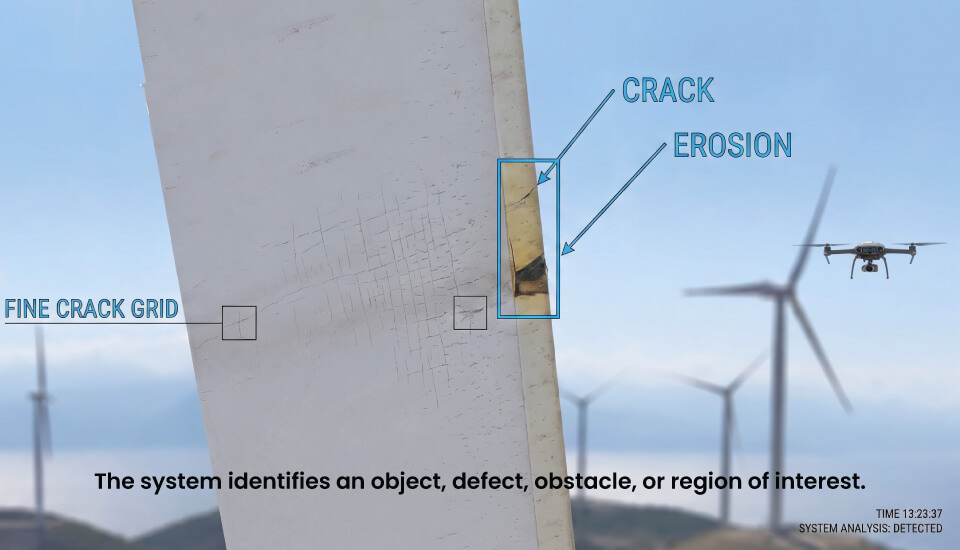
- Detection: The system identifies an object, defect, obstacle, or region of interest.
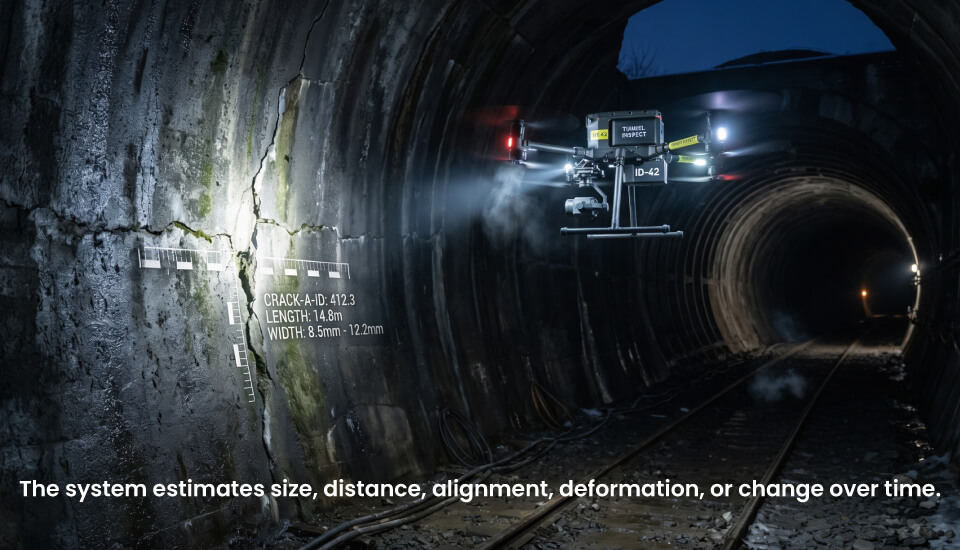
- Measurement: The system estimates size, distance, alignment, deformation, or change over time.
- Decision: The inspection output supports maintenance, safety, compliance, or operational action.
For example, a drone monitoring a power asset must first capture surface detail. The analytics pipeline must then distinguish wear, deposits, heat damage, physical damage, or foreign material from background noise. After that, the inspection record must give the maintenance team enough confidence to plan a repair.
What Industrial Drone Cameras Must Handle During Inspection
Industrial drones rarely capture images from calm, repeatable conditions. They move through vibration, air turbulence, changing light, reflective surfaces, shadows, narrow paths, and distance variation. Some of the factors that affect their imaging capabilities are:
Motion and vibration
A drone is always moving, even when hovering. Aircraft corrections, payload vibration (movement of equipment attached to the drone), and wind can impact how frames are captured. Rolling shutter cameras, which scan each line of the image sequentially, can distort shapes when the drone moves past equipment, pipes, or machinery.
These aberrations can cause false readings for inspection tasks that require accurate edges or reading text.
Global shutter cameras expose the entire frame at the same time. These cameras work well when the drone must capture fast motion, fly near moving assets, or keep image geometry consistent during route-based inspection. Preserving object shapes helps with asset mapping, reading serial numbers, detecting surface problems, and navigating industrial structures.
Lighting range
It is well-known that industrial sites create difficult lighting. The same route can include harsh sunlight, dark corners, LED flicker, shiny metal, shaded understructures, and nighttime operation. A camera with poor dynamic range may wash out bright sections or bury details in dark zones.
HDR (High Dynamic Range) cameras are useful when inspection routes have mixed lighting. A tuned ISP (Image Signal Processor) adjusts exposure, white balance, noise reduction, and color before the frame reaches AI processing.
This minimizes the need for extra image correction on the main computer, securing more resources for detection, tracking, and navigation.
Distance and Field of View (FoV)
Drone inspection demands a balance between wide coverage and detail capture. A wide FoV can help with navigation and general monitoring, but small defects may occupy too few pixels. A narrow view can capture detail, but it may increase flight time plus reduce situational awareness.
It is also crucial to understand that lens choice, sensor resolution, and working distance must be planned together.
How to Select the Right Camera Based on Drone Inspection Tasks
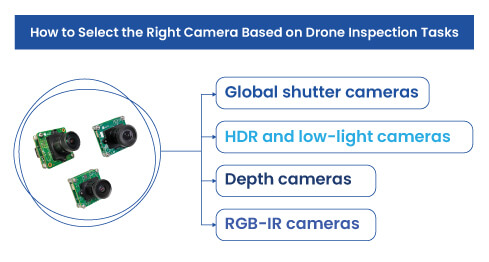 Global shutter cameras
Global shutter cameras are useful when the drone captures moving scenes or flies along assets at speed. They help reduce motion distortion in frames used for detection, reading, counting, or navigation.
HDR and low-light cameras
For monitoring programs conducted at different times of day, lighting tolerance directly affects repeatability. It is especially true in low-light conditions, which can reduce edge clarity, obscure surface details, and make the same asset appear different across inspection runs. Outdoor assets, solar installations, metal structures, yards, and plant exteriors can also create extreme contrast between sunlit and shadowed areas.
HDR cameras are valuable when a drone route passes between bright and dark zones. They retain detail in both shadowed and brightly lit areas, helping the camera capture usable imagery despite challenging conditions.
RGB-IR cameras
RGB-IR cameras help when the system needs color information along with IR imaging. In industrial drone monitoring, this can support day-to-night inspection, reflective marker reading, low-light scene interpretation, and object classification, where visible and IR cues complement each other.
This kind of camera can reduce the need to use separate payloads for visible and IR-assisted imaging in compact platforms.
Depth cameras
Depth cameras measure distance, locate obstacles, and build 3D models of scenes. In industrial inspection, they help drones estimate how close they are to assets, determine position relative to structures, and gather spatial data during repeat visits.
An iToF (Indirect Time-of-Flight) camera captures depth, reliability, and IR (infrared) data, which is useful for robotics and automation tasks needing distance awareness.
Maximize Your Drone’s Imaging Power with e-con Systems
e-con Systems has been designing, developing, and manufacturing OEM and ODM camera solutions since 2003. We offer USB, MIPI, GMSL, FPD-Link, GigE, 10GigE, and ToF cameras, along with edge AI compute platforms, ISP tuning, driver development, carrier board engineering, lens selection, and enclosure support.
Our cameras have been successfully deployed across several smart surveillance applications, such as industrial drones.
View all our smart surveillance camera solutions
Use our in-house Camera Selection tool to find the exact imaging solution for your industrial drone needs.
The vision experts at e-con Systems can also help choose the right sensor, interface, optics, processing path, and mechanical configuration.
Prepared to maximize your drone’s vision capability? Contact camerasolutions@e-consystems.com to discuss your requirements and unlock state-of-the-art imaging solutions.
FAQs
How does camera selection affect industrial drone inspection accuracy?
Camera selection affects how much usable visual data a drone captures during inspection. Resolution, shutter type, lens choice, dynamic range, frame rate, exposure control, ISP tuning, and mechanical fit all influence detection, measurement, and decision quality.
Which camera features are key for drone-based industrial inspection?
The main features include sensor resolution, pixel size, global shutter, HDR capability, low-light performance, field of view, interface bandwidth, and ISP tuning. These factors help the drone capture surface detail, asset edges, labels, corrosion patterns, obstacles, and structural changes with higher dependability.
When should industrial drones use global shutter cameras?
Global shutter cameras work well when drones fly near moving assets, capture frames while in motion, or inspect routes where shape accuracy matters. They expose the entire frame at once, helping reduce distortion during tasks such as asset mapping, serial number reading, defect detection, and navigation around structures.
How do HDR and low-light cameras help inspection drones?
HDR and low-light cameras help when drones move through harsh sunlight, low-light conditions, LED flicker, reflective metal, and dark corners. HDR imaging keeps detail visible in bright and dark areas, while ISP tuning prepares frames for detection, tracking, and navigation.
What role do depth cameras play in industrial drone monitoring?
Depth cameras help drones measure distance, detect obstacles, understand position near assets, and collect spatial data during repeat visits. iToF cameras capture depth and IR data, which supports distance awareness in robotics and automation tasks.

Ram Prasad is a Camera Solution Architect with over 12 years of experience in embedded product development, technical architecture, and delivering vision-based solution. He has been instrumental in enabling 100+ customers across diverse industries to integrate the right imaging technologies into their products. His expertise spans a wide range of applications, including smart surveillance, precision agriculture, industrial automation, and mobility solutions. Ram’s deep understanding of embedded vision systems has helped companies accelerate innovation and build reliable, future-ready products.