



Key Takeaways
- How ALPR cameras capture, recognize, and contextualize license plates
- Challenges faced by ALPR systems in real-world traffic environments
- How ALPR systems support law enforcement violation ticketing workflows
- Camera features that enable automated, audit-ready violation processing
The troubling reality is that cities are expanding faster than enforcement mechanisms can scale. While law enforcement agencies remain responsible for tracking traffic violations, managing this manually in high-density zones presents logistical limitations.
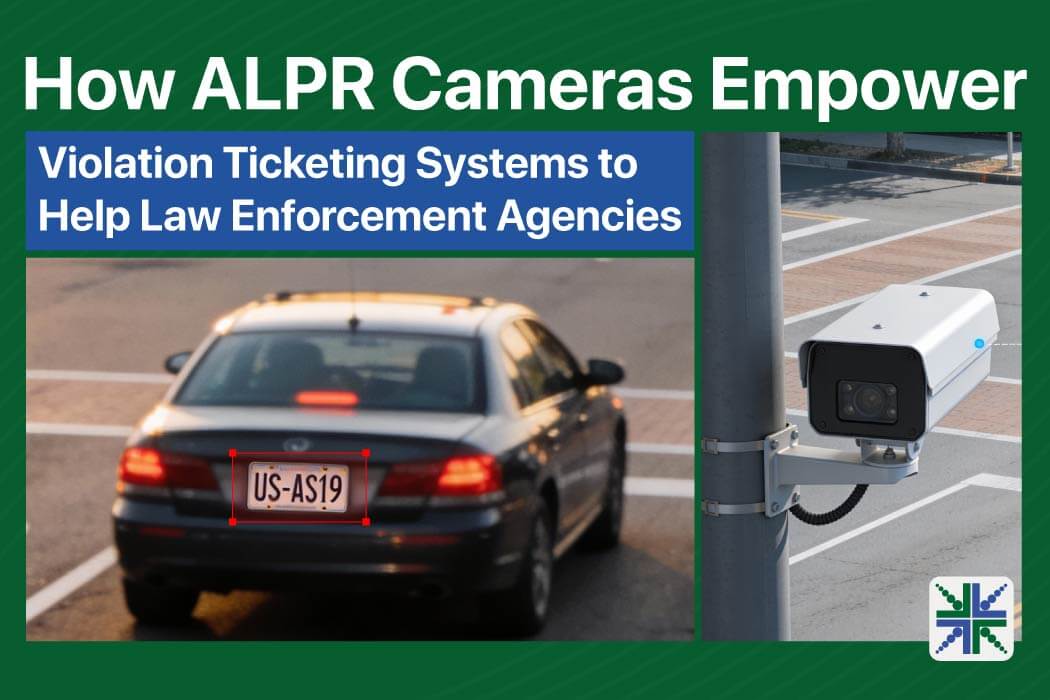
It’s why Automatic License Plate Recognition (ALPR) systems have become an important part of smart city management. They offer a scalable, camera-based solution for capturing license plate data and streamlining violation management.
In this blog, you’ll learn about how ALPR cameras work, their role in violation ticketing systems, and the must-have imaging features.
How ALPR Cameras Work
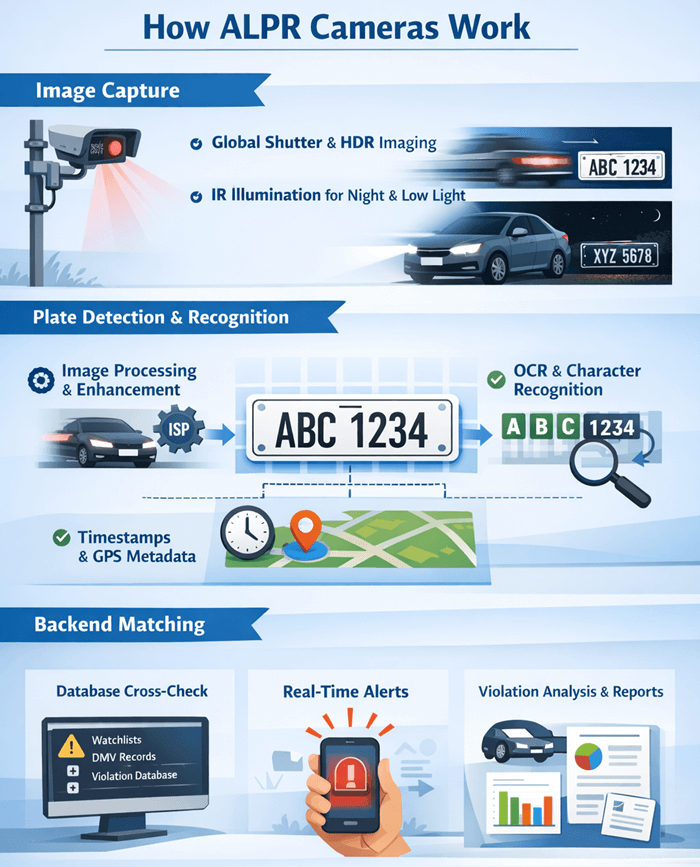
Image capture
- Global shutter or short-exposure sensors help freeze motion, especially in high-speed or multi-lane deployments.
- Multiple exposures or HDR imaging enables plate capture under backlit, night-time, or uneven lighting conditions.
- Infrared illumination supports night-time or low-light applications without relying on ambient light sources.
Plate detection and recognition
- Image signal processors (ISPs) adjust exposure, gain, and white balance for optimal contrast.
- Recognition pipelines combine plate detection, character segmentation, OCR, and confidence scoring to extract reliable alphanumeric data.
- The extracted data is paired with timestamps and location metadata such as pole ID, lane ID, direction, geo-coordinates, or zone IDs.
Backend matching
- License plate numbers are compared against traffic violation databases, registration records, or security watchlists.
- Matches trigger real-time alerts and initiate automated workflows for review and ticket generation, depending on local enforcement policy.
- The aggregated data enables violation pattern analysis, helping prioritize enforcement in high-risk zones.
Precision Perception in Real-World Traffic Environments
ALPR systems must operate reliably in uncontrolled, real-world traffic environments—not just ideal lab conditions. Effective systems are designed to handle a wide range of visual challenges, including:
- Angled plates at intersections
- Partial occlusions (tow hooks, dirt, bike racks)
- Mixed vehicle speeds in the same FOV
- Headlight glare + reflective plates
- Rain, dust, and construction-site lighting
How ALPR Helps Law Enforcement Agencies in Violation Ticketing
Reduces manual oversight
Officers no longer need to be physically present at every location to detect violations. So, departments can reassign human resources to investigative and community-focused duties.
Automates documentation
Every detected violation includes timestamped footage, license plate data, and scene imagery. Automated data capture removes subjectivity from reporting and maintains standardized record-keeping.
Strengthens Evidence Integrity and Legal Readiness
- Multi-frame evidence capturing pre-, during-, and post-violation events
- Consistent timestamps and location metadata
- Plate confidence scoring
- Scene context such as lane position, signal phase, or vehicle speed (where applicable)
- Secure storage with tamper-resistant safeguards
Increases coverage
ALPR systems can monitor multiple zones simultaneously, including intersections, highways, toll booths, and school zones. It helps create a more structured and measurable enforcement environment.
Detects repeat offenders
Central databases log violations linked to individual vehicles, enabling pattern detection and prioritization. Identifying habitual offenders early supports preventative enforcement actions before more severe incidents occur.
Improves ticket accuracy
Captured images and license data reduce disputes and administrative overhead. Each ticket carries clear, verifiable proof, strengthening the agency’s position during legal or administrative reviews.
Speeds up violation processing
Automated workflows reduce delays between detection and issuance of notices. Faster processing also improves fine collection rates and contributes to timely corrective action by offenders.
Enables real-time alerts
Matches with stolen or blacklisted vehicle records trigger immediate follow-up actions. Instant alerts enable officers to intercept flagged vehicles swiftly, improving public safety outcomes.
Enhances audit readiness
Every violation event is archived with verifiable, machine-readable evidence. Organized records make internal audits, public inquiries, and compliance reporting more straightforward and transparent.
Optimizes field deployment
Officers can be dispatched only when required, based on alerts generated by the system. Hence, limited field resources are directed where they are most needed.
Supports unattended enforcement
Cameras operate 24/7 with no drop in detection consistency across time slots. This continuous coverage eliminates the gaps inherent in shift-based manual patrols and extends monitoring to less trafficked hours.
Key ALPR Performance Metrics Used by Enforcement Agencies
To evaluate system effectiveness, agencies typically track the following metrics:
- Capture rate – Percentage of vehicles successfully captured by the system
- Read rate – Percentage of captured plates correctly recognized
- End-to-end accuracy – Combined effectiveness of capture rate, read rate, and confidence thresholds
- False positives / false negatives – Error rates assessed based on enforcement policy and legal tolerance
ALPR Camera Features That Help Automate Violation Ticketing
Global shutter mode
Fast-moving vehicles often introduce distortions in rolling shutter systems. ALPR cameras with global shutter sensors capture frames where all pixels are exposed simultaneously, ensuring clarity during high-speed travel or sudden directional changes.
HDR Imaging and exposure control
License plates need to be readable under direct sunlight, shade, or glare from headlights. High Dynamic Range (HDR) imaging handles high-contrast scenes by capturing multiple exposures and stitching these into one frame.
High frame rate
Traffic cameras often cover multiple lanes with vehicles moving at different speeds. A high frame rate improves multi-frame capture, enabling consistent license plate capture across speed variations and occlusions.
Built-in ISP
Integrated ISP modules adjust exposure, sharpness, white balance, and contrast automatically. This ensures reliable capture across weather changes, lighting conditions, and during day-night transitions.
Synchronized multi-camera support
For wide roadways or large intersections, synchronized multi-camera setups capture vehicles from different angles. It improves coverage and helps avoid partial or blocked views of license plates.
Environmental sealing and durability
ALPR cameras are often installed on poles, gantries, or traffic signals. They are enclosed in IP-rated housings to resist water, dust, and high temperatures. Thermal control mechanisms keep internal components stable during prolonged exposure.
External trigger and timing control
External trigger input ensures capture synchronization with other sensors or traffic events, such as red-light timers or radar-based speed detectors, for better alignment of violation data.
Onboard processing and connectivity
Modern ALPR systems include onboard compute modules that support edge-based processing. This reduces data load on networks and allows instant decision-making. Integration options like GigE or USB3 make it easy to stream data to backend systems.
e-con Systems’ High-Performance Vision solution for Violation Ticketing Systems
e-con Systems has been designing, developing, and manufacturing OEM camera solutions since 2003. We offer a comprehensive portfolio engineered for ITS applications. Our ANPR cameras, edge AI vision boxes and an ITS software suite together support scalable traffic monitoring and violation enforcement deployments.
We have unparalleled expertise in helping clients find and implement the best camera module for their violation ticketing systems.
Learn about our traffic management camera expertise.
Go to our Camera Selector to browse our end-to-end portfolio.
If you’re looking for the best-fit camera module for your violation ticketing system, please write to camerasolutions@e-consystems.com.

Dilip Kumar is a computer vision solutions architect having more than 8 years of experience in camera solutions development & edge computing. He has spearheaded research & development of computer vision & AI products for the currently nascent edge AI industry. He has been at the forefront of building multiple vision based products using embedded SoCs for industrial use cases such as Autonomous Mobile Robots, AI based video analytics systems, Drone based inspection & surveillance systems.