



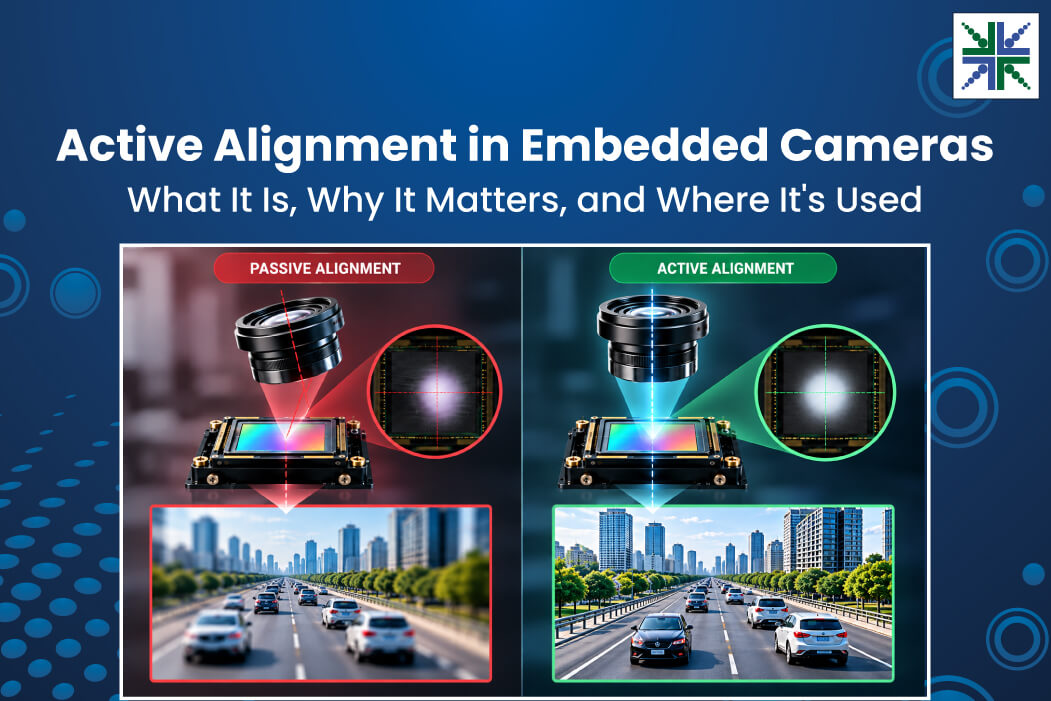
In the world of embedded camera manufacturing, achieving precise alignment between the lens and sensor is crucial for delivering exceptional image quality. The traditional passive alignment methods have limitations, leading to inconsistencies and challenges in focus and image sharpness.
However, with the advent of Active Alignment (AA) technology, a ground-breaking solution has emerged.
In this blog, we will explore the benefits of AA technology over passive alignment methods, how it adds value, and its most popular use cases.
Lens-Sensor Alignment: Challenges of Passive Alignment
Achieving optimal lens-sensor alignment has been a persistent challenge in passive alignment. Manual assembly methods often result in tilt tolerances and variations, leading to inconsistencies in focus and image sharpness.
The reliance on mechanical tolerances for lens holder alignment further adds to the complexity of passive alignment. These challenges necessitate the adoption of a more advanced and precise approach: Active Alignment.
What is Active Alignment in Embedded Camera Manufacturing?
Active Alignment is an advanced technology used in embedded camera manufacturing to achieve precise alignment between the lens and the sensor. In the AA process, the lens is positioned at the center of the sensor plane to ensure optimal performance and image quality.
The AA machine is equipped with advanced capabilities that enable it to measure the optical center and image sharpness. Using this information, the machine actively adjusts the position of the lens/sensor, based on feedback from the software.
What are the Benefits of Active Alignment?
As discussed above, AA technology offers several key benefits over passive alignment methods.
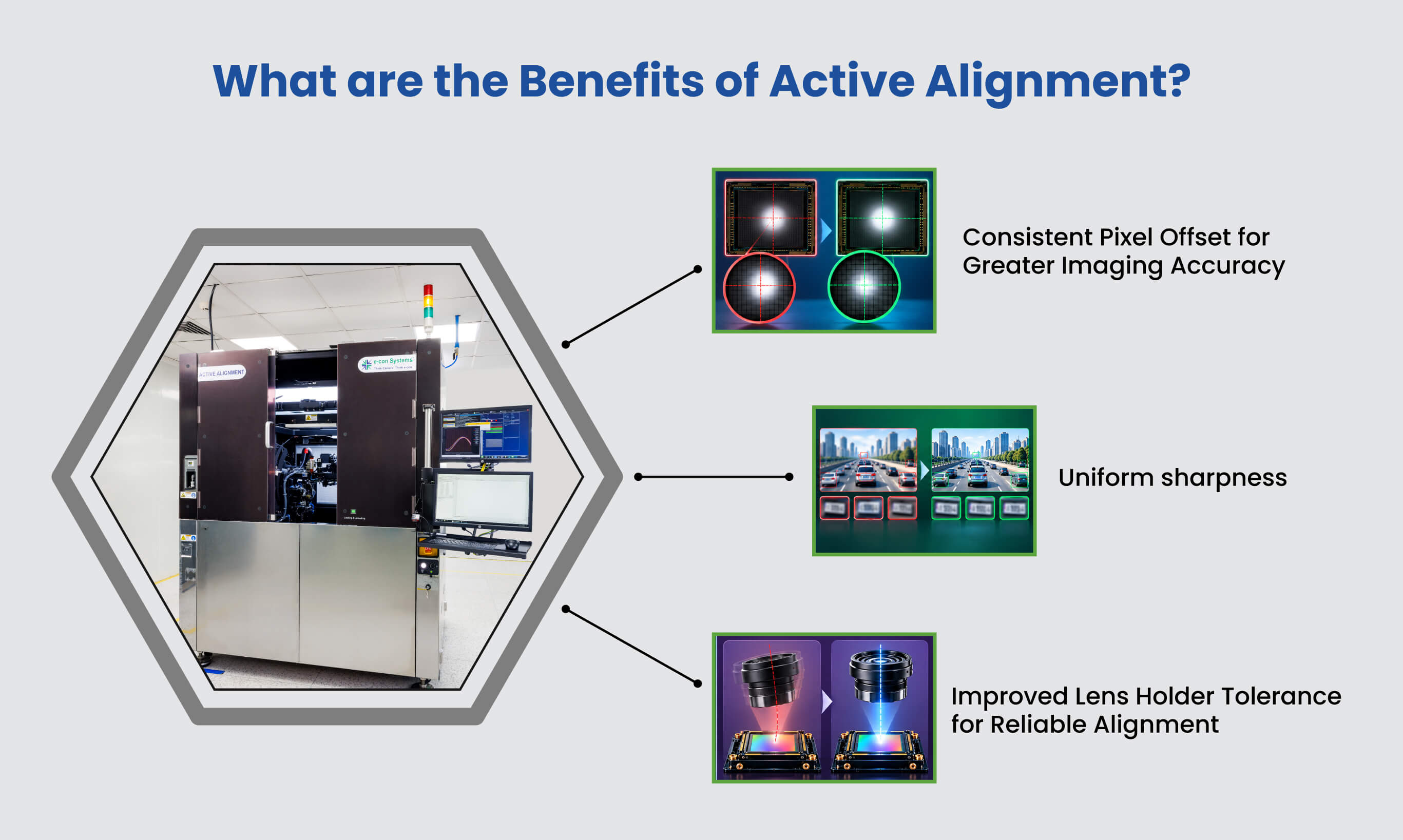
Let’s explore these advantages further:
- Consistent Pixel Offset for Greater Imaging Accuracy: Pixel offset represents the deviation of the optical center (OC) from the desired/reference image center, expressed in pixels. One of the key advantages of Active Alignment (AA) is its ability to precisely position the lens with respect to the image sensor, thereby minimizing optical center offset. Compared with passive alignment methods, which rely primarily on mechanical tolerances, AA enables more precise optical alignment and helps achieve a lower and more consistent pixel offset. This improves the alignment of the optical axis with the sensor and contributes to consistent image quality from center to corner of the image.
- Uniform sharpness: Active Alignment technology eliminates the inconsistencies in image sharpness that can arise from passive alignment methods. By precisely aligning the lens and sensor, AA technology ensures uniform sharpness across the image, allowing for consistently crisp and detailed images.
- Improved Lens Holder Tolerance for Reliable Alignment: In passive alignment, lens holder offset due to mechanical tolerances can introduce further challenges. Active Alignment technology minimizes these mechanical tolerance issues, delivering more reliable and accurate lens-sensor alignment.
Where Does Active Alignment Add the Most Value?
A camera module can pass basic assembly checks and still fail real-world image expectations. Active Alignment becomes useful when the final image has to remain consistent across the full frame, across production batches, and across deployment conditions. This is where the assembly method starts affecting product performance, especially in embedded vision programs where image data feeds software decisions.
High-resolution camera modules
Higher-resolution sensors expose small optical errors faster. A slight lens-to-sensor mismatch can reduce usable detail, especially near the edges of the image. Active Alignment helps manufacturers control these variations before the module reaches final validation.
Wide field-of-view designs
Wide-angle lenses are common in robotics, surveillance, automotive vision, smart retail, and industrial monitoring. These designs need balanced image quality from center to edge. Active Alignment helps reduce the risk of a sharp center with weaker corner performance.
Software-dependent vision systems
Many embedded cameras feed OCR, object detection, measurement, navigation, inspection, or recognition pipelines. In these systems, poor image consistency can reduce the accuracy of downstream software. Active Alignment supports cleaner input for these vision workloads.
Use Cases of Active Alignment in Embedded Cameras
ADAS and automotive vision
ADAS cameras need reliable image quality across the frame for lane detection, object tracking, surround view, and collision avoidance. In wide-angle automotive cameras, edge clarity matters because pedestrians, traffic signs, and other objects may appear near the periphery rather than the center.
Robotics
Robotics systems use camera input for perception, navigation, object detection, and spatial awareness. Active Alignment helps reduce optical variation that can affect image consistency, especially when higher-resolution sensors and compact camera modules are used.
Industrial inspection
Industrial inspection systems depend on clear, consistent image data to identify defects, labels, dimensions, and production anomalies. When corner sharpness drops, the system may miss defects or produce unreliable inspection results.
Medical imaging
Medical imaging devices need stable focus and image clarity to support visual assessment, measurement, and documentation. Active Alignment helps control lens-sensor variation in high-resolution camera modules where small optical errors can affect usable detail.
Drones
Drone cameras often depend on wide field coverage for mapping, inspection, surveillance, and aerial data capture. Active Alignment helps maintain edge performance, which is useful when objects of interest appear away from the center of the image.
How e-con Systems Helps Leverage Active Alignment Technology
e-con Systems has been designing, developing, and manufacturing OEM and ODM camera solutions since 2003. We follow a meticulous, unique process that ensures that each camera module achieves precise alignment, ultimately enhancing the imaging experience and satisfying the demands of various applications. With Active Alignment technology, e-con Systems continues to lead the way in delivering cutting-edge camera solutions for a multitude of industries and applications.
To explore our comprehensive product portfolio, visit our Camera Selector page.
If you need expert assistance integrating a multi-camera system into your applications, please contact us at camerasolutions@e-consystems.com.
FAQs
What is Active Alignment in embedded camera manufacturing?
Active Alignment is a camera module assembly method that aligns the lens with the image sensor using software feedback. The system measures the optical center and image sharpness, and then adjusts the lens position to improve image quality across the sensor plane.
Why does passive alignment create image quality issues?
Passive alignment depends heavily on manual assembly and mechanical tolerances. This can lead to lens tilt, focus variation, lens holder offset, and uneven sharpness, especially in camera modules used for demanding embedded vision applications.
What are the main benefits of Active Alignment?
Active Alignment ensures consistent pixel offset, improves sharpness uniformity, and minimizes lens holder offset caused by mechanical tolerance issues. This helps camera modules deliver clearer and more consistent image output across camera modules and the full image plane.
Which camera designs benefit most from Active Alignment?
Active Alignment adds the most value in high-resolution camera modules, wide field-of-view designs, and software-dependent vision systems, where image quality needs to stay consistent across batches.
What are common use cases for Active Alignment?
Active Alignment is used in ADAS and automotive vision, robotics, industrial inspection, medical imaging, and drones. These applications need reliable image detail across the frame because the captured image often feeds detection, navigation, inspection, analytics, or documentation systems.

Prabu is the Chief Technology Officer and Head of Camera Products at e-con Systems, and comes with a rich experience of more than 15 years in the embedded vision space. He brings to the table a deep knowledge in USB cameras, embedded vision cameras, vision algorithms and FPGAs. He has built 50+ camera solutions spanning various domains such as medical, industrial, agriculture, retail, biometrics, and more. He also comes with expertise in device driver development and BSP development. Currently, Prabu’s focus is to build smart camera solutions that power new age AI based applications.