



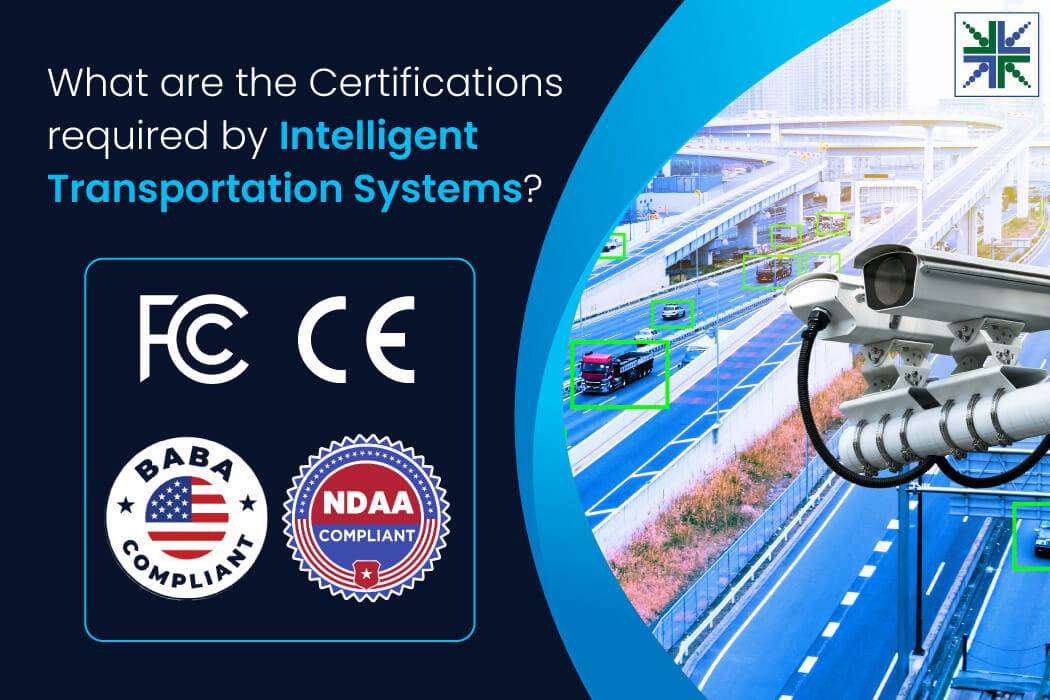
Camera-based Intelligent Transportation Systems (ITS) cannot operate in isolation. Roadside cameras, controllers, sensors, and compute units must function within strict engineering, safety, and procurement frameworks to be deployed in public infrastructure.
Therefore, compliance remains a top priority. Without it, no traffic enforcement system, smart signal controller, or edge camera can operate in the public domain. That’s why a successful ITS camera deployment depends on understanding and aligning with these frameworks.
This blog is relevant for system integrators, ITS consultants, city agencies, and OEMs deploying cameras in traffic enforcement, monitoring, or smart mobility projects. You’ll learn about the certifications that are important for Intelligent Transportation Systems.
First, let’s understand a little more about the nature of compliance in this industry.
Why Compliance Is Critical for Intelligent Transportation Systems
ITS deployments must work flawlessly in unpredictable outdoor environments. Traffic cameras monitor high-speed targets in tunnels and at highway exits. Signal controllers manage the flow of traffic across intersections. Data generated here is used to inform routing decisions, enforcement actions, or historical analysis.
With such a wide surface area, the risk of system-wide fault propagation is high unless every unit adheres to recognized compliance benchmarks. There are three main reasons why compliance is mandatory:
- Environmental and operational: Traffic infrastructure is exposed to extreme conditions. Rapid temperature shifts, moisture, salt fog, electromagnetic exposure, and mechanical shocks are daily realities. Components may underperform or trigger system-wide faults without validation under established standards.
- Legal and procurement: Municipalities and federal agencies enforce strict rules on what gets installed in public infrastructure. For example, contracts reference specific standards. Products lacking the necessary clearances are disqualified, regardless of their engineering merit.
- Long-term interoperability: Generally, ITS deployments span decades. Newer modules must integrate with legacy systems. Compliance ensures that communication protocols, voltage tolerances, and mechanical fits remain predictable across generations.
Key Certifications for Intelligent Transportation Systems
Build America, Buy America Act (BABA)
BABA links infrastructure eligibility to local production. ITS devices used in federally funded projects must meet thresholds for domestic content and final assembly. It impacts sourcing decisions for camera modules, computing units, and controller enclosures.
This means that components sourced from outside the United States must meet specific transformation thresholds or risk being excluded from federal contracts. ITS vendors must maintain manufacturing documentation and chain-of-custody declarations to comply with BABA expectations.
National Defense Authorization Act (NDAA) Section 889
NDAA Section 889 prohibits the use of surveillance and telecommunications equipment from vendors flagged as problematic. It extends to ITS applications, especially those involving imaging, monitoring, or wireless data transmission. For instance, products containing chipsets or modules from restricted manufacturers cannot be deployed in public infrastructure.
Integrators must audit component bills of materials and disqualify hardware that may include restricted silicon or firmware. Even indirect sourcing from resellers can result in violations.
Federal Communications Commission (FCC) Part 15
Every ITS device that emits radiofrequency signals or contains digital electronics must undergo emissions testing. FCC Part 15 governs the amount of electromagnetic noise a device may emit into its environment.
Cameras, radars, V2X units, and smart detectors are subject to these rules. Non-compliant emissions may interfere with vehicle communications, cellular relays, or GPS accuracy. Devices must be tested in certified laboratories and carry a declaration of conformity to be deployed in the U.S. market.
National Electrical Manufacturers Association (NEMA) TS2
Cameras are not the direct subject of NEMA TS2, which is primarily written for traffic signal controllers, cabinets, and related intersection hardware. However, if imaging systems are installed inside TS2-compliant cabinets or draw power and data through the same roadside infrastructure, their physical and electrical behavior may fall under scrutiny.
In such deployments, compliance helps ensure that cameras operate safely without interfering with controller functions or violating enclosure constraints.
National Transportation Communications for ITS Protocol (NTCIP)
NTCIP defines communication protocols for ITS devices to ensure interoperability between control centers and field equipment. Cameras are not always required to directly support these protocols. Still, those integrated into broader ITS platforms may need to exchange metadata, event triggers, or diagnostic information via NTCIP-compliant gateways.
For example, a camera providing footage for a violation system might relay alerts to a traffic management center through NTCIP channels.
Institute of Transportation Engineers (ITE) Standards
Standards issued by the ITE focus on signal control, cabinet dimensions, pedestrian systems, and intersection logic. Cameras are usually outside the direct scope, but many municipalities base procurement criteria on ITE-aligned infrastructure.
When a camera is part of a roadside deployment that connects to or interoperates with ITE-specified systems, the surrounding hardware or controller interfaces may require the camera to meet certain electrical or mechanical expectations. Hence, camera integrators working with ITE-compliant deployments should help avoid system-level conflicts.
IEC 60529 (IP Rating)
IEC 60529 defines the IP Code used to grade enclosure protection against access to hazardous parts and the ingress of solid objects and water. The IP code uses two characteristic numerals. The first numeral relates to solid objects and dust. The second numeral relates to water exposure. For roadside ITS hardware, this rating is used for camera housings, junction boxes, and connectors exposed to dust, rain, spray, and washdowns.
IEC 60068 (Environmental)
IEC 60068 is a series of environmental test methods and severities used to assess how equipment performs under transportation, storage, and operational conditions. Common test categories cover temperature, humidity, vibration, and shock. These tests support qualification for field stress from weather and vehicle-induced vibration for ITS electronics mounted outdoors.
ISO 9001
ISO 9001:2015 specifies requirements for a quality management system. Many public-sector tenders and OEM supply chains look for ISO 9001 certification as evidence of audited processes for consistent product and service delivery, along with continual improvement.
STQC
STQC, the Standardisation Testing and Quality Certification Directorate under India’s Ministry of Electronics and Information Technology, provides testing, calibration, and certification services. Its certification services cover areas such as QMS certification and product certification schemes.
What Do These Certifications Actually Mean for ITS Cameras?
- FCC Part 15 and NDAA compliance are mandatory:Cameras with wireless functions must meet FCC emissions limits to avoid interfering with other systems. NDAA requires verifying that no restricted components are in the supply chain.
- BABA applies to federally funded projects:Cameras must meet U.S. manufacturing and assembly requirements to qualify for these contracts.
- NEMA TS2, NTCIP, and ITE standards apply at the system level:While not for the camera alone, the camera must integrate without disrupting the compliant cabinet, controller, or communication protocols.
- Integrators must validate overall system compliance:It ensures the camera doesn’t cause electrical faults, EMI issues, or mechanical fit problems within the larger ITS deployment.
- IEC 60529 (IP rating) ties directly to roadside exposure: It helps match a camera housing to conditions like rain, spray from traffic, washdowns in tunnels, or fine dust at highways.
- IEC 60068 maps field stress into repeatable environmental tests: The camera can withstand pole and gantry vibration, seasonal shifts, and long-duty outdoor operation.
- ISO 9001 signals process control behind the hardware: This reduces unit-to-unit variation and supports repeatable deployment outcomes.
- STQC matters in Indian public-sector ITS tenders: When a tender calls for STQC coverage, it serves as a compliance checkpoint for deployment eligibility and audit readiness.
e-con Systems’ Vision Solutions for Intelligent Transportation Systems
e-con Systems designs, develops, and manufactures OEM and ODM vision platforms with over 20 years of expertise in embedded vision. Our team provides specialized guidance in selecting and integrating imaging solutions for traffic sign detection applications. From initial planning to deployment, we work closely with clients to align camera performance with real-world requirements.
Use our Camera Selector to get a detailed view of our portfolio.
Know more about our traffic management camera expertise.
If you need help choosing a compliance-focused camera module for your embedded vision system, please reach out to camerasolutions@e-consystems.com.

Dilip Kumar is a computer vision solutions architect having more than 8 years of experience in camera solutions development & edge computing. He has spearheaded research & development of computer vision & AI products for the currently nascent edge AI industry. He has been at the forefront of building multiple vision based products using embedded SoCs for industrial use cases such as Autonomous Mobile Robots, AI based video analytics systems, Drone based inspection & surveillance systems.