



In the first two parts of this three-part blog series, you saw why camera design matters in ORT and MLFF and how transaction validation works.
In this final part, you’ll take a look at the wider operating system around tolling. This includes evidence handling, back-office integration, redundancy, cybersecurity, compliance, scalability, and field maintenance.
That’s when ORT and MLFF become revenue-grade infrastructure.
Moving From Transaction to Evidence
A gantry event has limited value until it becomes evidence. The system has to preserve ample context for billing, violation review, customer support, enforcement, and audit. A plate crop alone can answer who the system thinks the vehicle is. It can’t prove the whole event.
A revenue-grade evidence package should give reviewers the same context that the roadside system used when it created the transaction.
Evidence package checklist
- Wide context image showing the vehicle, lane, and surrounding traffic
- Plate crop used for OCR and reviewer confirmation
- Vehicle class output, such as car, truck, bus, motorcycle, or trailer category
- Sensor data from radar, LiDAR, or loops, depending on corridor design
- Metadata, including lane, gantry ID, timestamp, direction, and capture zone
- Decision history, including confidence score, exception reason, and reviewer action
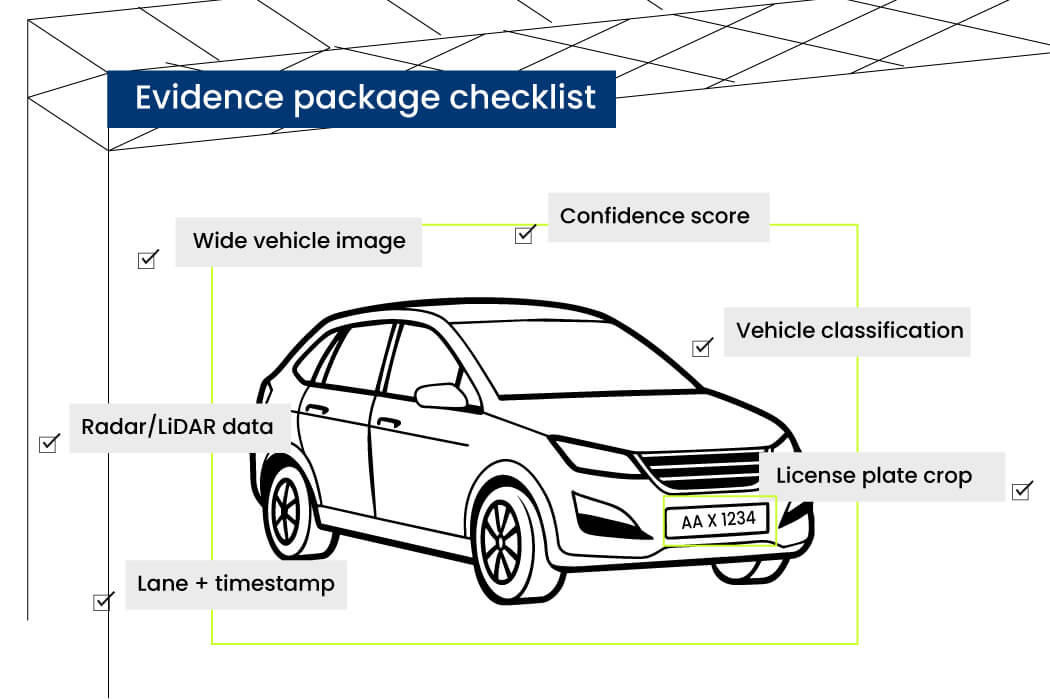
A customer may challenge a charge because the vehicle class looks wrong, the trip path looks unfamiliar, or a tag event conflicts with the plate image. So the platform should retain the images, sensor records, and decision path needed to resolve the case without rebuilding the event from scattered logs.
Integrating Imaging Data with the Tolling Back Office
Revenue is created when the roadside event reaches the systems that bill, enforce, support, and audit. While the camera and edge system identify the vehicle, the back office determines the tariff, account, payment path, and exception workflow.
The quality and completeness of the roadside capture directly affect the reliability of everything that follows, because downstream systems cannot recover information that was never captured correctly.
For that handoff to work, the tolling record has to carry consistent identifiers, timestamps, evidence links, and status flags. Any gap between roadside data and back-office records can create rework, disputes, or leakage.
| Back-office area | What the record must have |
| Billing | Account or plate identifier, tariff category, amount, gantry ID, timestamp, and payment status |
| Enforcement | Violation package, plate crop, context image, location, timestamp, and legal evidence record |
| Customer service | Transaction ID, vehicle image, class output, reason code, reviewer notes, and dispute status |
| Chain of custody | Record origin, timestamp history, access log, edits, retention status, and reviewer identity |
Remember that a strong back-office connection also helps keep enforcement and customer service aligned. The same evidence package used for billing should be available for dispute review, audit requests, and violation handling. That reduces guesswork during manual review and keeps decisions traceable.
Redundancy and High Availability in Live Toll Corridors
Free-flow tolling gives the system a narrow capture window. If a camera, illuminator, network link, or edge processor fails during that window, the lost event may never be reconstructed. Redundancy has to be part of the original corridor design.
Primary and secondary cameras can protect the capture path. Overlapping views can also reduce loss during lane changes, occlusion, or partial field failure. The design goal is continuity without waiting for a field team or manual restart.
Checklist for capture continuity
- Primary and secondary cameras for critical read zones
- Overlapping capture coverage between adjacent lanes
- Automatic failover for critical camera streams and processing nodes
- Local event buffering during network backhaul failure
- Redundant power paths for gantry devices and roadside cabinets
- Health checks for camera uptime, frame rate, illumination, storage, and network status
Cybersecurity and Data Protection
MLFF and ORT platforms process sensitive records. Plate images, vehicle attributes, location, timestamps, account links, payment events, and dispute data all need protection from the camera to the cloud.
Therefore, security should be built into the device, network, application, and review workflow. A weak device credential, exposed update path, or broad user access can compromise evidence integrity and customer confidence.
Some of the security controls include:
- Encryption to protect image, event, and payment-related data in transit and at rest
- Secure boot to check device integrity before roadside systems run
- Encrypted OTA updates to safeguard firmware and software updates from tampering
- Access controls to limit users by role, location, and review responsibility
- Audit trails to record who viewed, edited, approved, or exported transaction evidence.
- Network segmentation to separate roadside devices, payment systems, review tools, and admin networks
Security also affects evidence admissibility. If the system can’t show a traceable path from capture to review, a dispute may become harder to resolve.
How Procurement and Compliance Affect Deployment
Camera choice is only one part of procurement. Public tolling and ITS programs may require proof of component sourcing, domestic content, testing, certification, country of origin, and data storage policy. These checks can decide if a camera platform reaches the tender stage at all.
The main point is simple. Compliance should be reviewed before hardware selection, because a technically strong camera can still cause procurement risk if documentation is incomplete.
Before selecting a camera platform, review:
- Country of origin and component sourcing
- Applicable certifications and testing requirements
- Domestic-content or local-sourcing requirements
- Cybersecurity architecture and software/firmware requirements
- Data storage and residency requirements
- Environmental and transportation requirements
- Required technical documentation and traceability
- Project- or tender-specific compliance requirements
Designing for Long-Term Scalability
Toll corridors rarely remain fixed. Lanes may be added, gantries may be introduced, tolling zones may expand, and enforcement rules may change. A system built only for the initial lane count can become expensive to extend.
Scalability has to cover capture, processing, storage, review, billing, and analytics. Edge and cloud design should give the operator room to add traffic volume and evidence volume without rebuilding the whole platform.
- Use a data model that can accept added lanes, gantries, vehicle classes, and tariff rules
- Keep edge processing strong enough to reduce bandwidth at the roadside
- Use cloud verification for account checks, analytics, storage, and scalable review workflows
- Provide sufficient local storage to retain evidentiary data during expected network backhaul outages
- Design APIs for billing, enforcement, customer service, and dispute tools
- Plan review queues for peak traffic, incidents, festivals, and lane closures
- Design the edge and cloud architecture so new algorithms, analytics capabilities, or vehicle-classification models can be added without replacing deployed hardware.
Hybrid edge and cloud design is useful because each layer can handle the work it is better suited for. Edge systems can process immediate roadside events, store local evidence during outages, and send compact event packets. Cloud systems can compare records, scale review queues, retain evidence, and run analysis for corridor operations.
The Reality of Field Maintenance
A tolling system can pass lab tests and still lose revenue in the field. Here’s why:
- Dirty optical window: Lowers contrast and scatters IR illumination
- Fogging or water ingress: Softens the plate image and reduces OCR quality
- Bracket vibration: Changes camera angle or focus at the capture point
- Aging firmware: Leaves known issues unresolved and may weaken security
- Storage pressure: Overwrites evidence during network outages
- Network instability: Delays event upload and review routing
Physical access also affects uptime. For instance, a gantry 20+ feet high without a service platform can make a simple lens wipe or cable check into a lane closure. Hardware should be placed with routine inspection, cleaning, alignment checks, and replacement paths in mind.
Hence, a revenue-grade deployment assumes these failures will happen. The question is whether the operator can detect these issues before they affect a full day of transactions. Monitoring KPIs such as ANPR read rate, camera uptime, evidence completeness, and exception or dispute rate per gantry can help identify degradation before it affects revenue.
Full-Series Recap
In blog 1, we covered the pixel stage, with camera design deciding image quality. In blog 2, we discussed the validation stage, with the system identifying the plate, tag, lane, class, timestamp, and payment event. And finally, this blog completes the information chain by taking you through how validated events are turned into auditable, scalable records ready for billing, enforcement, dispute handling, and long-term operations.
It’s important to understand that revenue-grade tolling depends on the whole system. Evidence packaging, back-office integration, high availability, cybersecurity, procurement compliance, scalability, and field maintenance all affect transaction trust. That’s why accurate tolling is a system design problem, not a camera problem.
Boost Tolling System Performance with e-con Systems’ AI Vision Cameras
Our cameras empower smart traffic systems to perform across high-speed corridors, changing light, mixed vehicle categories, and demanding roadside or gantry installations. Specifically for MLFF deployments, e-con Systems offers an AI vision solution that helps detect, monitor, and classify vehicles in real time. It is ideal for tolling environments where image clarity, power consumption, and dependable vehicle intelligence directly influence transaction accuracy.
Interested in knowing how we helped a client develop a next-generation imaging system for MLFF tolling? Read this case study!
Visit our Camera Selector Page to check out our full camera portfolio.
Want to have a helpful conversation regarding how to choose a camera solution for your smart traffic system? Don’t hesitate to contact our experts by writing to camerasolutions@e-consystems.com.
FAQs
Why does revenue-grade tolling need an evidence package?
A tolling event has to support billing, enforcement, dispute review, and audit. A strong evidence package includes the context image, plate crop, vehicle class, sensor data, timestamp, lane details, confidence score, and reviewer history.
How does back-office integration affect tolling revenue?
Back-office integration connects roadside capture with billing, enforcement, customer service, and audit workflows. When each record has the right identifiers, timestamps, evidence links, and status flags, operators can reduce rework, disputes, and revenue leakage.
Why is redundancy important in ORT and MLFF corridors?
Free-flow tolling gives cameras a narrow capture window. Redundant cameras, overlapping lane coverage, automatic failover, local buffering, and health checks help protect transaction capture when a camera, network link, illuminator, or edge processor fails.
What cybersecurity controls matter in tolling systems?
Tolling systems handle plate images, vehicle details, location data, payment events, and dispute records. Encryption, secure boot, encrypted OTA updates, role-based access, audit trails, and network segmentation help protect data and preserve evidence integrity.

Dilip Kumar is a computer vision solutions architect having more than 8 years of experience in camera solutions development & edge computing. He has spearheaded research & development of computer vision & AI products for the currently nascent edge AI industry. He has been at the forefront of building multiple vision based products using embedded SoCs for industrial use cases such as Autonomous Mobile Robots, AI based video analytics systems, Drone based inspection & surveillance systems.